
In recent years, the ideal of “holistic mission” has dominated thinking about the church’s call to make disciples of all nations. Broadly speaking, a “holistic” approach weaves together two essential threads of mission: sharing the gospel of eternal life through faith in Christ and meeting people’s earthly needs, which often involves challenging political and economic forces that breed injustice and poverty.
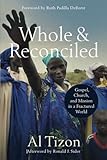
Influenced by liberation theology, the work of the Lausanne Movement, and books like Ron Sider’s Rich Christians in an Age of Hunger, holistic mission came of age in the 1970s and ’80s through the missional church movement. Today, its animating spirit can be found in institutions like the Christian Community Development Association and the global Micah Network. As Sider likes to say, and as Al Tizon repeats in Whole and Reconciled: Gospel, Church, and Mission in a Fractured World, “We won.”
In the 1980s, holistic-mission advocates used the language of “transformation.” Then, under the influence of Latin American theologians, they pivoted to “integral mission.” Tizon, executive director of Serve Globally (the international-ministries arm of the Evangelical Covenant Church) and a missions professor at North Park Seminary, argues for recasting holistic mission in terms of reconciliation.
As Tizon acknowledges, this proposal is indebted to a host of theologians and missiologists (whom he cites generously). His purpose is more about showing how this newer paradigm meets the needs of the prevailing global situation. He begins the book with a series of chapters on “The Whole World” that address the effects of globalization. Though he acknowledges that a global consciousness can be useful to the church’s mission, he denounces globalization as an ideology that “warrants our uncompromising resistance.” Christians, he argues, should respond by going local, practicing reconciliation in our various communities and neighborhoods. This means resisting the Christendom model and taking up residence on the margins. Tizon, as a Filipino American, has some hard words for the church’s complicity with colonial mischief and racial disunity. This, he tells us, should lead to confession, repentance, and an ongoing corporate humility.
The book’s second group of chapters addresses the “Whole Gospel,” which Tizon defines as reconciliation that “flows out of God’s big vision to transform . . . the world and everything in it” toward a state of shalom. The church, he says, needs to challenge the half-gospels that foster violence and fear or promise prosperity alone.
A third section, “The Whole Church,” envisions a church that fosters whole persons, models the Trinitarian love of God, and relies on the work of the Holy Spirit. And a final section focuses on “Whole Mission,” outlining how churches can learn and practice a discipleship of the kingdom. Here, Tizon proposes peacemaking as the central need of our time, arguing that “peacemaking is discipleship is mission.”
I wholeheartedly support putting reconciliation and peacemaking at the center of mission strategy today. But this is an ambitious book—and the flurry of citations, the repetitive variations on “whole” (“Wholly Spirit”!), and the frequent digressions do not always contribute to its thesis. For example, Tizon’s pushback against globalization and megachurches (issues about which he seems to be of two minds) offers little practical guidance on bringing a program of reconciliation to bear on these challenges.
There are frequent lists: The church, for instance, needs intercultural, intergenerational, and internet competence. It needs a devotional life of worship, a wise life of Bible study, an interdependent life in the Spirit, and an ethical life of social holiness. By themselves, these commitments are certainly helpful, but they don’t always illuminate the imperatives of reconciliation and peacemaking. And in light of Tizon’s frequent, albeit much needed, encouragement toward humility and repentance on the part of the First World church, it seems odd to insist that holistic mission has “won” the missiological battle. His own critique of persistent false gospels suggests that this may be a premature boast.
But overall, this book is a useful contribution to an important and ongoing conversation. Tizon’s Filipino American perspective provides a valuable angle of vision, and his personal stories lend the narrative added power. Whatever terminology we choose to describe the church’s global mission, we’ll need voices like Tizon’s to help us visualize and fulfill it.
William Dyrness is senior professor of theology and culture at Fuller Theological Seminary. He is the co-author of Theology Without Borders: An Introduction to Global Conversations (Baker Academic).
Have something to say about this topic? Let us know here.