
We joke that most people fear public speaking more than death, but this has not been the case for me. I am frequently behind a microphone teaching the Bible to large groups with a healthy fear of the text but little fear of the audience. So I was caught off guard by the sheer panic I felt when one of my pastors asked me to do a reading. That’s it. Just a simple reading before he preached—no commentary, no embellishments, just read it and take my seat.
Why my sudden crisis of confidence? The text was Luke 3:23–38, the genealogy of Jesus, composed of 77 tongue-twisting names, requiring a solid two and a half minutes to read aloud from start to finish.
The pastor, a dear friend, noted the look on my face and asked, “Is it weird to read that before I preach?” Everything in me knew I should say no, but I wanted to yell, “Yes! I’m just going to read these endless names and wander back to my seat in the awkward ensuing silence?”
Don’t get me wrong. I love the genealogies with all of my Bible nerd heart. Because I teach the Bible line by line on a weekly basis, I regularly go through parts of the text that are often skipped. I know that by fighting through difficult, weird, or boring verses, we find our faith deepened on the other side. Those passages challenge me as a teacher, but they don’t intimidate me.
I fell hard for genealogies when I taught the Book of Genesis. I was forced for the first time to ask why these lists of individual names were so carefully preserved. As my affection for them grew, I became more vocal about the need for us to pay attention to these neglected lists.
Unlike the more well-worn passages of Scripture, the genealogies test whether we actually believe that all Scripture is, in fact, profitable. I relished opportunities to teach on them and point out their merits.
But reading one of the longer ones aloud without comment scared me to death. It seemed like the perfect way to reinforce the misconception that they were dusty, boring, meaningless lists. Honestly, there’s only so much one can do with vocal inflection and tone.
So I stood, a faintly trembling microphone in one hand and the text in another. And I read into the silence: “Now Jesus himself was about thirty years old when he began his ministry. He was the son, so it was thought, of Joseph.” Son of a son of a son of a son. Line after line, name after name. Time crawled. The silence deepened. Lulled by the rhythm of the passage, my fear began to dissipate. Two-thirds of the way through, my throat had grown tight, and by the time I hit “Methuselah” my vision had blurred with hot tears.
“… the son of Enos, the son of Seth, the son of Adam, the son of God.”
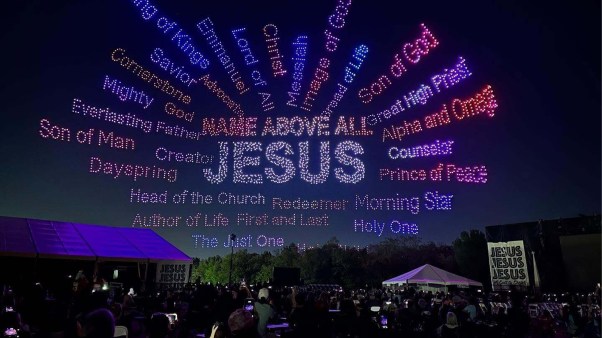
Every name points to our need of the One who bears the Name above all names.
As I exhaled the final names, the clapping began, growing steadily to full, wild applause and cheers.
I looked up in disbelief to see my tears in the eyes of others.
I’m so faithless sometimes. I’m so prone to believing the words of Scripture need my help, that the Spirit won’t speak unless I paint my “wisdom” around the margins. I didn’t believe that 77 names could speak clearly on their own of the steadfast love of the Lord to all generations. And I couldn’t have been more wrong.
All Scripture is God-breathed. All is profitable. In the genealogies, God speaks to us of his attention to the individual. He sees us not as a teeming mass of humanity, but as individual names and faces and personalities, each with our own stories that play into the larger story of redemption.
In the genealogies, God attests to his faithfulness to do what he says he will do—working through heroes and hucksters, all far from perfect. No plan of his can be thwarted. Each name is a blade of withered grass, but his eternal purposes endure.
Every name points to our need of the One who bears the Name above all names. Every name, recorded and remembered by God, gives us assurance that our names are recorded and remembered by him as well. And because of this, we apprehend their worth and offer our gratitude for their preservation.
Our God is in the business of naming names. Read them and celebrate, for this—even this, especially this—is the Word of the Lord. Thanks be to God.
Jen Wilkin is a wife, mom, and Bible teacher with a passion to see women become committed followers of Christ. She is the author of None Like Him.
Have something to say about this topic? Let us know here.