After most of the United States has been under stay-at-home orders for the past several weeks, the governors of some key states have signaled their intention to begin reopening businesses in the coming days.
With that policy shift, churches will have the option to return to in-person worship. A new initiative by the Liberty Counsel—a Christian legal team that has defended congregations who gathered in violation of government orders—encourages churches nationwide to resume services next week, May 3, declared “ReOpen Church Sunday.”
But religious demography indicates that, for the sake of the safety of aging congregations in particular, pastors in particular should be cautious. Their sanctuaries are ideal places for the coronavirus to spread, and the results could be catastrophic.
Older churchgoers are bound to be among the most eager to return to services. The elderly were particularly prone to social isolation and loneliness before the pandemic, and during the intervening weeks of social distancing, they were less likely to have participated in the digital options offered as an alternative to in-person fellowship.
But the elder saints who faithfully fill American pews also fall in the demographic shown to be at the greatest risk right now. While scientists still don’t know much about COVID-19, one of the most consistent findings is that the disease carries a much higher fatality rate among older adults. According to data from the Centers for Disease Control and Prevention, 91 percent of all deaths related to the virus have occurred among people 55 or older, though they make up just 29 percent of the population.
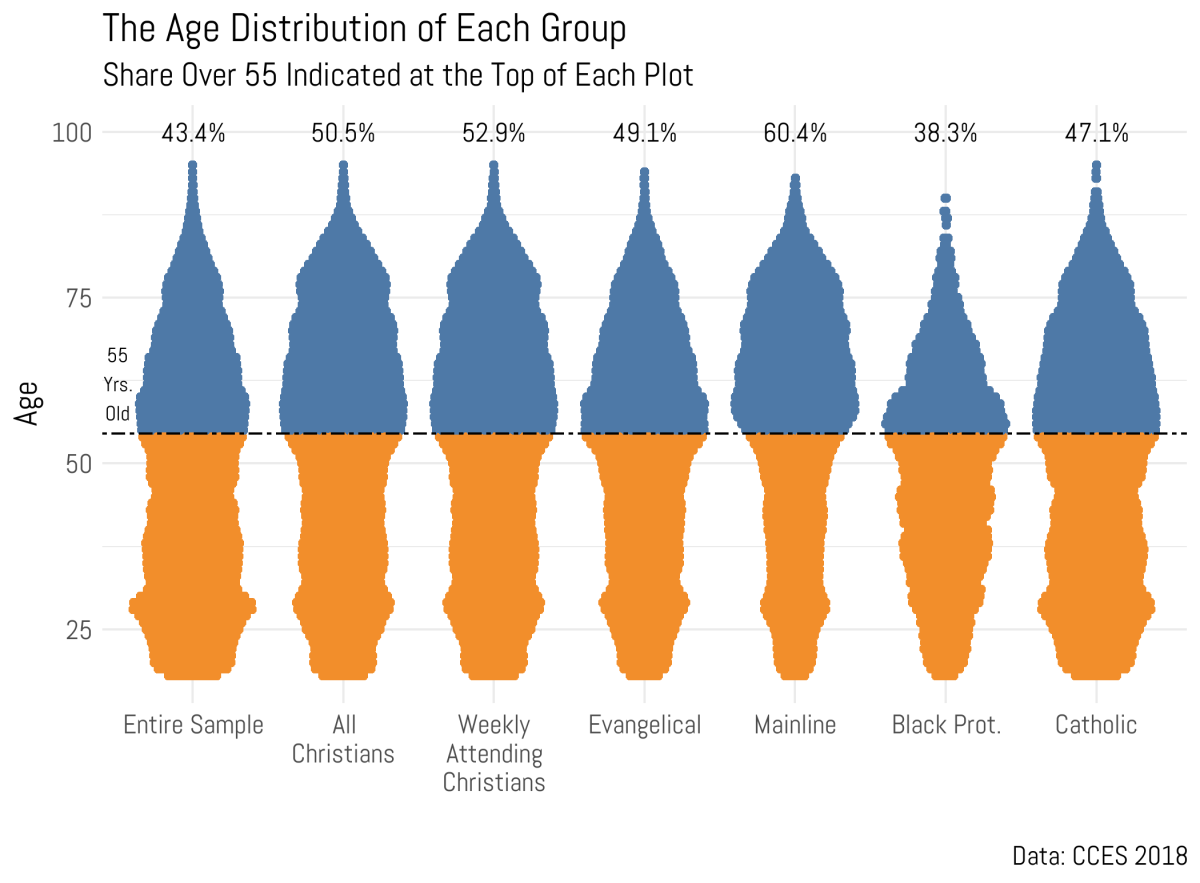
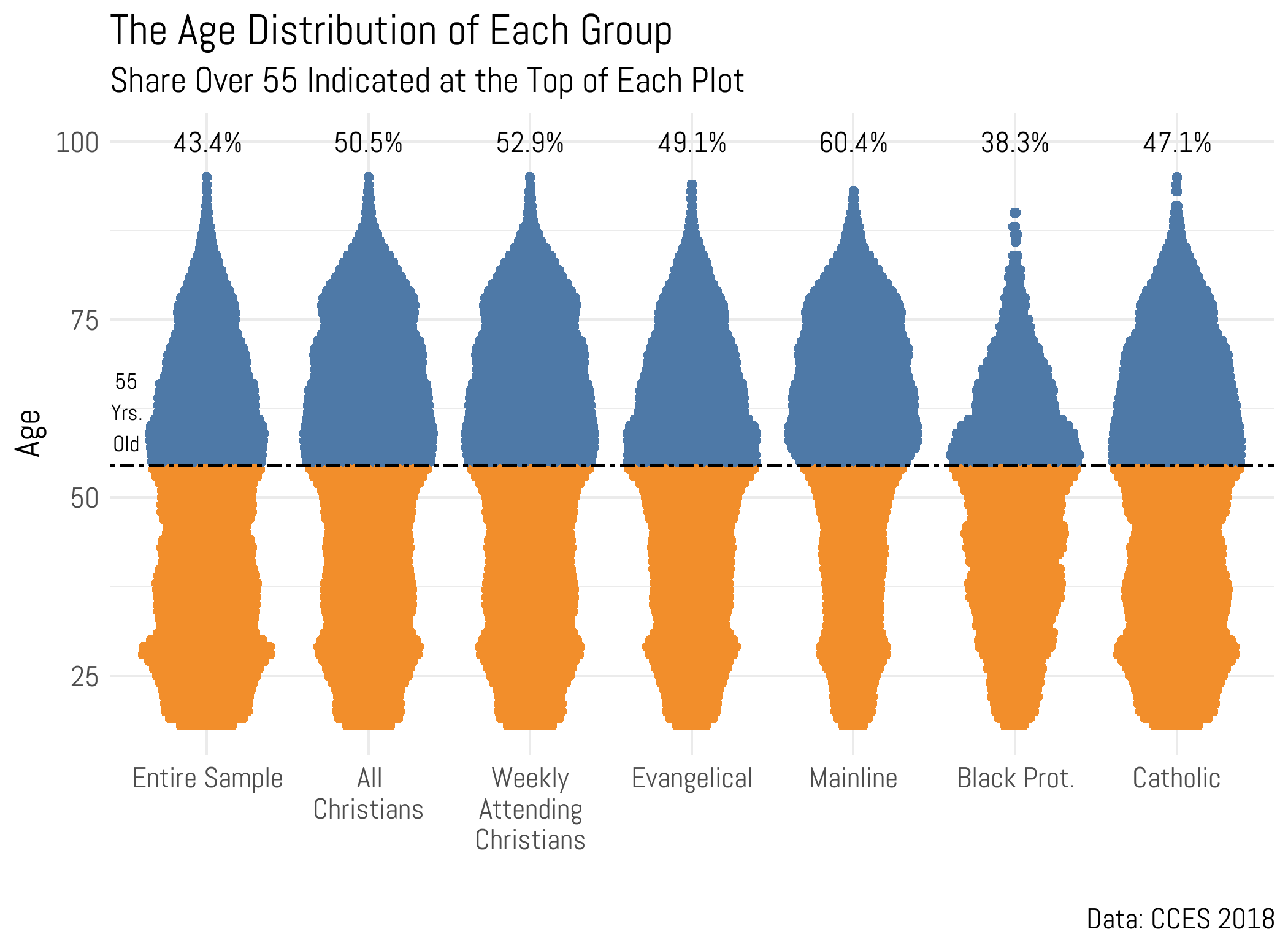
Survey data shows more than half (53%) of Christians who attend church at least weekly are 55 or older, compared to 43 percent of the population overall. Mainline traditions in particular skew older, with over 60 percent of members who are at least 55. Half of evangelicals in the US are at least 55, followed by 47.1 percent of Catholics.
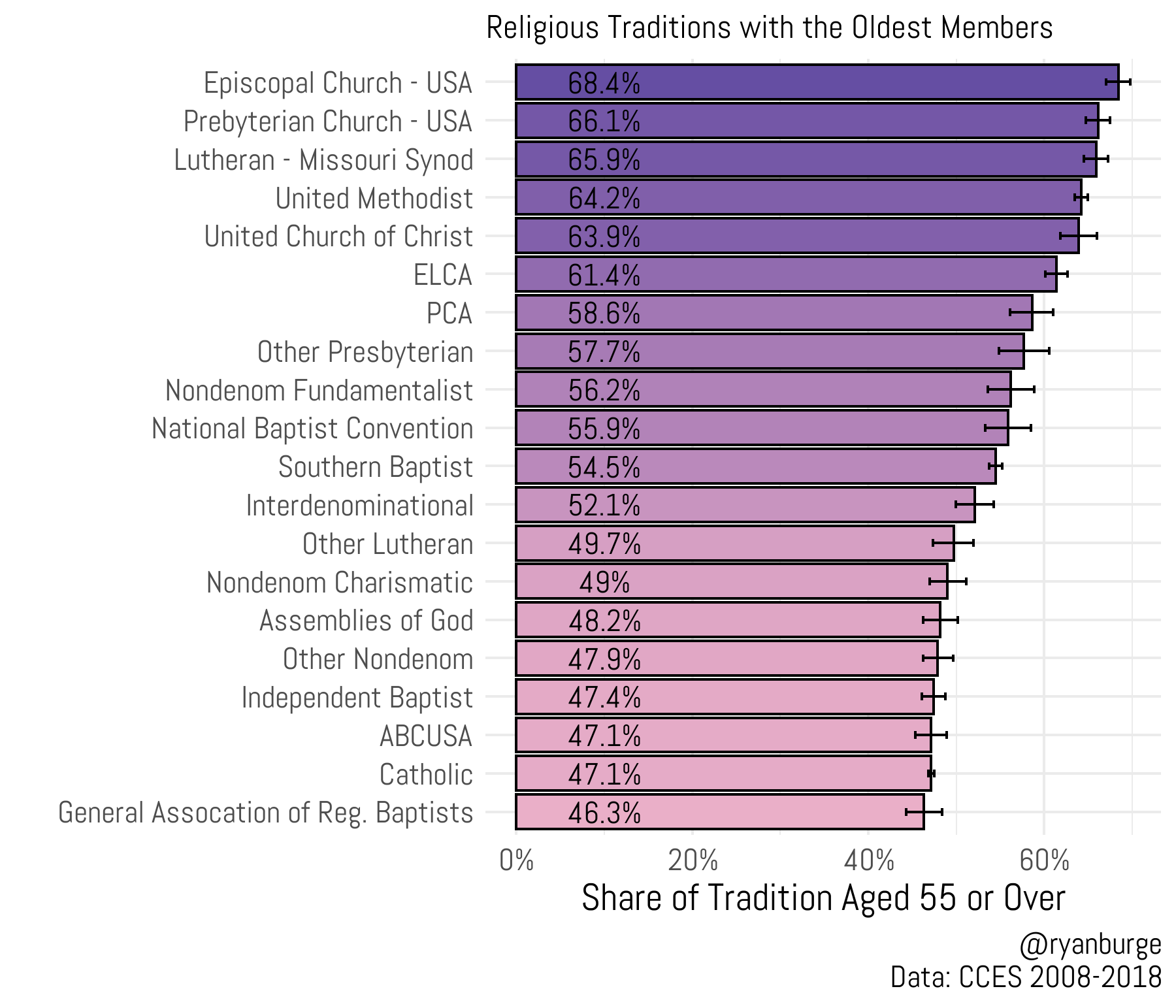
Baby Boomers and members of older generations make up around half or more of every major Christian tradition in the country. Among Episcopalians, Presbyterians (PCUSA), and Lutherans (LCMS), close to two-thirds of members are 55 and over.
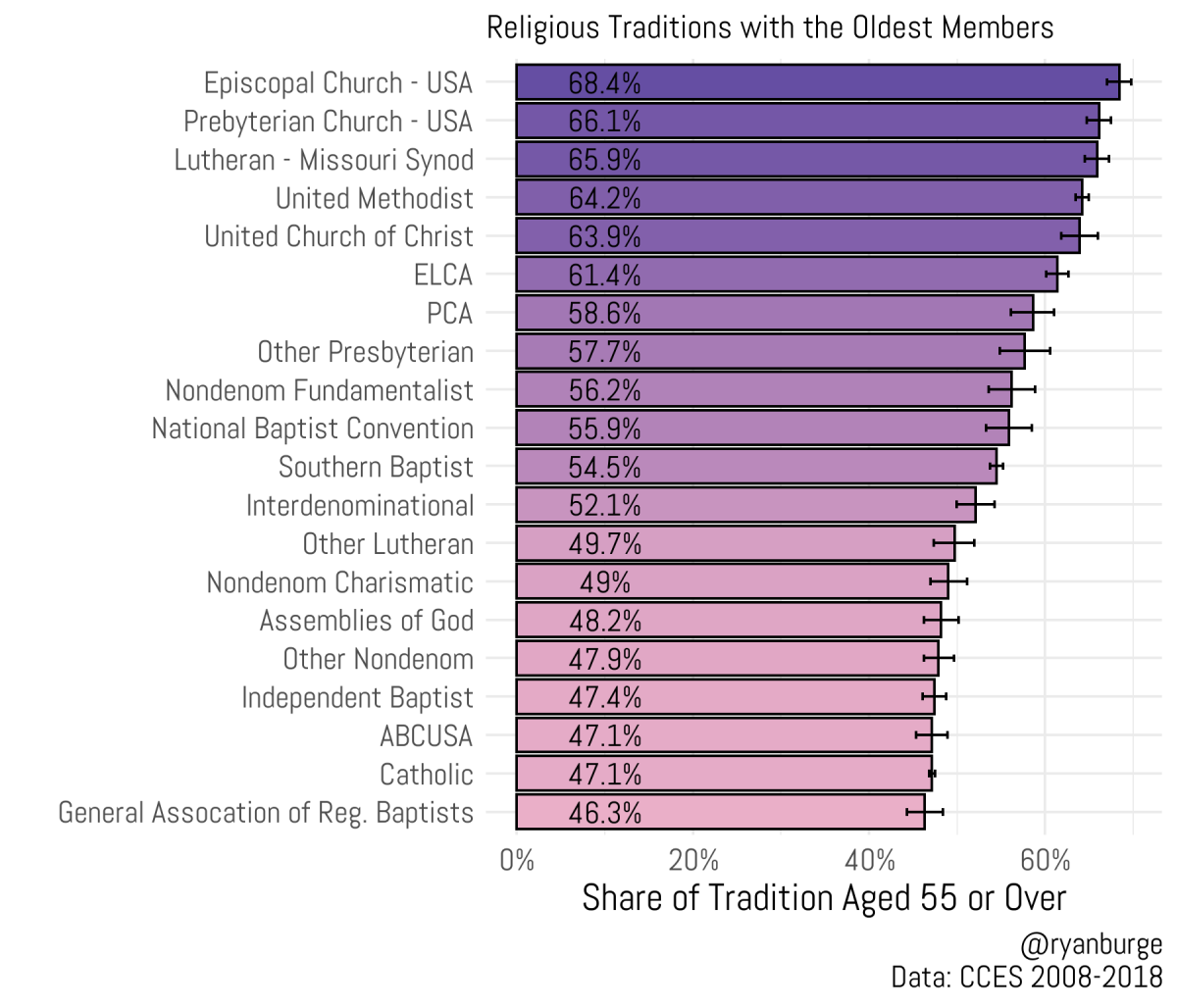
The United Methodist Church, the second-largest Protestant denomination in the US, has a worrisome share of those in the older demographic as well (64.2%). Southern Baptist Convention ranks 11th, with just over half of their congregants in the advanced age bracket.
Over the past few decades, white Christianity has aged far more rapidly than the black church and churches of other racial backgrounds.

The average white evangelical was 45 years old in 1972, the same as the average evangelical of color. While there has been no significant net change in the average age for nonwhite evangelicals, white evangelicals have gotten seven years older.
The picture for white mainline Protestants is much more dramatic, from an average of 48 years old in 1972 to nearly 60 today. While white Catholics have gotten about 10 years older since the early 1970s, for nonwhite Catholics the increase in age is about 7 years.
Though Protestants from historically black denominations skew younger than majority white churches (just 38.3% are 55 or older), their congregations may also be at greater risk. COVID-19 has taken a disproportionate toll on the African American community, and at least a dozen bishops and pastors in the Church of God in Christ (COGIC) have died from the virus.
Many churches that opt to return to worship in their sanctuary won’t rush back to normal; there will be extra efforts to sanitize, promote hand washing, and encourage the six-foot social distance between attendees.
But even with precautions in place, returning to the shared space of worship—of singing, sitting, kneeling, and greeting—brings the possibility of unknowingly spreading the virus among a population that is older and particularly vulnerable. Churches became hot spots for the initial outbreaks of the virus in the US, including in Georgia, one of the states moving to reopen. If things go badly, they could be responsible for the dreaded “second wave” of infections.
Pastors are often referred to as shepherds of their flock. This may be a good time for church leaders to think carefully about the welfare of their sheep.
Ryan P. Burge is an instructor of political science at Eastern Illinois University. His research appears on the site Religion in Public, and he tweets at @ryanburge.
Speaking Out is Christianity Today’s guest opinion column and (unlike an editorial) does not necessarily represent the opinion of the publication.