China will suffer “repercussions” for its human rights abuses, President Biden warned at a CNN town hall event last month. But beyond pledging public rebukes, he said little on what repercussions he means.
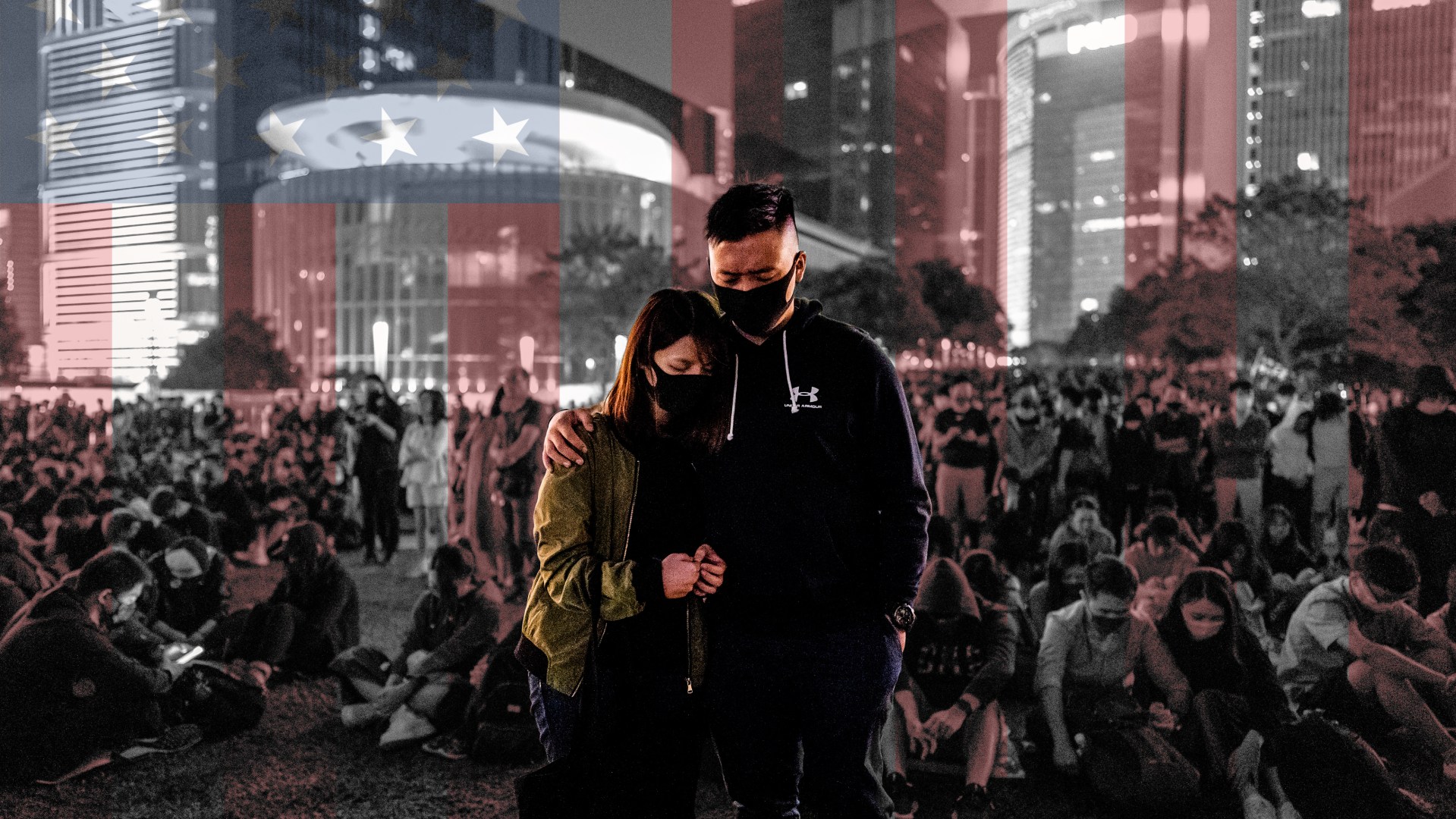
Biden’s reticence might be nothing more than the difficulty of “talk[ing] China policy in 10 minutes on television,” as he joked at the town hall. Or it might be the fact that the United States has very few realistic options here. Yet there is one option Biden can and should pursue immediately: welcoming the Uighurs, Hong Kongers, and others fleeing Beijing’s oppression to America as asylum seekers and refugees.
The president has undoubtedly considered this option. In a statement for World Refugee Day last summer, he promised to “work with our allies and partners to stand against China’s assault on Hong Kong’s freedoms and mass detention and repression of Uighurs and other ethnic minorities and support a pathway for those persecuted to find safe haven in the United States and other nations.” That sounds like openness to imitating the United Kingdom’s citizenship program for select Hong Kongers, which is expected to bring about 300,000 people from the former British colony to the UK in the next five years. Yet in the CNN town hall, Biden explicitly delineated the China conversation from an immediately preceding discussion of refugee admissions. He’d spoken with Chinese President Xi Jinping about the Uighurs, Biden said, which is “not so much [about] refugee[s].”

But it could be, and Christians should hope Biden will select safe haven as a unique tool for responding to Beijing’s abuses. It’s a wise choice in terms of practical politics and scriptural principles alike.
The political reality is this: It is easy to speak of “repercussions” for China’s general authoritarianism, its crackdowns in Hong Kong, and its genocidal treatment of the Uighur people, reportedly including forced abortions, rape, brainwashing, concentration camps, and more. It is far harder to devise US-imposed repercussions that meet three vital criteria: (1) not harming innocents; (2) not generating unacceptable risk of great power conflict extending, in the improbable but not impossible worst-case scenario, to nuclear war; and (3) actually changing the Chinese government’s behavior.
Offering refuge to people fleeing Beijing’s brutality is quite different. It’s a repercussion without confrontation.
Consider the usual options. Diplomatic pressure and the rebukes Biden mentioned are good, but they’ll probably change fairly little. That’s not because diplomacy is ineffective but because in Beijing’s perspective, authoritarianism is a core national interest. Sanctions usually meet criteria 2, but they often do great harm to civilians who can’t affect their government’s actions. Moreover, sanctions’ record of changing targets’ behavior is stunningly poor. (One significant study of 85 sanctions on regimes found just four successes and concluded they are “not likely to achieve major foreign policy goals.”) Escalate economic punishment enough or threaten military repercussions, and we’d court catastrophic war between the world’s two most powerful militaries. War would neither reduce suffering nor tone down Beijing.
Offering refuge to people fleeing Beijing’s brutality is quite different. It’s a repercussion without confrontation. It doesn’t harm innocents or threaten war. If the outflow of citizens were great enough, especially from Hong Kong’s finance community, it might eventually induce Beijing to reduce its subjects’ impetus to flee. The US almost certainly can’t coerce China’s domestic policy. But we can give Hong Kongers, Uighurs, and other victims of the Chinese government a haven here if they want it. (We may even be able to do it with comparative political ease. A bill for a small-scale version of this idea nearly passed last year with broad bipartisan support.)
There is a wealth of scriptural support for welcoming the oppressed and persecuted to come make a new life for themselves in peace, security, and freedom. Giving sanctuary to Uighurs and Hong Kongers is a way to “love those who are foreigners” (Deut. 10:19), invite in the stranger and care for the “least of these” (Matt. 25:35, 40), “look after orphans and widows in their distress” (James 1:27), and love our neighbors as ourselves. (If Washington governed like Beijing, we too might want someplace to run!)

For regular CT readers, these biblical arguments will be familiar. But there’s another scriptural congruity I see that comes less from commands of hospitality and more from our general call as Christians to follow Jesus in self-sacrificial love (Eph. 5:1–2).
There are good reasons to think welcoming Chinese refugees would benefit the United States, including economic ones. Yet settling refugees can be difficult and costly. It might seem like this proposal requires us to deal with something that’s “not our problem.” But to the extent it gives us an opportunity to imitate Christ by putting others’ interests ahead of our own, in making their problems ours (Phil. 2:3–4), we can exude the very characteristic of Christlike love. As we read in 1 John 3:16, “Jesus Christ laid down his life for us. And we ought to lay down our lives for our brothers and sisters.”
Then there’s the Good Samaritan. Our focus when reading this parable (Luke 10:30–37) tends toward crossing lines of national animosity, but the Samaritan also helped with a problem he’d neither caused nor suffered and couldn’t, in a larger sense, hope to solve. He had no way to make the dangerous road from Jerusalem to Jericho a safer place. He couldn’t ensure no one would be robbed and beaten there again. He did have a way to help the injured man he encountered, though, and he did so at cost to himself.
We can do the same here. There is no clear path to ending the Chinese government’s abuses, certainly not at US behest. But Washington can open US doors to Hong Kongers, Uighurs, and other persecuted people in China, and the American church can stand ready to welcome and serve them when they come.
Bonnie Kristian is a columnist at Christianity Today.