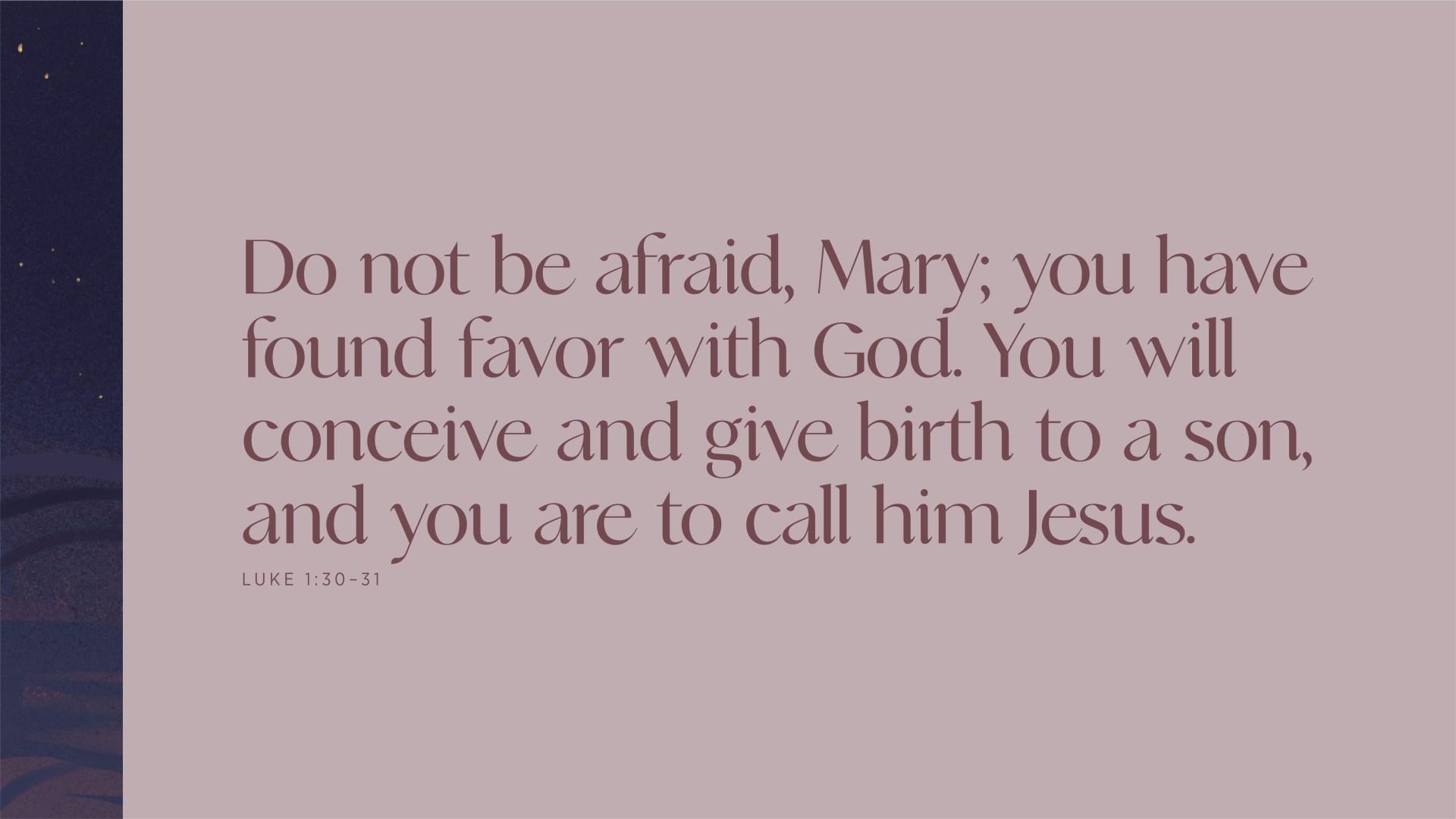
Theology

Let it Be

An Advent reading for December 21.

Advent Week 4: Incarnation and Nativity


This week, we step into the events of the Nativity and consider the miracle of the eternal Word entering the world as a human child. We learn lessons of faith from the people whom God chose to play a part in these events. And we celebrate the good news of great joy for all people!

Read Luke 1:26–38.

Obedience would be easy if it all made sense. And if we agreed. Or if we thought of the plan ourselves. But I suppose then it wouldn’t really be obedience, would it?

When we read the stories of women and men of great faith, we imagine there was no struggle—that they heard the word of the Lord and rushed to obey right away. But the truth is, even when the word of the Lord is clear, obedience is challenging.

An angel of the Lord appeared to Mary. An angel! We might tell ourselves that if we were to have an angelic visitation, obedience would be easy—but we would be fooling ourselves. Mary, the Bible tells us, was “greatly troubled” (Luke 1:29). More than that, Mary had some serious questions. “Mary said to the angel, ‘How can this be, since I am a virgin?’ ” (v. 34, NRSV). Fair point.

In many respects, Mary’s question is not all that different from Zechariah’s. When the angel told him that he and his equally aged wife were going to have a son, Zechariah asked, “How can I be sure?” (v. 18), also translated as “How will I know?” (NRSV). And yet Zechariah was struck mute.

We might parse the grammar of their respective questions and mine the language for clues, but I suspect the answer is not so much in the initial response as in their subsequent reactions. We have no reason to think Zechariah moved beyond bewilderment or disbelief during this initial encounter. (Though in time, of course, he did.) But in verses 26–38, Mary seemed to quickly move to a posture of surrender. “Then Mary said, ‘Here am I, the servant of the Lord; let it be with me according to your word’ ” (Luke 1:38, NRSV).

Paul would later pray that Christ would be formed in us, Jesus’ followers (Gal. 4:19). But it is Mary who actually had Christ being formed in her—in her very womb! While the Virgin Birth and the Incarnation are cornerstone miracles in Christian confession, we also find in this moment of Mary’s a paradigm of spiritual formation. For Christ to be formed in us, like Mary we must move through our turbulence and uncertainty and doubt to the posture of surrender. Participation in Christ happens as we pray, “Here am I, the servant of the Lord; let it be with me according to your word.” Even when we are tempted to fixate on “How can this be?”, may God give us the grace to end up in the “Let it be” of faith.

Glenn Packiam is an associate senior pastor at New Life Church in Colorado Springs. His books include Worship and the World to Come and The Resilient Pastor (February 2022).

Ponder Luke 1:26–38.

Why is it signifi cant that Mary was initially “greatly troubled” and voiced a question? How does she exemplify spiritual formation here? How do you feel challenged or inspired by Mary’s response? Pray, expressing your total surrender to God.

Also in this issue

Many core tenets of the gospel reverberate powerfully throughout Advent’s traditional readings and themes. In these daily devotional readings from CT, we reflect on the mystery of the Incarnation, on Christ’s purpose as the long-awaited Messiah, on our sin and need for repentance, on God’s promises of salvation and justice, and on our firm hope in Christ’s return and everlasting kingdom. We prepare to celebrate the “newborn King” who was “born that man no more may die,” as Charles Wesley’s beloved carol declares. And we’re reminded again and again throughout Advent that the gospel is not just for us, but it is a message of “great joy for all the people” (Luke 2:10)—it’s good news that’s meant to be shared.

The God Who Suffers

A Light to the Nations

Glenn Packiam

Great Joy for All People

Rachel Gilson

Quietly Hidden

Tracey Gee

Gospel Anticipation

Matthew D. Kim

A Pregnant Promise

Silent Time, Holy Time

Jonathan T. Pennington

What it Means to Be God

Wesley Hill

The Baby King

Matthew D. Kim

The Light Is Coming

Rich Villodas

The Messiah’s Mission

Glenn Packiam

True Hope

Kristie Anyabwile

Bringing Us Home

Marlena Graves

What Hope Looks Like

Marlena Graves

The Gospel of Advent: Good News for the Season

Behold the Lamb

Anthony J. Carter

Amazing, Cleansing Grace

Jen Pollock Michel

Good, Severe News

Jen Pollock Michel

Repentance Made Possible

Jen Pollock Michel

The Rising Son

Wesley Hill

Comfort My People

Jennifer M. Rosner

He Won't Leave Us Alone

Jennifer M. Rosner

The Gospel Life in Person

Matthew D. Kim

Come, Lord Jesus!

Richard Bauckham

City of Light

Richard Bauckham

All Things New

Richard Bauckham

Right or Left?

Rachel Gilson

Watch and Pray

Rachel Gilson

We Begin at the End

Kelli B. Trujillo

View issue

Our Latest

The Bulletin

No Iran Deal, Russell Brand Reads the Bible, and Ben Sasse’s Public Dying

Clarissa Moll, Russell Moore

Trump insists on nuclear deal with Iran, Brand’s viral Bible faux pas, and Senator Sasse shares his dying and his faith.

News

The Christian Migrants Feeding the Displaced in Lebanon

Ghinwa Akiki and Hunter Williamson in Beirut, Lebanon

The war left many domestic workers jobless and homeless. Some Christians see a chance to serve their community.

Desperately Seeking Alternatives to Arrogance

The Trump administration’s critique of elite universities is worthwhile, but government control is problematic. Good news: Christian study centers are multiplying at major universities.

The Algorithm Is Changing How We Speak—and Strive

Griffin Gooch

“Algospeak” capitalizes on our desire for attention and status. We should turn to God for both.

Review

When Faith Feels Cloudy

Three books for the doubting Christian.

News

Black Churches Urge Congregants to Mobilize After Supreme Court Ruling

Denominational leaders say the latest weakening of protections for minority voters is discouraging but not cause for despair.

Black Hope Faces a Crisis

Thomas Anderson

An influential academic theory says anti-Black racism won’t change. As it trickles into popular culture, the church should be ready to respond.

We Need the Doctrine of Hell

The harsh reality shows us our depths of depravity and the depth of Christ’s redemption.

addApple PodcastsDown ArrowDown ArrowDown Arrowarrow_left_altLeft ArrowLeft ArrowRight ArrowRight ArrowRight Arrowarrow_up_altUp ArrowUp ArrowAvailable at Amazoncaret-downCloseCloseellipseEmailEmailExpandExpandExternalExternalFacebookfacebook-squarefolderGiftGiftGooglegoogleGoogle KeephamburgerInstagraminstagram-squareLinkLinklinkedin-squareListenListenListenChristianity TodayCT Creative Studio Logologo_orgMegaphoneMenuMenupausePinterestPlayPlayPocketPodcastprintremoveRSSRSSSaveSavesaveSearchSearchsearchSpotifyStitcherTelegramTable of ContentsTable of Contentstwitter-squareWhatsAppXYouTubeYouTube