American evangelicals’ grasp on theology is slipping, and more than half affirmed heretical views of God in this year’s State of Theology survey, released Monday by Ligonier Ministries and Lifeway Research.
The report references Ligonier founder R. C. Sproul’s teaching that everyone’s a theologian. “However, Dr. Sproul would be quick to add that not everyone is a good theologian,” it read. That caveat applies to Americans in general and evangelicals too.
Overall, adults in the US are moving away from orthodox understandings of God and his Word year after year. More than half of the country (53%) now believes Scripture “is not literally true,” up from 41 percent when the biannual survey began in 2014.
Researchers called the rejection of the divine authorship of the Bible the “clearest and most consistent trend” over the eight years of data.
“This view makes it easy for individuals to accept biblical teaching that they resonate with while simultaneously rejecting any biblical teaching that is out of step with their own personal views or broader cultural values,” the researchers wrote.
It’s clear that US evangelicals (defined by belief and church affiliation) share some core faith convictions. Well over 90 percent agree that God is perfect, God exists in three persons, Jesus’ bodily resurrection is real, and people are made righteous not through works but through faith in him.
But in some areas, even evangelicals responded with significant misunderstandings and were not far off from the trends in society overall.
In the 2022 survey, around a quarter of evangelicals (26%) said the Bible is not literally true, up from 15 percent in 2020. They also became more likely to consider religious belief “a matter of personal opinion” and “not about objective truth”; 38 percent said so in 2022, compared to 23 percent in 2020.
Here are five of the most common mistaken beliefs held by evangelicals in this year’s survey:
1. Jesus isn’t the only way to God.
More than half—56 percent—of evangelical respondents affirmed that “God accepts the worship of all religions, including Christianity, Judaism and Islam,” up from 42 percent in 2020. And while the question doesn’t include all religions, it indicates a bent toward universalism—believing there are ways to bypass Jesus in our approach to and acceptance by God.
This contradicts orthodox theology found in the Scriptures, in which Jesus affirms that “I am the way and the truth and the life. No one comes to the Father except through me” (John 14:6).
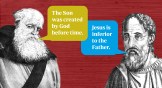
2. Jesus was created by God.
A surprising 73 percent agreed with the statement that “Jesus is the first and greatest being created by God.”
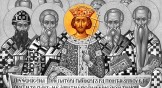
This is a form of Arianism, a popular heresy that arose in the early fourth century. Those believing it caused such a stir that it led to the gathering of the very first ecumenical council of church leaders. They discussed and denounced these and other unorthodox beliefs as heretical for being contrary to Scripture.
Out of the Council of Nicea came the Nicene Creed, which states in part that Jesus was “not made” but “eternally begotten” and “one in being with the Father,” as found in passages including John 3:16 and John 14:9.
3. Jesus is not God.
Given the above beliefs on Jesus as a created being, it’s not too surprising that 43 percent affirmed that “Jesus was a great teacher, but he was not God,” which is another form of Arian heresy.
This effectively denies the divinity of Christ and his unity with God the Father as an equal member in the Trinity, who is one God in three persons. This has been considered classic orthodox belief since the early church, and is based on many biblical passages—like where Jesus says “I and the Father are one” (John 10:30). For this, he gets accused of blasphemy (and threatened with stoning) by religious leaders for claiming to be God.
4. The Holy Spirit is not a personal being.
Speaking of the Trinity, 60 percent of the evangelical survey respondents had some confusion about its third member, believing that “The Holy Spirit is a force but is not a personal being.”
To be fair, the Spirit of God is often described as an impersonal force throughout the Bible (sometimes as a dove, a cloud, fire, wind, or water), but these are all just metaphors for the Spirit’s personal presence. The Scriptures clearly affirm that the Spirit is fully God—just like Jesus and the Father, who sent us the Spirit—including the time when Ananias was described as simultaneously lying to the Holy Spirit and to God (Acts 5:3–4).
5. Humans aren’t sinful by nature.
Interestingly, 57 percent also agreed to the statement that “Everyone sins a little, but most people are good by nature.” In other words, humans might be capable of committing individual sins, but we do not have sinful natures.
This response indicates that many American evangelicals believe humans are born essentially good, which leans toward a heresy known as Pelagianism. This denies the doctrine of “original sin,” which is based on a number of biblical passages, such as Romans 5:12. Even David acknowledged in the Old Testament that humans were born in sin, saying “Surely I was sinful at birth, sinful from the time my mother conceived me” (Ps. 51:5).
Respondents were considered evangelical by belief if they strongly agreed in the Bible as the highest authority; the importance of encouraging non-Christians to trust Jesus as their savior; that his death removed the penalty of sin; and that trust in him alone brings salvation. This four-part definition was adopted by Lifeway and the National Association of Evangelicals in 2015.
While evangelicals were found to be moving away from orthodox beliefs in several of the questions about God, they’ve grown more assured in their stances on cultural and ethical issues.
Among evangelicals, 94 percent believe “sex outside of traditional marriage is a sin” and 91 percent believe abortion is a sin, both the highest levels since the survey began.
You can take the State of Theology survey and view full results and data visualizations at stateoftheology.com.