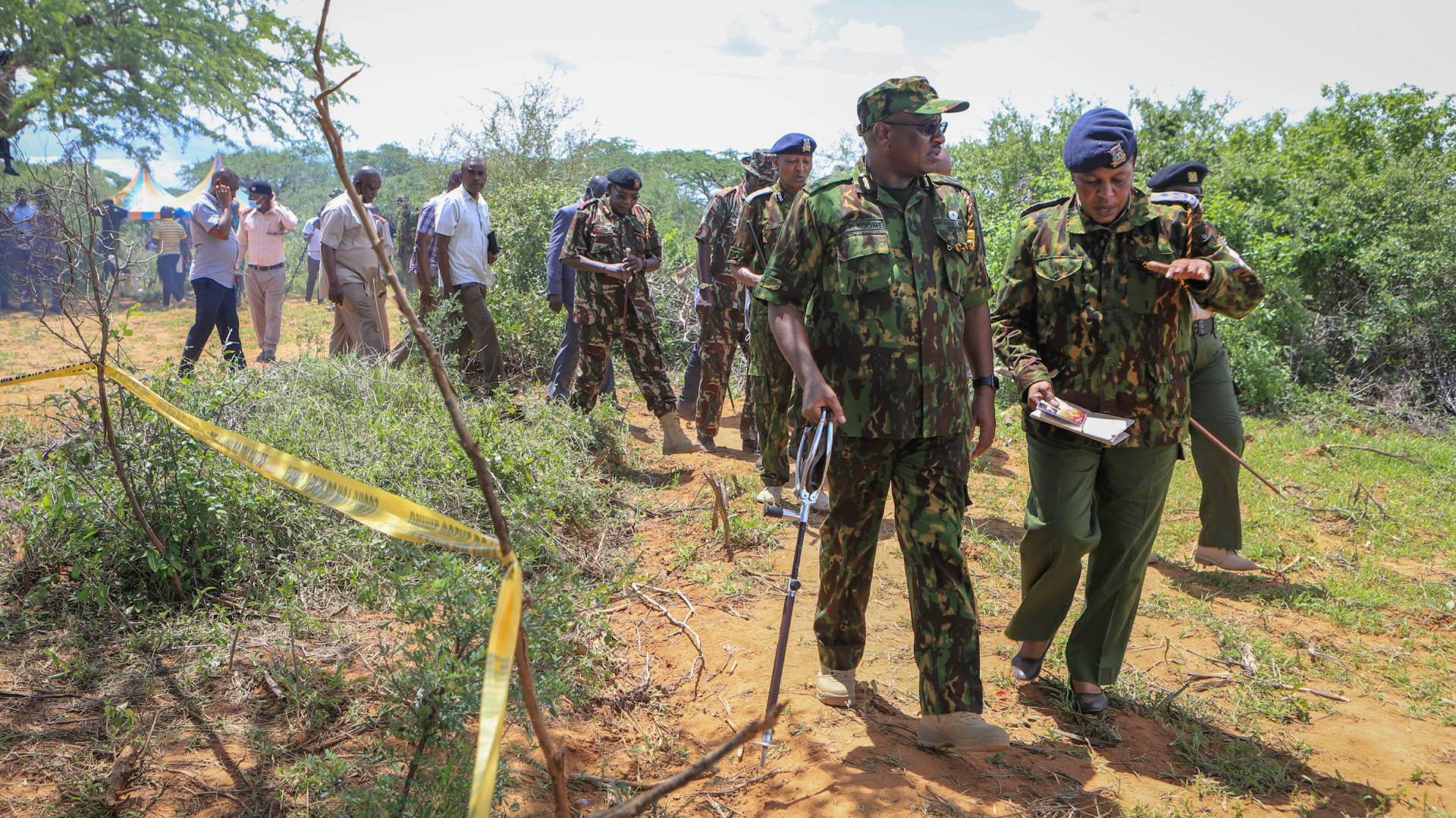
In the forest compound owned by the founder of Good News International Church, Kenyan police have discovered dozens of starving people and 65 bodies buried in unmarked graves. They arrested two people who weren’t starving: the church’s leader, Paul Mackenzie, and Mackenzie’s ministry partner, pastor Zablon Wa Yesu.
Since Friday, authorities searching Mackenzie’s land outside the coastal town of Malindi have exhumed bodies in shallow graves, including mass burials with as many as seven people—men, women, and children.
The investigation follows the police rescue of 15 members of Mackenzie’s congregation from the property earlier this month. Their fasting was so severe that four died before they reached the hospital. Others continued to refuse food despite being emaciated.
Police believe the victims are acting at the direction of Mackenzie, an end times preacher who promised them heaven if they starved to death.
Christians in Kenya have longed for a solution to regulate the spate of fraudulent preachers in their country. Mackenzie’s high-profile case has once again alarmed them, their politicians, and their neighbors, upset at the fatal consequences to manipulative, cultish practices by leaders who claim to be pastors.
Police found nine more starving people on Monday, when they arrested Yesu, who was reading a Bible on the property. Yesu said he wasn’t fasting but had a planned to in June. Authorities have not yet released details on the condition of the bodies or how long they have been buried.
The horrific discoveries at Mackenzie’s property have reignited the call for the government to ensure illegal and dangerous activity cannot use religious freedom as a cover.
Kenyan president William Ruto, the country’s first evangelical head of state, likened Mackenzie’s use of religion to terrorism and condemned “people who want to use religion to advance a shady and unacceptable ideology.”
Interior minister Kithure Kindiki responded, “This horrendous blight on our conscience must lead not only to the most severe punishment of the perpetrator(s) of the atrocity on so many innocent souls, but tighter regulation (including self-regulation) of every church, mosque, temple or synagogue going forward.”
Mackenzie was arrested on April 15 and began his own hunger strike then. It is the third time he has faced charges around the deaths of children. The most recent was in March, after two children starved.
“It is alleged that the children starved under his instructions,” said Japhet Koome, inspector general of police. “He told them to fast to the point of death to meet their maker.”
Mackenzie, who was released on bond for the previous arrests, denies wrongdoing and claims his church shut down four years ago.
He founded Good News International in 2003 and claimed a congregation of a thousand in Malindi around a decade ago. “The mission of this ministry is to nurture the faithful holistically in all matters of Christian spirituality as we prepare for the second coming of Jesus Christ through teaching and evangelism,” according to the church’s old website.
The pastor grew his ministry with a daily TV show called End Times Messages. His program was pulled around 2018, when Mackenzie was accused of “radicalizing school children” by teaching them that education is evil.
The church reportedly moved to the Shakahola Forest last year, where Mackenzie had amassed 800 acres of land.
Critics speculate that the pastor had encouraged his dying members to deed their land to him. Prosecutor Vivian Kambaga said the police is also investigating allegations of money laundering around the acquisition of the forest property.
Evangelicals in Kenya have been eager to partner with the government to address preachers who peddle dangerous theology and engage in fraud.
“People are selling their property, taking money to the pastor. It looks like it was a church but a program this pastor was using to steal from his followers,” said Chris Kinyanjui, secretary general of Kenya’s National Council of Churches. “And he is not alone. There are many others.”
Leaders of the group condemned Mackenzie, though his congregation was not a member.
The council called on citizens to avoid churches that do not have a proper governance structure, refuse to meet in the open, or rely on a pastor to pray for members instead of being encouraged to pray to God themselves.