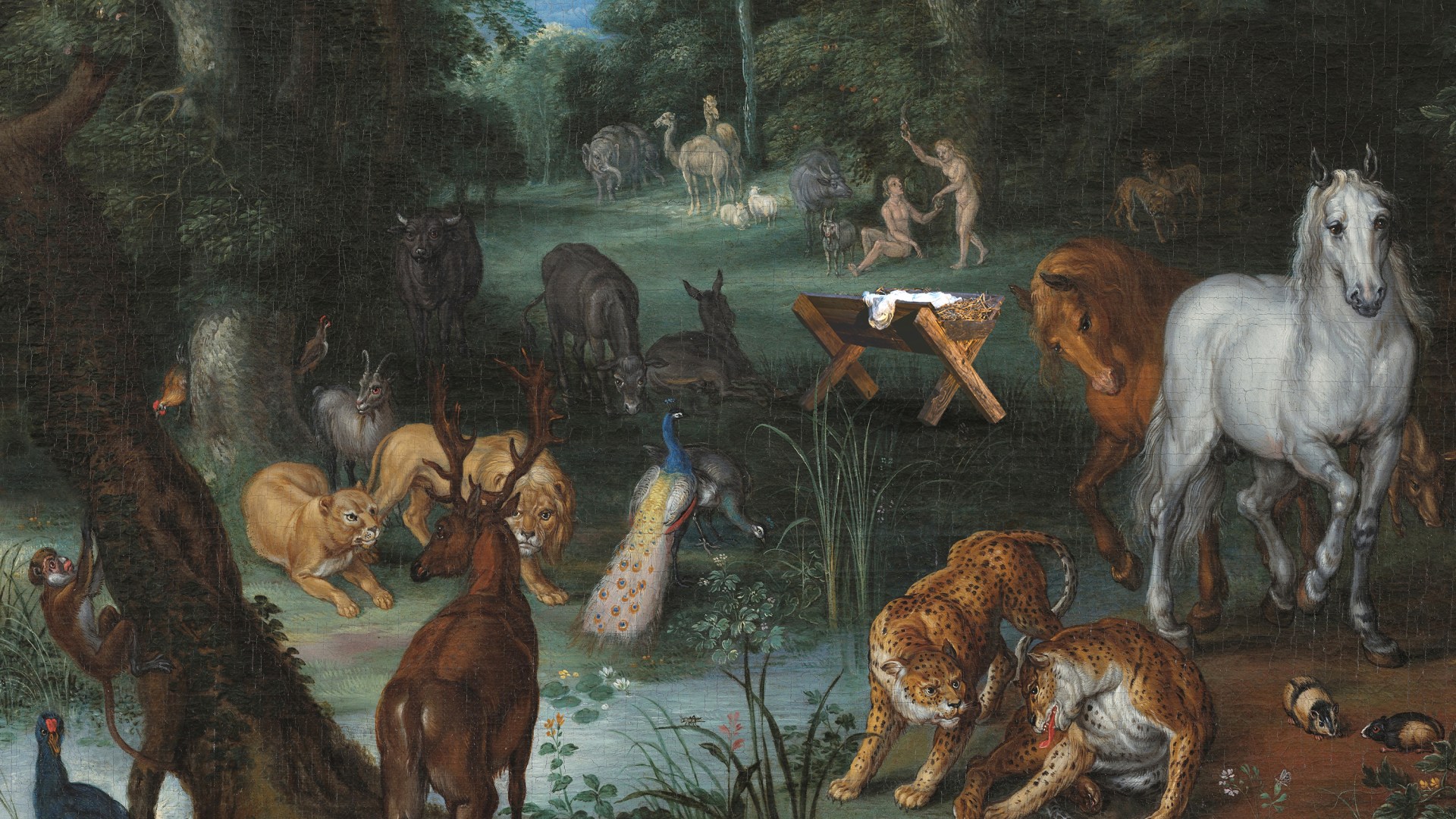
More than two centuries before the Reformation, a theological debate broke out pitting the premier theologian Thomas Aquinas against an upstart Scottish Franciscan priest, John Duns Scotus. The heart of the debate circled around the question “Would the event we celebrate at Christmas have occurred if humanity had not disobeyed God?”
Like most theologians, Aquinas viewed the Incarnation as God’s remedy for a fallen planet, a rescue plan that God first prophesied in Genesis 3. Aquinas pointed to Scripture passages that highlight the Cross as God’s redemptive response to a broken relationship with humanity.
Duns Scotus, nicknamed “the Scotsman,” saw much more at stake. To him, the Word becoming flesh, as described in the prologue to John’s gospel, must surely represent the Creator’s primary design—God’s original goal—and not a plan B. Duns Scotus cited passages from Ephesians and Colossians on the cosmic Christ in whom all things have their origin, hold together, and move toward consummation.

The evangelical tradition often emphasizes the atonement and Christ living in us. We urge children to “accept Jesus into your heart,” an image that can be both comforting and confusing. More pietistic strains speak of “the exchanged life” in which Christ lives in the believer. Yet far more often—164 times in Paul’s letters, according to one author—the New Testament speaks of us being “in Christ.” At a time when theories of the atonement seem mystifying to moderns, we could learn from the Christ-centered view of Creation once expounded by a Scottish theologian from the high Middle Ages.
Did Jesus only come to earth as an accommodation to human failure? Was the Incarnation a humiliation God had to endure, or was it the center point for all creation? Duns Scotus and his school suggested the Incarnation was God’s underlying motive for Creation, not merely a correction to it. God spun off this vast and beautiful universe for the singular purpose of sharing the divine life and love with humanity, intending all along for us to participate in eternal fellowship with him.
Ultimately, the church fathers decided that both approaches had biblical support and could be accepted as orthodox. And although most Western theologians followed Aquinas, prominent Catholics like Karl Rahner have since taken a closer look at Duns Scotus.
Imagine a time before the creation of matter. What did God have in mind with our planet, one of trillions in the universe? One answer to that question is Jesus: that he came to show us earthlings what God is like and what we should be like. The history recorded in the Old Testament serves as a prelude for God’s supreme act of incarnation. And as the Gospels’ genealogies stress, Abraham, Isaac, Jacob, Judah, David, and others provided Jesus a family and a culture into which he would be born.
When Mary gave birth to Jesus in Bethlehem, she participated in an act of divine creation that continues to this day. Paul’s recurrent phrase “in Christ” hints at a reality made vivid in his metaphor of the church as the body of Christ, which extends the Incarnation through time. And when Jesus ascended, he turned over this grand mission to his followers.
Hang on—am I suggesting that the miracle of Christmas is somehow replicated and carried out in the lives of those who identify as Jesus’ followers? Some immediate objections arise, such as how fallen human beings such as ourselves could possibly be entrusted with this divine mission.
In the words of Eugene Peterson: “Friends, we are immersed in great and marvelous realities. Creation! Salvation! Resurrection! But when we come up dripping out of the waters of baptism and look around, we observe to our surprise that the community of the baptized is made up of people just like us: unfinished, immature, neurotic, stumbling, singing out of tune much of the time, forgetful, and boorish. Is it credible that God would put all these matters of eternal significance into the hands of such as we?”
In a sermon to his theology students at Oxford, Austin Farrer articulated this question in a different way: “What are we to do about the yawning gulf which opens between this Christhood of ours and our actual performance … between what Christ has made us and what we make of ourselves?”
His answer is simple: We do the very thing Jesus’ disciples did. On the first day of the week, we gather to “reassemble the whole body of Christ here, not a member lacking, when the sun has risen; and have the resurrection over again.” We remind ourselves, to borrow Paul’s words, that there is no condemnation for those who are in Christ Jesus, that we are dead to sin but alive to God in Christ Jesus, that if anyone is in Christ, he is a new creation; the old has gone, the new has come (Rom. 8:1, 6:11, 2 Cor. 5:17)!

In short, we confront the stunning truth that God gazes at us through the redemptive lens of the Son who became incarnate and dwelt among us.
Then, assured of that new identity, we go forth to revitalize God’s world. Duns Scotus called his approach the doctrine of the Absolute Primacy of Christ in the universe. Those who root their identity in Christ have a holy mission to advance his kingdom. Christians minister to the poor and suffering not out of humanistic motives but because the least of these also express the image of God. We insist on justice because God insists on it throughout Scripture.
And we honor nature because it is God’s work of art and the backdrop for Christ’s incarnation. As Simone Weil put it, “The beauty of the world is Christ’s tender smile for us coming through matter.”
Some time ago, I had a conversation with Makoto Fujimura, an esteemed artist who founded the International Arts Movement to encourage Christian artists to look to their own faith for inspiration. “So many contemporary artists turn to other religions, like Buddhism,” he said to me. “I remind them that God is about Creation from the Book of Genesis to the Book of Revelation, in which God promises to make all things new.”
Among Jesus’ final words in Revelation are these: “I am the Alpha and the Omega, the First and the Last, the Beginning and the End” (22:13). In this light, Christmas represents God’s masterpiece, the as-yet-unfinished act of cosmic restoration.
Philip Yancey is the author of many books including, most recently, the memoir Where the Light Fell.