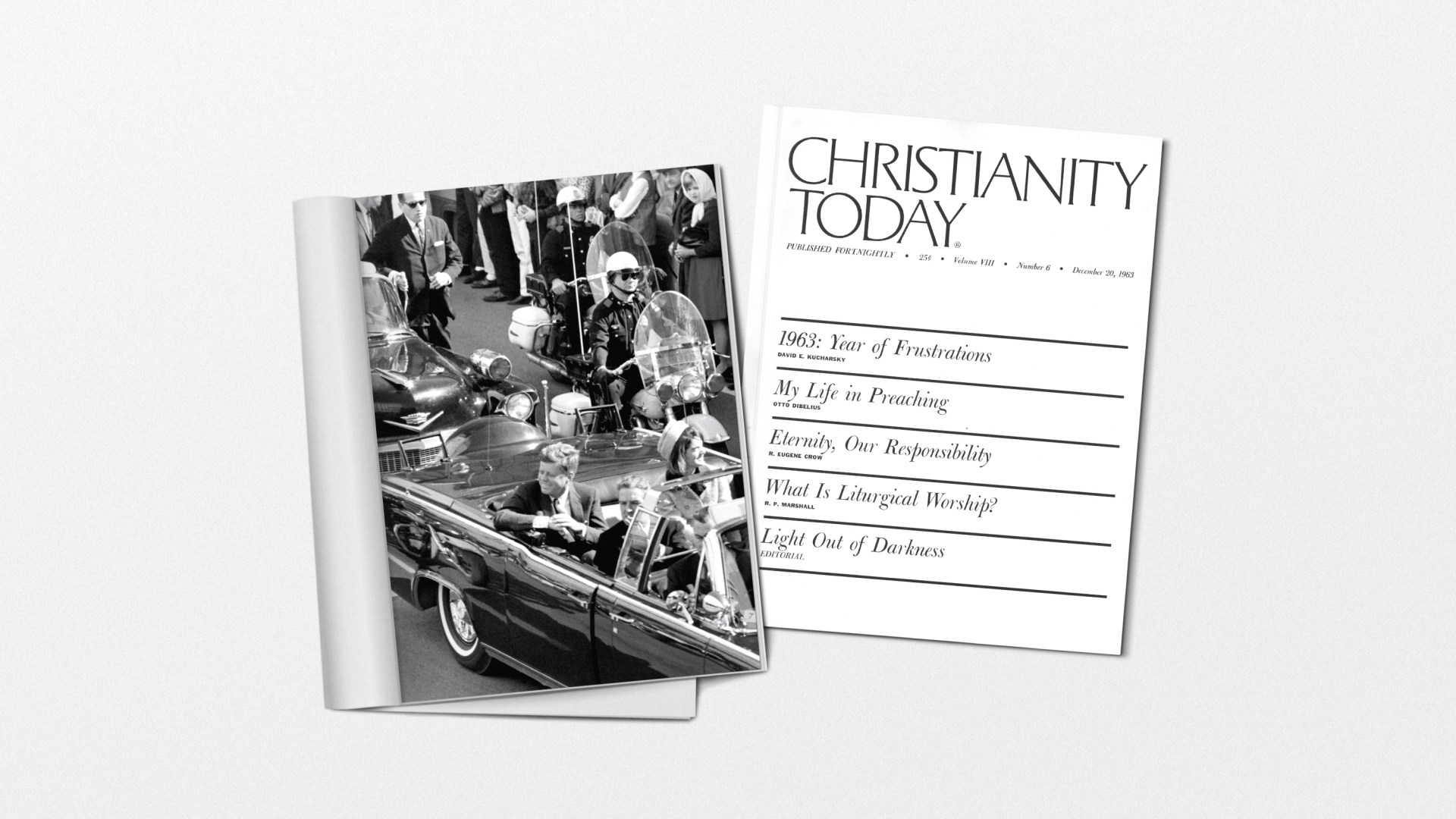
CT in 1963 covered one of American history’s tumultuous years. When President John F. Kennedy was assassinated in Dallas, editors in the magazine’s Washington, DC, office collected religious leaders’ comments on “The Death of the President” and tried to capture the feeling of the moment:
A shot came out of nowhere and changed a thousand things around the world. An unknown assassin brought sudden and tragic end to the life of a world-renowned figure; John F. Kennedy was dead by the hand of an evil man whom nobody knew, and who will be known only as long as his infamy is remembered. …
In one tragic moment, an unexpected event changed the plans and hopes of many people and of a nation. Strategies devised with an eye to next year’s presidential elections were suddenly obsolete. The whole civil rights issue at once took on new but unknown dimensions. … So little, one shot, by one unknown man, changed so much. …
During the 35 minutes that the fallen President lay dying in a Dallas hospital, three men gathered dead leaves and leisurely loaded them into a truck that stood on the circular drive that fronts the White House. The whirring blades of a helicopter could be seen above the grass in the back of what was the Kennedy home. Here of all places everything looked normal on this warm, gray, November day.
But suddenly a flag was quietly lowered to half mast above the white mansion. Others on surrounding public buildings were similarly lowered, and the eye received the message that the mind found impossible to believe. The President was dead.
Authorities identified the assassin as Lee Harvey Oswald—a lone gunman, they said, but one whose sketchy past, shadowy meetings with underworld figures, and sudden death in police custody would fuel decades of conspiracy theories. CT sent a correspondent to interview the accused killer’s mother.
Mrs. Marguerite Oswald … tried under difficult circumstances to provide religious training for her three sons. … The infant Lee was baptized in a Missouri Synod Lutheran church in New Orleans. He was never confirmed.
Mrs. Oswald attempted to stay at home and rear her family but eventually was forced to go to work. She paid a maid to care for the children for a time, but when World War II came, she had to make other arrangements. The older two sons she placed in a Lutheran institution which accepted children having only one parent. She said she was expected to pay whatever circumstances would permit.
But Lee was too young to enter the church home. Mrs. Oswald said she had no choice but to leave him to the care of a sister, who also lived in New Orleans, and to hire other attendants for him whenever possible. …
“I know that my son was not an atheist,” Mrs. Oswald declared.
Before that fateful day, the biggest political story of the year was the Supreme Court decision in Abington School District v. Schempp. The court decided that teachers reading Scripture to students was a violation of the First Amendment. CT reported from the court:
Justice Tom C. Clark had been drawling over a zig-zag sewing machine patent when, with scarcely a pause, he shifted to cases 119 and 142. Clark talked for another 25 minutes. His voice trailed off as he finally announced the court’s decision against a 150-year-old American tradition of prayer and Bible reading in the public schoolroom. The decision was regarded in some quarters as imposing a restriction upon the religious practices of more Americans than any prior government action.
The court’s decision on June 17 was 8 to 1, with Justice Potter Stewart, an Episcopalian, voicing the lone dissent, just as he did in 1962 when the court struck down the 22-word interfaith prayer approved by the New York Board of Regents for use in the public schools of that state. … The justices differ sharply on why required public school devotions are unconstitutional. Clark’s majority opinion was shared only by Chief Justice Earl Warren, Justice Hugo L. Black, and Justice Byron White.
Clark’s argument against devotional exercises in the public schools rested largely on the contention that the government must maintain an attitude of neutrality in religious matters. He said the test may be stated as follows: “What are the purpose and the primary effect of the enactment? If either is the advancement or inhibition of religion then the enactment exceeds the scope of legislative power as circumscribed by the Constitution.”
CT followed developments in the Civil Rights Movement in 1963, with an eye toward shifting religious positions and the impact on churches.
Anti-segregation campaign in Birmingham, Alabama, included a series of attempts by Negroes to worship in all-white churches. Several of the churches welcomed the demonstrators, while others turned them away. … Mercer University (Southern Baptist) trustees voted 13 to 5—with 3 abstentions—to enroll Negroes on the Macon, Georgia, campus.
Martin Luther King Jr. led the March on Washington in August. Four CT editors joined the throngs gathering on the National Mall to see if the “religious element” of the movement offered a “genuine spiritual under-girding” or if it was “a mere form of godliness.” They reported back:
The day was mostly bright, with temperatures in the eighties. Washington’s notorious humidity was somewhat offset by a fresh breeze and scattered clouds in the afternoon.
Highlighting the afternoon ceremony was the great oratory of King, who cried again and again, “I have a dream.” But as if to prove that people doze despite the best of preachers, hundreds stretched out on the grass and slept most of the afternoon away. Another temptation was the cool water of the Reflecting Pool, and other hundreds kicked off their shoes and stockings to dangle their feet over the edge. At least two persons fell into the shallow pool.
A. Philip Randolph, 74-year-old elder statesman of civil rights in America and the son of a clergyman, was among several speakers who appealed to religious precedent. Randolph, program emcee and chairman of the national march committee, reminded the vast throng of more than 200,000 that “We are leading the multitudes in the streets just as … Jesus Christ led the multitudes in the streets.”
NAACP leader Roy Wilkins, seeking to perpetuate the fervor of the day, said:
“You got religion here today. Don’t back-slide tomorrow.”
[Dr. Eugene Carson Blake, stated clerk of the United Presbyterian Church in the USA] declared that Negroes “have mirrored the suffering of Jesus Christ.” He quoted Romans 12:1 as a helicopter whirred high overhead.
CT founding editor L. Nelson Bell continued to oppose civil rights laws. He said there was no biblical justification for segregation, but his main concern was that “voices of moderation on both sides of the issue are being drowned out by the louder voices of ‘rights’ without reference to the realities of the situation.” Other evangelicals called for white Christians to join the Civil Rights Movement—or forfeit any claim to moral authority in America.
Evangelical leadership completely missed the point of the March on Washington and was not represented. … The evangelicals should do some soul-searching to discover how they got themselves into such a predicament. A biblical sense of the importance of men’s souls should have brought them close to the Negro. Also, the Negro churches are very conservative in their theology. Evangelicals pride themselves on affirming the oneness of man in their support of foreign missions. But conservative American churches and churchmen have done little in meeting the Negro problem. The little that has been done has been rather patronizing, and this the Negro considers an insult.
Evangelicals have often allied themselves with the conservative social and political forces in the United States, especially in the South. … Christianity at its inception and at certain great points in its history has been extremely radical. The usual conservative exaltation of property rights as the basic right sounds strange from those who profess to uphold the spiritual and downgrade the material. …
The members of evangelical churches need to learn the disciplines of the love of Christ.
CT also called readers to action on another current issue: cigarettes. The magazine urged Christians to read a recent report on tobacco and to stop smoking.
The Consumers Union Report on Smoking and the Public Interest approaches the problem on a medical and social basis without direct reference to its moral aspect, although ethical implications inevitably shine through its discussion of the industry’s deliberate blindness to evidence and the mendacity of its advertising. But the Christian community is in a different position. It can no more look at the cigarette-lung cancer problem from a morally neutral point of view than it can be oblivious of the moral implications of the daily slaughter on the highways and the human wreckage through alcoholism. …
Habitual cigarette smoking is no longer for the Christian a mere take-it-or-leave-it matter. It has moved from an optional indulgence to a question of the stewardship of the body. … On the scriptural ground that the God who gives us our bodies requires accountability for their use, none of us has the right to contract any habit that has been shown to lead to grave illness and premature death.
Amid the year’s crises and conflict, CT redesigned the magazine, hiring the artist who would go on to develop the iconic ad campaign, “I’d like to buy the world a Coke.” The redesign was announced with a note:
Christianity Today’s contemporary, clean look reflects tradition and at the same time maintains dignity and respect for the subject matter of conservative religious publication. To achieve it, New York artist Harvey Gabor made use of areas of white space, contrasting with text areas. … “There is always the same seeming paradox: to be contemporary and simple, but not sterile; to be modern, but with a touch of classicism. … Perhaps the most intangible quality I sought for Christianity Today was a style and momentum all its own.”
An English professor argued that Christians could read contemporary literature—even if the literature is itself immoral.
Salinger’s Catcher in the Rye may be taken to illustrate these distinctions. Because it contains offensive language, instances of censurable behavior, and a number of reprehensible ideas, many readers would label it an immoral book. But in doing that they may have overlooked the most significant scene in the novel, the one which provided its title, in which Holden explains to Phoebe his vision of standing in a rye field full of small children to guard them from plunging over a cliff. This is his way of making sense out of the terrifyingly chaotic world which envelops him, a world empty of values but full of phonies, and if we accept the idea that literature has some basic part to play in the human search for order, then the worth of this one scene ought to outweigh what we may regard as the worthlessness of the other elements. Catcher in the Rye is thus seen to be a mixed product, one requiring careful thought if it is to be evaluated sensibly. …
At the end of the year, CT reported a widespread sense of failure and helplessness in American culture and American churches.
Ministers and laymen alike felt a sense of defeat.
For clergymen, a chief source of frustration was what to do with the latest variety in a historic strain of hearers-only Christians. The 1963 crop of professing believers whose lives reflect so little of New Testament teaching drew many a pastor into the lonely garden of perplexity.
One candid young minister came out of an experiment aimed at more meaningful Christianity with these words: “It’s been a flop. So far I’ve managed to reduce the congregation from 400 to about 50.”
He had tried modern music, jazz, dialogues, discussions, and plays. Next on the list was a plan to convert the church into an apartment house with the lobby as a chapel.
The heresy of universalism, implicit or overt, may be held responsible for lay indifference in some quarters. But what about lethargy in evangelical ranks?
The growth rate of most evangelical enterprises has leveled off markedly in recent years, and in 1963 many such efforts were pushing to maintain the status quo. …
“It’s like trying to climb Niagara Falls to meet these needs,” one evangelical leader said publicly.