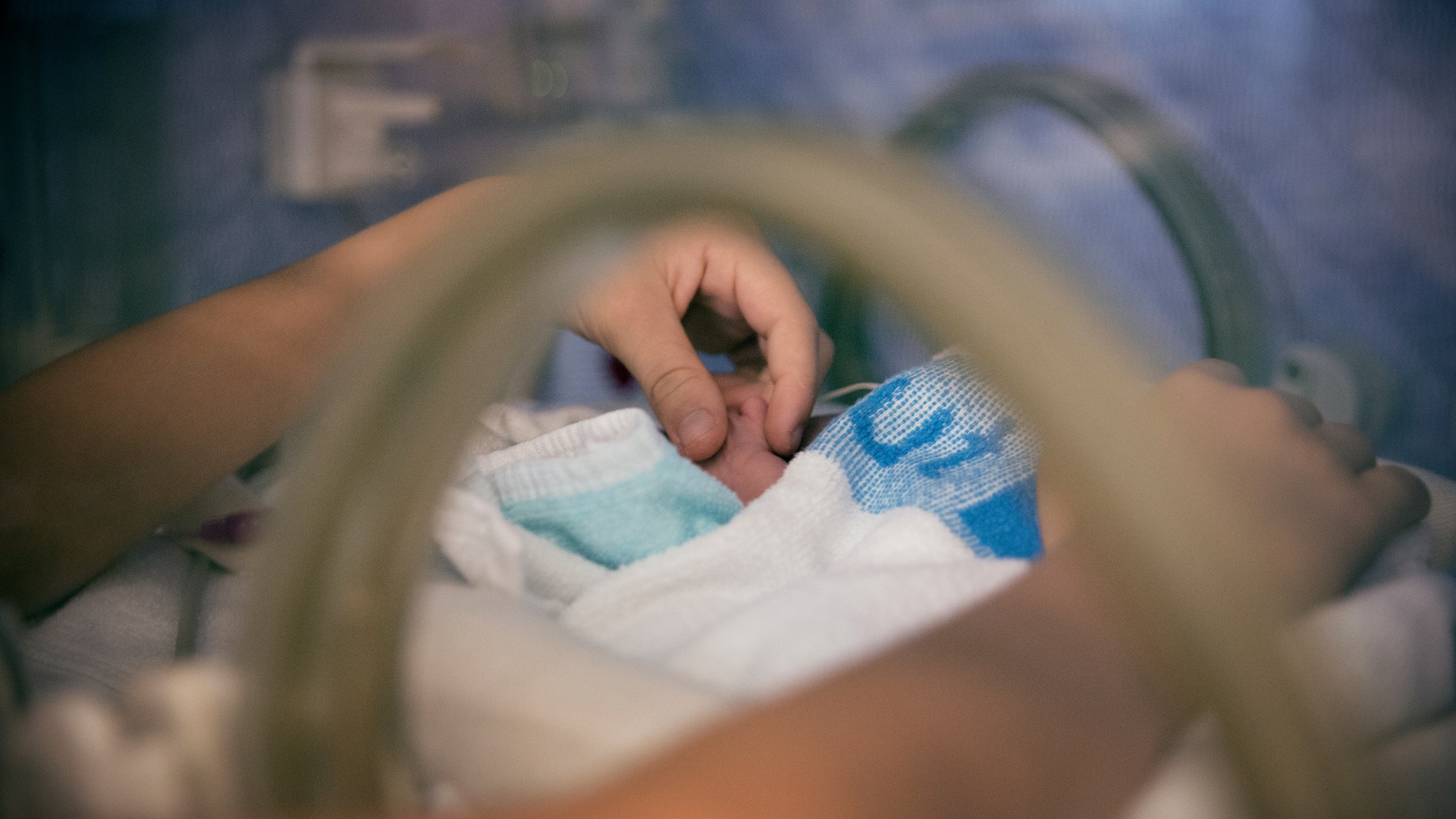
Six years later, Copeland’s stocking is still hung every Christmas.
And every year around this time, his parents, Matt and Taylor Walker, and their other children think about him and his brief life.
Copeland died less than an hour after he was born on December 22, 2019.
“We still look back at those 55 minutes joyfully, and we also still look back at that 55 minutes as a sorrowful experience,” Matt said.
Doctors diagnosed Copeland with Trisomy 18 while he was still in Taylor’s womb. His parents knew before he was born that their time with him would likely be short. While Matt has thought countless times since then about how he might have spent that treasured time differently, he has never once regretted having those minutes.
“There are so many God moments in that, even in the midst of sorrow,” Matt said.
Had they chosen to abort when they learned the diagnosis, they would have had no time with their son outside the womb.
“We had a choice, and we chose to honor Copeland’s life and to honor God through that,” Taylor said. “And it’s been a tremendous experience for us because of that.”
Before the overturning of Roe v. Wade in 2022, many Americans chose to abort when discovering a pregnancy with a life-limiting diagnosis. A 2015 study of cases between 2005 and 2014 found that 94 percent of people whose unborn child had Trisomy 13, Trisomy 18, or Down syndrome chose to abort.
“A lot of times in those situations, the doctors suggest to abort,” said Amy Ford, founder of Embrace Grace, based in Fort Worth, Texas, and the author of Help Her Be Brave. “They will say things like, ‘It might be easier for you to not have to carry this baby full-term because the baby may not make it full-term.’”
Some state laws are making abortions harder to obtain in these situations. According to the Guttmacher Institute, a pro-choice organization that tracks reproductive rights in the US, 41 states now have some form of abortion ban with limited exceptions.
According to Guttmacher, 28 of the 41 states that restrict abortion do not allow any exceptions for fatal fetal abnormalities, with four other states allowing exceptions up to 20, 24, or 28 weeks gestation.
As abortion options diminish, Christian support groups are finding new opportunities to come alongside parents facing difficult times ahead.
Embrace Grace focuses on supporting single and pregnant young women with unplanned pregnancies by connecting them with a church community. The organization trains people to lead support groups and now has a network of more than 1,100 at churches in all 50 states. In 2023, they ministered to 3,880 expecting mothers and fathers, and that number rose to around 5,400 by 2025.
They also have a campaign that gives “Love Boxes” to expectant mothers. Each box includes encouraging messages; personal stories from other moms; and resources that connect women to local Embrace Grace support groups, where they can receive emotional, spiritual, and practical care.
“Every Love Box represents a moment when a woman is reminded that she is not alone,” Ford said, noting that 150,000 of them have been distributed since 2012. “These boxes are often the first step toward a mom choosing life and discovering a community that will walk with her.”
Ford said that for many, finding out a life-limiting or life-altering diagnosis on top of dealing with the challenges of an unplanned pregnancy can be overwhelming. She believes this is an opportunity for Christians to offer hope.
“We are trying to walk with them and letting them see the bigger picture—that, with God, they have the strength to walk through it and they don’t have to walk through it alone—that we’re in this with them.”
While Embrace Grace’s ministry is for any woman dealing with an unexpected pregnancy, some expectant mothers they care for do receive a diagnosis of a fatal fetal abnormality. Ford is grateful she can point people to other organizations like Abel Speaks, a Texas-based organization that offers life-affirming support for parents walking through a life-limiting pregnancy diagnosis from all parts of the US.
This support can take the form of counseling, medical connections, or recommendations for a photographer to capture images from their time with their child or on how to plan a celebration of life.
“While we don’t track our work through a political lens, we can say that awareness of our organization has steadily grown in recent years, and as a result, more families are finding their way to us,” said Abel Speaks director of operations Kimberly Bradley.
The organization has helped close to 700 families since it started in 2018. As of December 10, it had already served 128 families this year.
“Each story is deeply personal, and we are honored to meet families right where they are—providing care, resources, and community in the midst of such a difficult journey,” Bradley said.
Taylor Walker remembers how helpless she felt in the hours and days after learning Copeland’s life would be short.
“There was no one in our community or the church community, our friends group—nobody that had experience with this,” she said.
So she got on Instagram and typed “Trisomy 18” in the search bar.
That’s how she found Abel Speaks.
“I was just thrilled when I got off that first call with Kelly [Crawford], the founder,” Taylor said. “It gave me a new sense of hope and peace that we would be okay.”
After Copeland died, the Walkers made a point of keeping his memory alive with traditions such as the Christmas stocking they hang each year. They also became mentors with Abel Speaks so they could help other parents. They are now directors of family care for the organization.
Through the joy and pain they experienced in 55 minutes with Copeland, they’re able to support others.
“We know there are a lot of questions, but having walked this journey and having learned from others as well who have walked that journey, we just want to support them and love on them the best that we can,” Matt said.
Taylor naturally has a heart for mothers going through what she did.
“It’s so much at first, but I do try to instill that courage in them to know that the life that they’re carrying still has so much meaning and the child was meant for them regardless of any diagnosis,” she said.
The Walkers said it meant a lot for them to know that other Christians from their church and from Abel Speaks were praying for them, and to have believers point them back to the reason Jesus died—to offer the hope of eternity with him and their loved ones.
“I remember a few specific conversations in the midst of our deep grief; our pastor was so good to remind us of God’s goodness and the faithfulness through his Son,” Taylor said. “I know that our faith when we were newly grieving was strong enough to hold and stand firm, but I also know the support of our community in that time has made a huge impact in the way we now grieve.
“I don’t feel like I need to hide it. I feel safe and confident to share my grief with the community, friends, and family and ask for prayers when I am struggling.”
That perspective during trials offers a bigger picture of hope that they share with others.
“It doesn’t make the grief or the loss disappear, but it does shape how they walk through it,” Taylor said.
She said the perspective is in line with Romans 8, where Paul talks about how present sufferings can’t be compared to the glory that will be revealed (v. 18).
“It’s about having a community that gently reminds you that you’re not alone and that there’s a greater story of redemption and hope even in the midst of heartache.”
For those who are grieving around the holiday season, as they have for the past six years, the Walkers encourage families to continue to speak their child’s name.
“We know the emptiness that comes when you are gathering around as a family, and you feel like your little one has been ‘forgotten,’” Taylor said. “We have found that including them in special ways, like lighting a candle in their honor, can be a great way to help family or friends think of them with you.”
In addition to continuing to hang Copeland’s stocking, the Walkers also put up a small tree each year with ornaments they’ve been given or bought specifically for Copeland.
“Our kids love to decorate that one, and it’s always a sweet way to remember him with our living children,” Taylor said. “Copeland’s birthday is on the 22nd, and while it does make the season a little more heavy, it is also a sweet reminder of Jesus’ birth and the gift of his life.“
Because of Jesus, they have an eternal hope.
“Matt and I know that we will see Copeland again.”