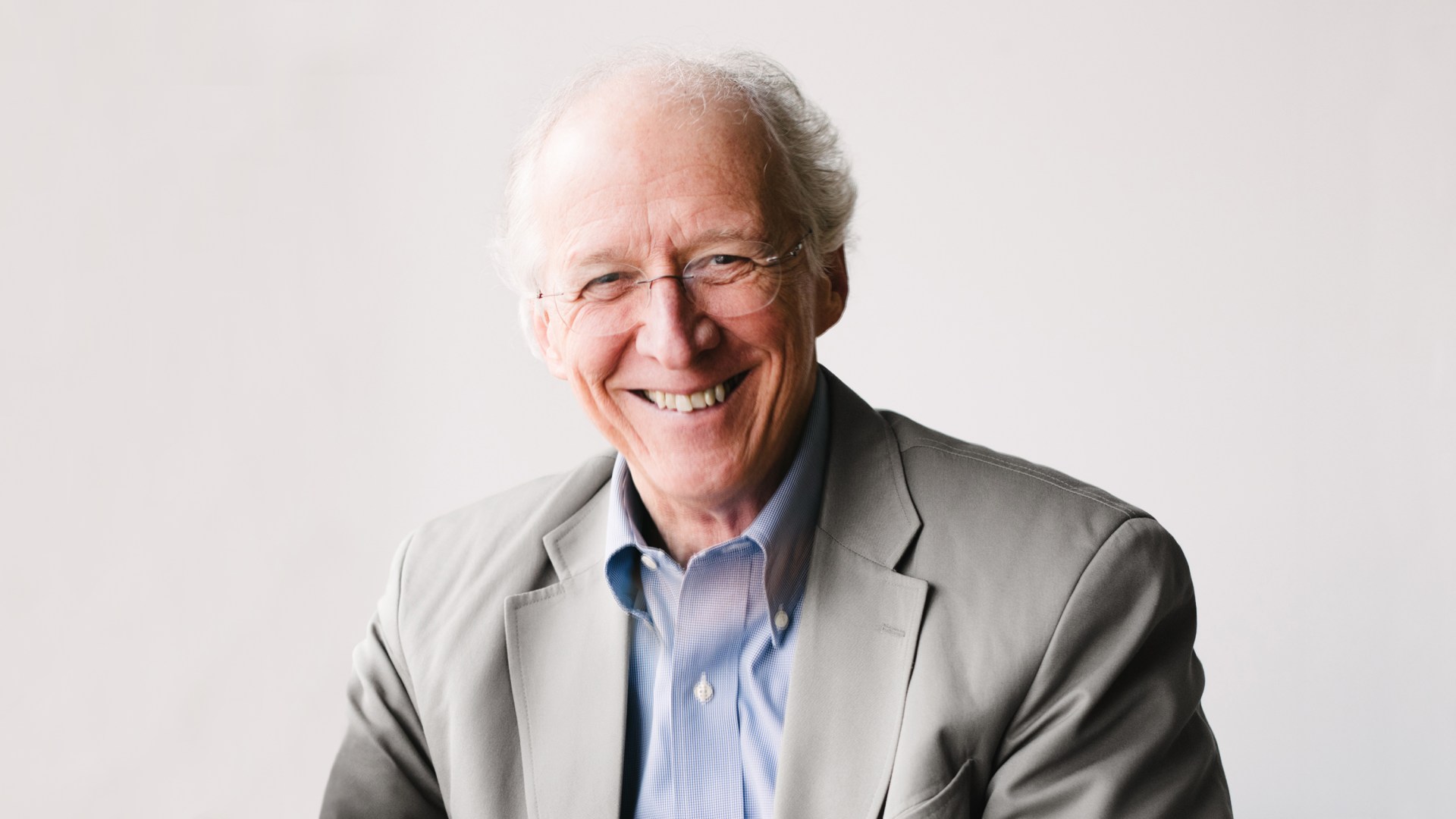
In July of 1980, 34-year-old John Piper preached his first sermon as pastor of Bethlehem Baptist Church on the eastern edge of downtown Minneapolis. Surveying a sea of gray hair, he retained traces of South Carolina lilt in his tenor voice as he said, “I have nothing of abiding worth to say to you. But God does. And of that Word I hope and pray that I never tire of speaking. The life of the church depends on it.”
Piper’s final sermon at the church fell on Easter Sunday of 2013. The gray-haired, balding pastor, then 67, looked out at a sea of younger faces and explained why this wouldn’t be a typical farewell sermon with personal reflections: “It has been our commitment in all these years together to preach not ourselves but Jesus Christ as Lord (2 Corinthians 4:5). People ought not to go to church to hear the sentiments or the ideas of a man, but to hear the word of God.”
“Our acts,” he once wrote, “are like pebbles dropped in the pond of history. No matter how small our pebble, God rules the ripples.” Piper, a self-described slow reader and “plodder,” fits well in CT’s Long Obedience in the Same Direction series. As he turns 80 this coming Sunday, January 11, he still teaches and writes full-time—and his ministry has had worldwide effects.
Piper’s fundamentalist parents were the happiest people he knew. He grew up in Greenville, South Carolina, within walking distance of Bob Jones University, where his itinerant evangelist father served on the board. After Piper’s parents split with Bob Jones’s family over their criticism of Billy Graham in 1957, Piper went to Wheaton College in the 1960s. There he met his wife (Noël Henry from Georgia) and, through an invitation to pray at summer chapel, was healed of a debilitating speaking phobia that had plagued him from childhood.
related


While confined to the infirmary with mononucleosis, Piper listened by campus radio to chapel expositions by Harold John Ockenga and felt called to the ministry. Then, at Fuller Theological Seminary, Daniel Fuller taught him how to read the Bible by asking questions of the text and tracing its arguments. When Fuller said Jonathan Edwards could both confound a philosopher’s mind and warm a grandmother’s heart, Piper started reading the 18th-century pastor-theologian and never stopped, with Edwards becoming his “most important dead teacher outside of the Bible.”
After tearful wrestling over the biblical texts, Piper embraced the absolute sovereignty of God and the doctrines of grace. He also put together the building blocks of “Christian Hedonism,” an arresting label for the old idea that only God can satisfy the deepest longings of our soul. Therefore, we glorify God by enjoying him forever. Piper in his breakout book, Desiring God, put it this way: “God is most glorified in us when we are most satisfied in him.”
A doctorate from the University of Munich, with a dissertation first published by Cambridge University Press, stamped Piper’s passport to academia. After six years of teaching at Bethel College (now Bethel University), he used a sabbatical to write a detailed academic work on Romans 9. During that time he sensed God calling him to the pastorate, as if saying, “I will not simply be analyzed, I will be adored. I will not simply be pondered, I will be proclaimed.”
related


Over the ensuing decades, Piper wrote more than 50 books and donated every penny of his book royalties to fund his nonprofit ministry Desiring God as well as Bethlehem College and Seminary. As the internet came of age, he made all his audio messages and sermon manuscripts available free of charge.
The outdoors OneDay Passion conference in 2000 was a watershed moment for many students who heard Piper for the first time. In what came to be called Piper’s “seashells sermon,” after a couple who retired early to build a seashell collection, he pleaded with 40,000 college students not to waste their lives.
Piper became a mainstay speaker for not only Passion Conferences but also Together for the Gospel, The Gospel Coalition, and later the Cross Conference. Along the way, he became a father figure for the Young, Restless, and Reformed movement. Piper’s passionate intensity and earnest articulation could carry a room, but his was not the revivalism of yesteryear. He was not a traveling orator but an ordinary-means-of-grace, local-church pastor who emphasized that his theology of happiness came through suffering, and his theology of glory came through the Cross. He labored to live within the biblical paradoxes of a man in Christ: sorrowful yet always rejoicing, brokenhearted but bold.
Becoming well-known did not change his lifestyle. Piper’s salary stayed under six figures, by his request, for virtually his entire pastoral career. He’s lived in the same nondescript urban house within walking distance of the church for four decades. At the age of 50, he and his wife adopted a daughter after raising four sons. His department-store clothing stands out only because he wears the same thing at virtually every conference.
At the age of 80, Piper works full-time from his home office, answering questions about the Bible and the Christian life through the Ask Pastor John podcast (400 million episode plays over the past 13 years) and through his verse-by-verse video series, Look at the Book (over 1,300 videos so far, with a life goal of working through all the Pauline letters). He and his wife remain faithful members at Bethlehem Baptist.

In an age too often marked by scandal, failure, and apostasy, Piper has no moral skeletons in his closet. He talks candidly about his patterns of sin and weaknesses. He asked the elders for an unpaid eight-month sabbatical from all public ministry to work on becoming a better husband and father and to do battle against besetting sins like pride and self-pity. For those inclined to put him on a pedestal, he points to his feet of clay.
In his second year as a pastor, Piper noted that the mercy of God and the sovereignty of God were the twin pillars of his life: “They are the hope of my future, the energy of my service, the center of my theology, the bond of my marriage, the best medicine in all my sickness, the remedy of all my discouragements. And when I come to die (whether soon or late) these two truths will stand by my bed and with infinitely strong and infinitely tender hands lift me up to God.”
Justin Taylor is the executive vice president of book publishing and the book publisher at Crossway. He has edited and contributed to several books, and he blogs at Between Two Worlds, hosted by The Gospel Coalition.