On a Sunday morning in Kakamega County in western Kenya, two elderly women dust plastic chairs, open windows, and lay white linen on the tables at the front of the sanctuary inside Grace Calvary Christian Baptist Church. Pastor Jackson Sikolia prepares his sermon in his small office as members start arriving one by one.
When the 56-year-old Sikolia enters the sanctuary, half the seats are empty and only a handful of the attendees are young people. No youth sing in the choir. Only one teen girl helps with the children in Sunday school.
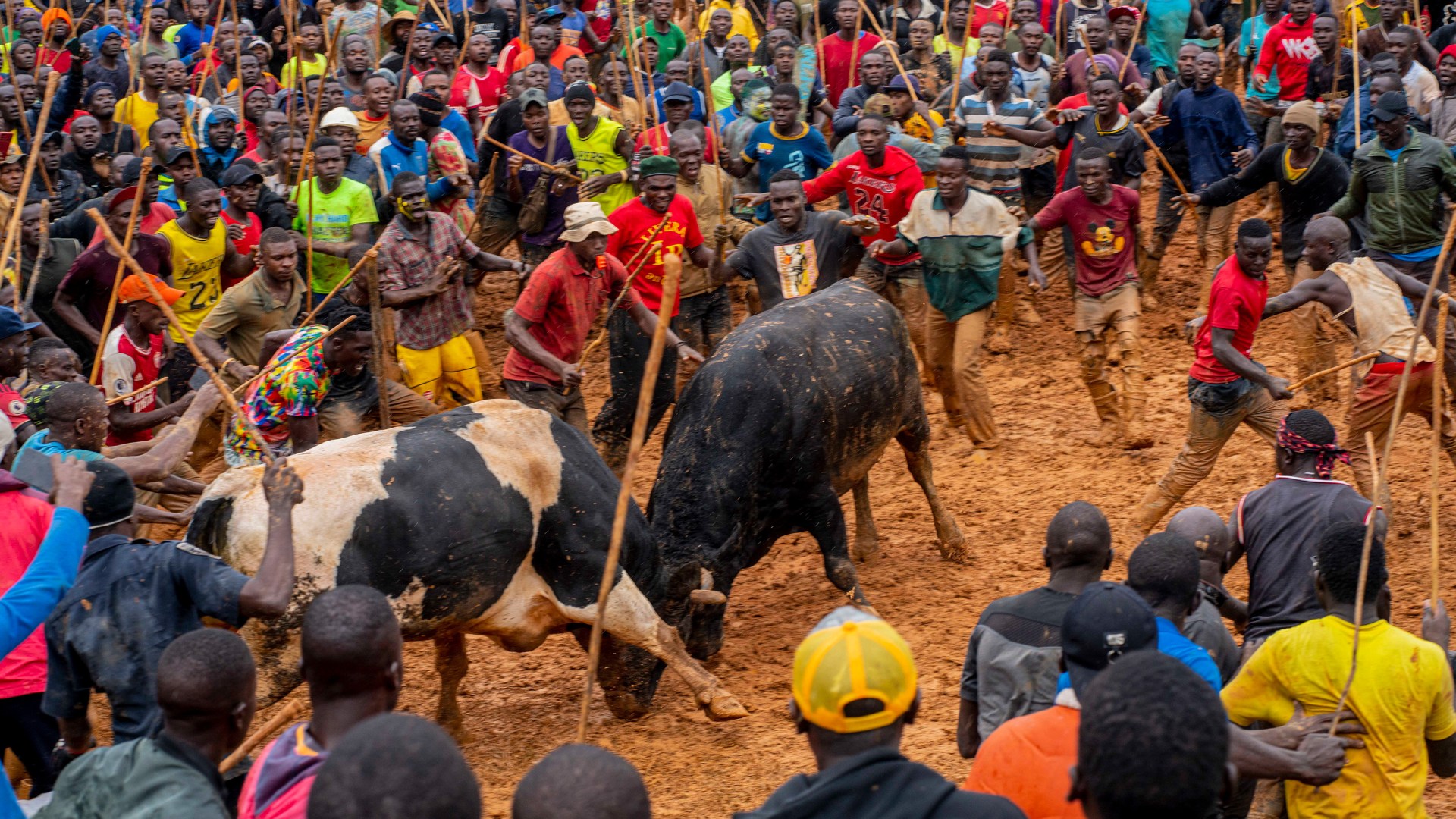
Yet outside, young men and women crowd the roads blowing vuvuzelas, whistling, or honking motorbike horns as they wait to accompany one of their village’s champion bulls to a fight a few miles away. Then they hop onto overloaded bikes—often holding four to six people—and carry tree branches (a traditional expression of excitement) as they cheer and follow the bull out of town.
Fights often start around 8 a.m. on Sunday mornings. Less successful “curtain raiser” bulls face off in up to 20 matches before the main event: a fight between the champion bulls. Matches only last a few minutes as the animals lock horns in an open space surrounded by a ring of spectators, while their owners wave sticks and shout to incite a fight. The match ends when one bull pushes the other out of the ring or when one falls down or runs away.
While locals celebrate the revival of the traditional form of bullfighting, pastors worry that the weekly events are leading young people to skip church. Although bullfighting used to take place on Saturdays and on public holidays, organizers now schedule them for Sundays, Sikolia said. For small churches like Grace Calvary’s 30-member congregation, a few more empty seats is a big loss.
Sikolia said his youth serve as the “main pillar” of the congregation, as the church’s current activities and future growth depend on them. Young people help with Bible readings, singing, and ushering on Sunday mornings. Now they’re not showing up.
“Sunday should be a day dedicated to God, not to fighting bulls,” Sikolia said. In Kakamega, about 1.7 million of the county’s 1.8 million residents identify as Christian.
Bullfighting in Kenya has centuries-old ties to the local Luhya culture. Its current form began in Kakamega in the 1960s as a post-harvest celebration and has grown in popularity, moving from fields to larger venues and capturing the attention of an increasing number of Kenyans. Fights can draw thousands, with some commuting hours to watch the events.
Now, even some prominent politicians, the county government, and a university in Kakamega promote bullfighting events on special occasions. Sociologist Kathleen Anangwe pointed to the country’s high unemployment and young people’s need for socialization as reasons for the rising popularity of bullfighting.
Francis Inganji, a 23-year-old from the village of Shibembe, said he prefers watching bullfighting to going to church. His mother required him to attend church services growing up, so he rarely had a chance to see the fights. After he dropped out of high school at age 15, Inganji started attending the fights with his friends. He still attends church on Sundays when no fights are scheduled.
These fights provide more than entertainment. Inganji said the bulls’ owners often treat fans to meals of beef or chicken, bread, rice, and sodas when they return from a fight to thank them for their support. Some owners build a fan base by giving money gifts as well.
One owner in his 70s, Joel Mulela, buys and sells bulls in Kakamega. He said since many families struggle to feed their children, free food from the owners can entice young people: “These children will never want to miss a bullfight.”
Some families invest in keeping bulls and grooming them to fight, hoping they will catch the eye of a wealthy buyer who wants aggressive animals for more elite fights, which come with cash prizes. Buyers may pay as much as 200,000 Kenyan shillings ($1,500 USD)—15 times the value of an ordinary cow at the village market, Mulela said. In contrast, selling a dairy cow’s milk only earns about 6,000–10,000 shillings ($47-77) per month.
Bullfight watchers also engage in gambling. Recently, sports betting companies such as Pepeta have started allowing people to place bets on bullfights, paying out cash to winners and making a profit off those who placed losing bets. Inganji admits he’s gambled on bulls. His occasional winnings keep him following the fights.
Pastor Moses Isachi of Friends Church Lurambi said he opposes bullfight gambling because it tempts young people to steal money from their parents: “We have had cases where these young people steal even chicken or eggs to go and sell in local shops to get money for gambling.”
He said gambling also encourages laziness and discourages learning jobs skills.
Brian Shinyaga, 25, another youth from Shibembe village, struggles to balance attending church on Sunday and watching bullfights. He said he tries to catch the 10 a.m. service at his Catholic church after attending a bullfight. Because of his frequent absences, he lost his position as youth group treasurer.
“A fight can last for between 10 and 30 minutes,” he said. “If it starts at 8, I have enough time to rush home and prepare for the next church service.”
Sometimes the crowds get rowdy. Shinyaga admits many youths end up fighting, falling off overloaded motorbikes, or engaging in sexual activities under the influence of drugs during these events. Bullfights can also lead to injuries as the overwhelmed bull seeks to escape from the ring, goring or trampling spectators in the process.
Bishop Zadock Lubira of the Holy Peace Fire Church, an evangelical congregation in Nyayo Tea Zone, Kakamega, said that in the late 1990s, churches and concerned parents convinced county authorities to shift fights from Sundays to Saturdays. “How it went back to Sunday is what I don’t understand,” he said. “We should unite as a church to change this.”
Sikolia agrees, but he wants to do more than change the schedule. Youth need job skills and leadership opportunities, he said. In 2020, he began teaching young men how to make energy-saving stoves and charcoal briquettes—made from sawdust, maize stalks, or other organic materials—to sell to locals at an affordable price. He’s currently mentoring 20 youths, hoping they will encourage their peers to get more involved in church and abandon bullfighting.
Whenever he preaches at funerals, Sikolia also slots in a message for the youth against bullfighting. “I tell them to stop mixing dangerous events with the church, because God wants the youth,” he said, adding that young people who skip church to attend the events have sometimes been injured or even killed. “At the end of the day … the church [is] called to pray for [these youth].”