This piece was adapted from the Mosaic newsletter. Subscribe here.
Nicki Minaj has gone MAGA.
The rapper’s political evolution seems to have begun last fall when she expressed rightful concern over the safety of believers in Nigeria. Minaj, who identifies as a Christian, has since started talking more about God and has expanded her commentary to other hot-button topics.
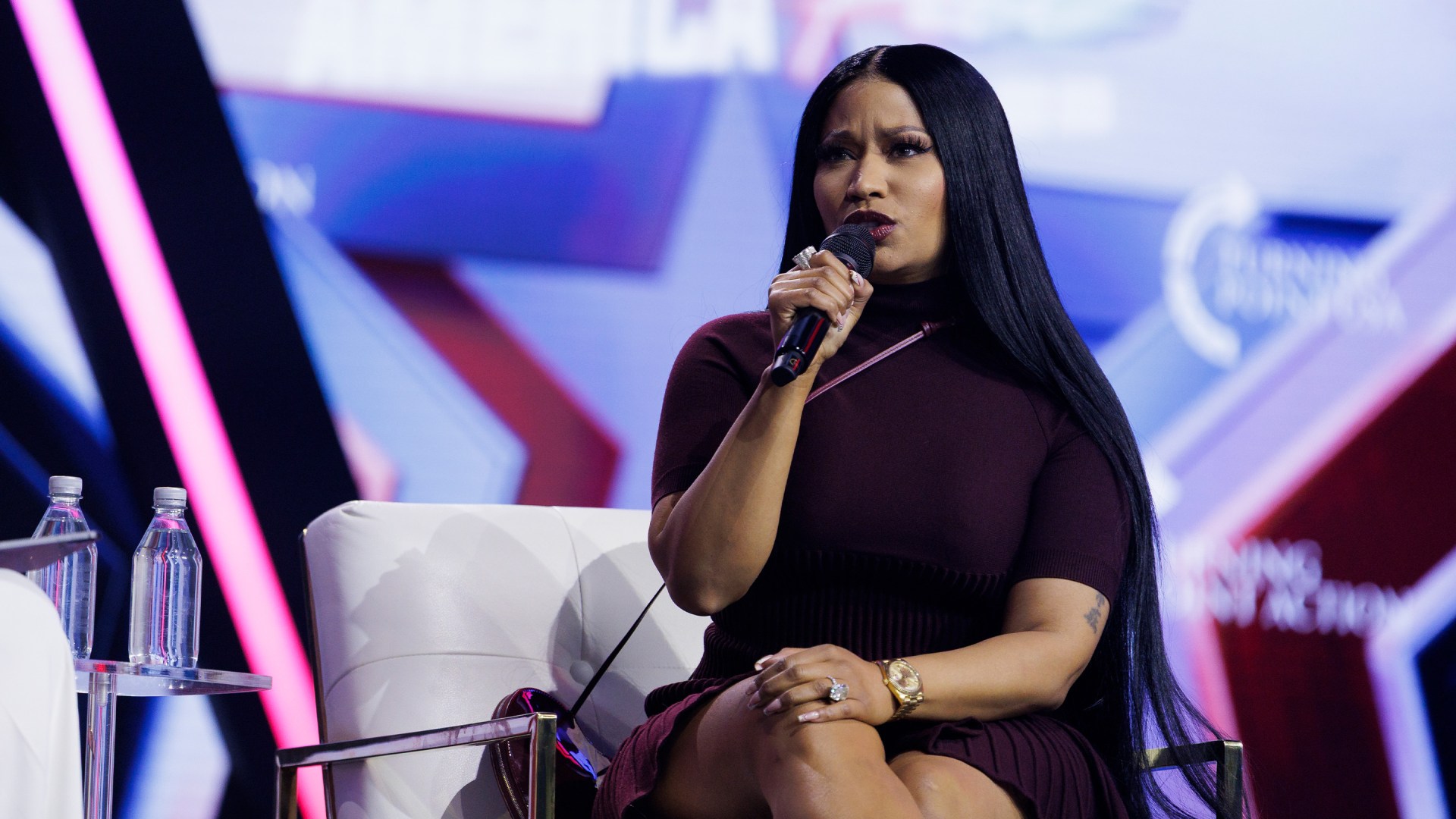
The modern right welcomed her with open arms: She exchanged compliments with Vice President JD Vance, spoke at a Donald Trump–friendly political event, and threw dehumanizing punches at media personality Don Lemon for his presence at an ill-mannered anti-ICE demonstration in a church. This week, Minaj also appeared with Trump at another event and called herself his “number one fan.” She said she is not concerned about the criticism she’s facing due to her alignment with the president. “It actually motivates me to support him more,” she added.
The problem with all this isn’t Minaj’s embrace of politically conservative principles. The Trinidadian-born rapper once had an expletive-filled one-liner in a song about voting for Mitt Romney. (She later said it was sarcasm.)
The problem is also not that she champions her faith or criticizes politicians over gender ideology—even though it is hypocritical to simultaneously promote her own debauchery-filled music. The real problem is her online taunts, middle-fingered Chucky memes, and the culture-war mentality that seems to fuel much of what she does. Her behavior is yet another sign that reveals what happens when genuine concern about social issues is formed by outrage.
related

I should say here that it’s possible everything she’s doing is part of a grift, as some have suggested. But as of right now, I’m not convinced by that theory.
Minaj, whose real name is Onika Tanya Maraj-Petty, grew up in a Christian home. It’s unclear if or where she goes to church, but she has previously pointed out she does have a pastor who leads a nondenominational ministry in Brooklyn, New York. Minaj speaks openly about prayer, baptism, and her desire to please God. She seems like she has sincere concerns about issues that resonate deeply with many believers—not just the persecution of Christians abroad and gender confusion but also the right to worship without intimidation.
These are not fringe concerns. They are real, morally serious questions, especially for Black Christians navigating a political landscape with two white-dominated parties that often treat faith as either a liability or a prop. But concern alone is not enough. Without discipleship, concern often curdles into grievance.
During an appearance last month at Turning Point USA’s AmericaFest, Minaj did not offer a comprehensive political platform or a detailed endorsement of the Trump administration’s policy agenda. The rapper had previously criticized the first Trump administration’s family-separation policy and revealed that she “came to this country as an illegal immigrant.” At the conference however, she didn’t bring up any of that.
Instead, she focused on areas of alignment with the administration—religious freedom, resistance to cultural coercion, and a shared sense of being bullied or silenced—complimented both Trump and Vance, and ignored the rest.
Omissions like this reflect the way our political culture increasingly trains participants, especially public figures, to emphasize alignment and bracket complexity. Internal critique is often framed as weakness, and complexity often seems like a liability rather than a virtue.
As a result, people amplify some of their concerns and become quieter on others, not because they abandoned those concerns but because they no longer feel speakable. Suppressing tension, however, doesn’t clarify our public witness; it only distorts it. Over time, many, including Christians, learn to say only what their tribe (or one they’re trying to belong to) will affirm.
This explains why figures like Minaj can speak passionately about Christian persecution abroad while remaining silent on policies that harm vulnerable families at home, why outrage over cultural coercion can coexist with indifference to state coercion, and why people can pair Christian language with rhetoric that dehumanizes perceived enemies.


But removing inconvenient tensions is not a problem unique to MAGA. I have similar concerns with the left, which treats dissent—especially on sexuality, race, and identity—as worthy of social exile. This very trait has been on full display with former fans of Minaj, who are circulating petitions calling for her deportation to Trinidad.
For Black Christians, the act of losing nuance can be especially dangerous. Historically, the Black church has held together moral commitments that do not fit neatly into America’s partisan binaries: a high view of human dignity alongside a strong sense of right and wrong, a demand for justice coupled with personal responsibility, and resistance to oppression in tandem with a search for reconciliation.
That tradition has always required discernment, not slogans. But discernment must be taught. And too often, it has not been.
Many churches, wary of political entanglement or exhausted by partisan conflict, have retreated from shaping consciences on public issues altogether. Others have functionally outsourced their political theology to one party or another, trading prophetic distance for access and affirmation.
But when churches fail to form believers politically—not by telling them who to vote for but by teaching them how to think Christianly about power, justice, and responsibility—the media, partisan movements, and social media often become places of discipleship and affirmation.
Minaj’s story illustrates this vividly. She does not arrive at Turning Point—or the recent event with Trump—as a policy technician or ideological theorist. She arrives as someone who feels pushed, mocked, silenced, and spiritually disrespected. And she is met not with patient theological conversations but with applause. Her anger is validated. Her “courage” is celebrated. Her complexity, however, is quietly narrowed.
The tragedy is that a community of Christians should be where someone like Minaj can bring all her convictions, examine them honestly, and refine them through Scripture and community. It should be among us that she can ask hard questions about immigration, religious liberty, gender, violence, and state power without hearing that only some of those concerns are welcome.
Unfortunately, both for Minaj and for the rest of us, these types of communities have become few and far between.
Chris Butler is a pastor in Chicago and the director of Christian civic formation at the Center for Christianity & Public Life. He is also the co-author of Compassion & Conviction: The And Campaign’s Guide to Faithful Civic Engagement.