A couple of lifetimes ago, back at the tail end of the second Bush presidency, I was working as a reporter in my rural Massachusetts stomping grounds. The small papers I wrote for had me covering pretty much everything, including area public schools.

At least in this neck of the woods, school board sessions were relatively tame affairs, revolving around the mundanities of budgets and building plans. Sometimes conversations turned testy over teacher layoffs or tax hikes, but they never felt like skirmishes in the culture wars. Townsfolk weren’t rushing the microphones with partisan diatribes, nor were board members auditioning to be the next Sean Hannity or Rachel Maddow.
Two decades later, I can’t say whether that neighborly spirit prevails. Elsewhere in the country, though, it’s not unusual to see school districts riven by ideological rancor. Angry parents make news airing grievances over curricula, library books, and transgender policies. Activist groups use their clout to pressure unobliging officials.
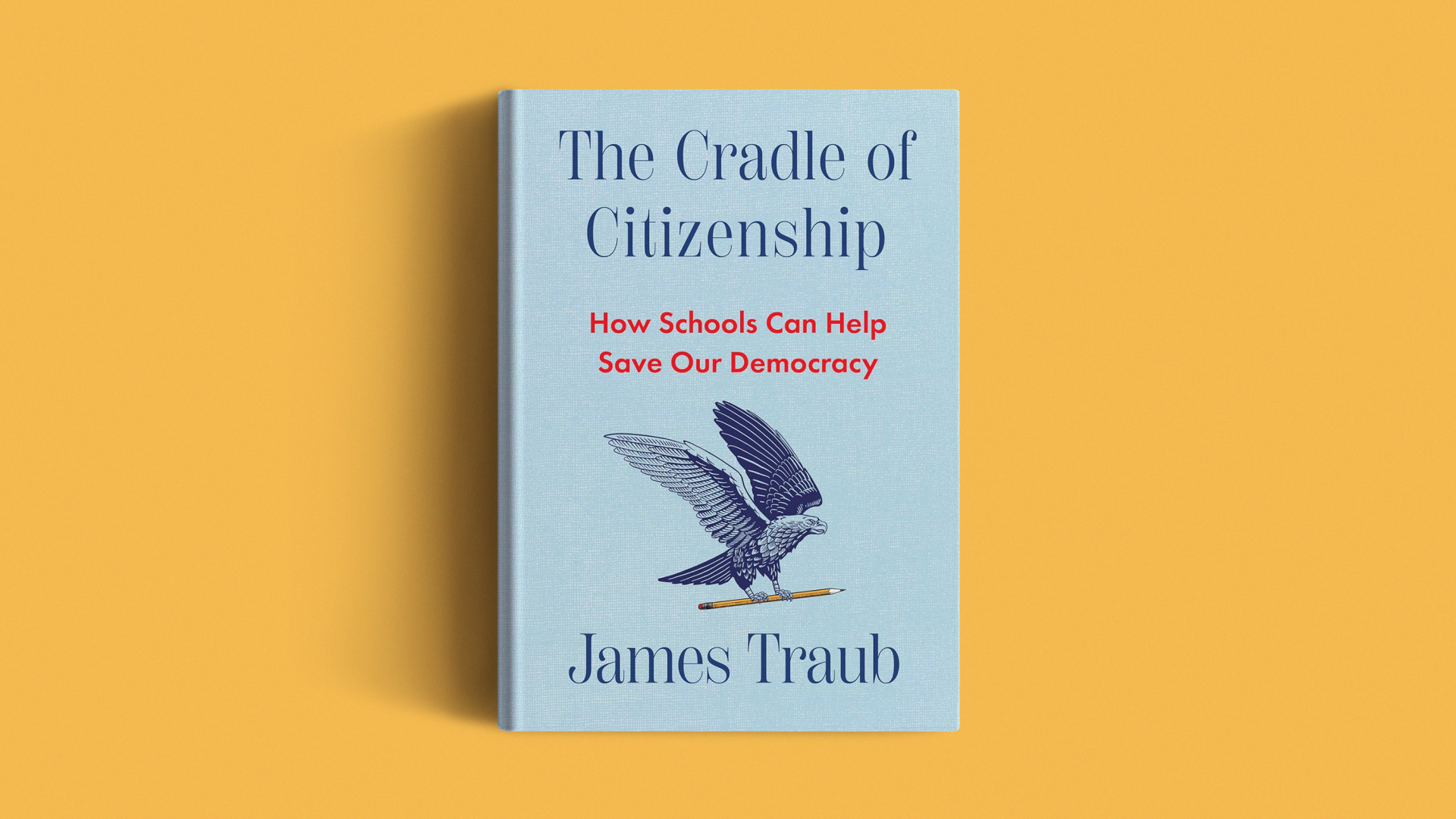
Are American public schools fated to be perpetual battlegrounds? Journalist James Traub doesn’t think so. In his latest book, The Cradle of Citizenship: How Schools Can Help Save Our Democracy, Traub—an influential voice in education policy circles—strikes a cautiously optimistic tone. Yes, he concedes, political division and acrimony can pull students and teachers into a destructive vortex. But schools can do more than merely weather these storms, he says, envisioning them as essential in reacquainting a polarized society with its better angels.
Banishing the demons, in this view, requires a renewed focus on both the doctrines and the arts of good citizenship. Traub asks how public education can inspire a better understanding of American history, a closer familiarity with the workings of American government, and more dependable habits of disagreeing without coming to blows. “Just as an increasingly coarse and intemperate culture is infecting our schools,” he writes, “so a conscious and thoughtful effort to promote civic education can help knit us back together.”


The Cradle of Citizenship combines careful reporting and trenchant analysis. Traub toggles between firsthand accounts from classroom visits across the country and broader attention to the ideas, institutions, and historical currents shaping contemporary debates about equipping students to preserve and enrich the public square. Along the way, he exposes readers to diverse perspectives on what schools should teach and—crucially—how they should teach it.
Naturally, if regrettably, a great deal of everyday education discourse tends to obsess over the whatwhile scanting the how. Ask many Americans how to improve the nation’s civics curriculum and they’ll gravitate toward specifics: more on the Founding Fathers and their glorious ideals, say, or more on the victims of state injustice and popular prejudice. Hence the fervor in so many local dustups over textbook pages devoted to this or that person or cause.
Traub pays due regard to these red-versus-blue dynamics shaping today’s educational landscape. He visits Florida, seeking on-the-ground reactions to woke-proofing projects spearheaded by the state’s governor, Ron DeSantis, as well as the backlash at schools in progressive enclaves. He covers dueling narratives of America advanced by The New York Times in its 1619 Project and the first Trump Administration’s rival 1776 Commission.
related
Speaking of Trump, Traub wastes little time tallying his offenses against civic concord. I’ll admit to wincing at the book’s introduction, which flays Trump for menacing democratic norms and peddling a cartoonishly chauvinistic brand of American patriotism.
I’m a firm, if mild-mannered, never-Trumper, so I can’t dispute this assessment, even if I would’ve welcomed more naming and shaming of the president’s left-wing foils. But Traub’s denunciations, easily swappable with a thousand others before, had me bracing for a wearying trudge down well-worn paths.
Thankfully, however, the book aspires beyond tendentious pleas to restore a consensus shattered by red America. Traub comes off as a moderate liberal, appalled by Trump but conspicuously uneasy with progressive excesses. He laments both hyperpatriotic mythology and crude revisionism, woke zealotry and anti-woke table-turning, silence on systemic racism and the dogmas of diversity seminars.
Traub cares a great deal, then, about the content of the lessons American students learn. He cares, as we all should, about whether those lessons are historically accurate and ideologically fair-minded. He advocates a civics curriculum that fortifies distinctive American ideals while honoring the diverse strains of American identity and experience.
But some of Traub’s deepest passions emerge when he looks beyond red and blue squabbles over American self-understanding. He wants to disabuse readers of any suspicion that public school teachers function as ideological foot soldiers, dutifully relaying orthodoxies handed down from on high. In his observation, “most teachers are deeply committed to keeping partisan politics, including their own, out of the classroom.” Closer to the point, he argues, other factors shape those classrooms more profoundly than what we see in the headlines.
Most important is pedagogy, the methods and goals of teaching. In its most illuminating moments, The Cradle of Citizenship presents questions more urgent—and, to my mind, more interesting—than whether to emphasize George Washington’s heroic deeds or his entanglements with slavery.
related


Like politics, pedagogy comes in conservative and liberal flavors, though often each side’s politics and pedagogy run along parallel tracks. Traub notes, for instance, the influence of Hillsdale College, whose curricular guides favor both conservative ideas (favoring limited government to bureaucratic meddling) and approaches (preferring a syllabus of “great books” to faddish modern alternatives).
Many, however, reject this kind of package deal. Traub classifies himself as a “political liberal but a pedagogical traditionalist.” He takes after thinkers like E. D. Hirsch, the author of the 1987 book Cultural Literacy who countered educational progressives and their fondness for “critical thinking” by insisting that schools should stock students’ minds with abundant stores of concrete knowledge. Throughout his book, Traub finds kindred spirits among blue-state teachers who chafe under policies discouraging paying detailed attention to demanding texts.
This pedagogical traditionalism includes an ambivalence toward philosopher John Dewey, renowned for developing “child-centered” education theories in the early-20th century. Dewey and his progressive disciples—understandably—wanted to leave behind dry lectures and rote memorization, dictated from teachers with unquestioned authority to desk-bound children bored out of their minds. Without such a shift, he worried that children would never find their place in a complex modern democracy.
Decades downwind from Dewey, Traub shows how public schools have channeled Dewey’s ideals into the work of molding mature, engaged citizens. Many schools seek to cultivate adaptable skills—reading comprehension or argument analysis—rather than presuming to transmit a foundational body of knowledge. They encourage teachers to lead with relatable discussion questions rather than a decree of books opened to page so-and-so. And they amplify civics lessons outside the classroom, organizing visits to city halls, trips to local museums and monuments, mock legislative debates, and other extracurricular supplements.
Traub never dismisses these approaches outright, and he has little patience for conservative critics who deride “action civics” as mere pretext for dragging impressionable teenagers to Black Lives Matter rallies or climate protests. He agrees that schools can meet students on their own terrain, that they can creatively make American history and government interesting and relevant.
related


Yet schools do students a disservice, he argues, when they fail to declare what young Americans should know and resolve to teach it well. If the Constitution, the Civil War, or the Civil Rights Movement seems like a tale from a dusty attic, the answer is never to stow them away. It is to empower talented teachers to return to the source materials and make them crackle.
Pedagogical progressives might protest that the purpose of discussion prompts is launching classes into the relevant material, not bypassing it. But as Traub notes, this technique only goes so far.
In one revealing anecdote, he mentions an Oklahoma City teacher who, while introducing the Constitution, invites students to pick other examples of “framers.” She’s a good teacher, and her brainstorming exercise gets the conversation humming. But the students struggle to think beyond celebrities, sport stars, and familiar historical icons like Martin Luther King Jr. “Perhaps,” Traub speculates, “they had brought a very remote idea closer to themselves.” Yet they gained only the shallowest acquaintance with Jefferson and Madison or checks and balances.
Somewhat surprisingly, Traub credits a largely red-state (and, commonly, conservative Christian) phenomenon—classical schools—with coming closest to realizing his educational vision. The classical public charter schools he visits embrace pedagogical traditionalism unapologetically, speaking confidently of truth, beauty, and virtue. They immerse students in challenging books, keep discipline tight, and minimize digital distractions. Where the public-school consensus zigs toward accommodating students’ felt needs, classical schools boldly zag.
What especially delights Traub is how classical schools succeed on terms set by educational progressives. “The child-centered pedagogy that has dominated schooling, or at least school doctrine, for much of the past century, seeks to foster inquiry, critical thinking, open discussion, and debate,” he observes, and this—not heavy-handed indoctrination—is precisely what he discovers in most classical classrooms.
related


Beneath these questions about what and how to teach American civics, though, lurks an even trickier question: whether schools should train students for citizenship in the first place.
Traub believes they should. Otherwise, why write the book? And most readers, I suspect, nod instinctively at the notion of enlisting public schools as guardians of a broad, commonly held, democratic culture.
Yet I wonder whether we’re sometimes too quick with that instinct. Civics, after all, touches on more than the bare facts of history or the mechanics of bills becoming laws. It addresses the way we order our loves and loyalties.
Christianity leaves ample space for measured, nonidolatrous attachment to earthly polities and nations. In many respects, Romans 13 commands it. Yet Christian parents are right to raise our kids to be more attentive to God’s eternal kingdom than a to single nation born in 1776.
How do public schools handle families like that? Or, for that matter, radical parents who raise their kids to see America as a wicked place? Or crunchy parents who ground their children’s identities in family farms instead of 350 million anonymous strangers?
In a big, diverse country, home to many such outlier perspectives, what entitles public schools to play arbiter? Sure, dissenting oddballs are free to indulge their beliefs at home—and free to set up rival schools teaching rival doctrines. But public schools, by nature, accept all comers. How aggressively can they evangelize nonconformists?
As it happens, I align with Traub more than the previous paragraph might suggest. I believe public schools should make efforts, however modest and circumspect, to uphold a common American identity, one grounded in appeals to liberty and the pursuit of happiness—one that itself implies a freedom to inhabit other, weightier identities.


But no civics program can (or should) resolve every last dispute about our renderings unto Caesar. We all benefit from principled educational pluralism, with a healthy assortment of schools—public, charter, private, and home-based—serving the common good by leaning into their peculiarities, not flattening them. Like the Dutch Reformed thinker Abraham Kuyper, I don’t regard the resulting mosaic as a reluctant sigh of squishy relativism. I recognize it as the hand of God’s common grace governing his world.
Traub acknowledges the folly and futility of demanding educational uniformity, and he does “not believe our wildly heterogenous society can be shoehorned into a single kind of school or curriculum.” Yet he clearly places a higher premium on strengthening public schools than letting alternatives flower. Public education, he approvingly writes, “is the only social institution that operates on all citizens and does so from early childhood to the edge of adulthood. School is a powerful civic force whether we wish it to be for not.”
With its deliberate focus on the civic aims of public schooling, The Cradle of Citizenship never intends to reckon with the civic value of schooling in all its forms. The full implications of educational pluralism—and brass-tacks matters like vouchers and parental choice—lie mostly beyond its scope. That said, I hope readers on all sides of these debates can appreciate its able defense of a public-spirited pedagogy that steers clear of tribalistic ditches.
Matt Reynolds is a writer and a former CT editor. He lives with his wife and son in the suburbs of Chicago.