At dawn one morning in the spring of 2000, Jibrin Abubaker awoke with a start to the voice of a street preacher speaking through a megaphone outside his window. The 23-year-old, who was on a business trip in Jalingo in Nigeria’s Taraba State, initially felt annoyed to have his sleep disturbed.
Yet he listened as Daniel Dangombe, then pastor of a United Methodist Church in Nigeria, declared that Jesus was the only sinless person to walk the earth. “I used to wake up every morning [of the business trip] to listen to him,” Abubaker recalled. “From his preaching, my conversion started.”
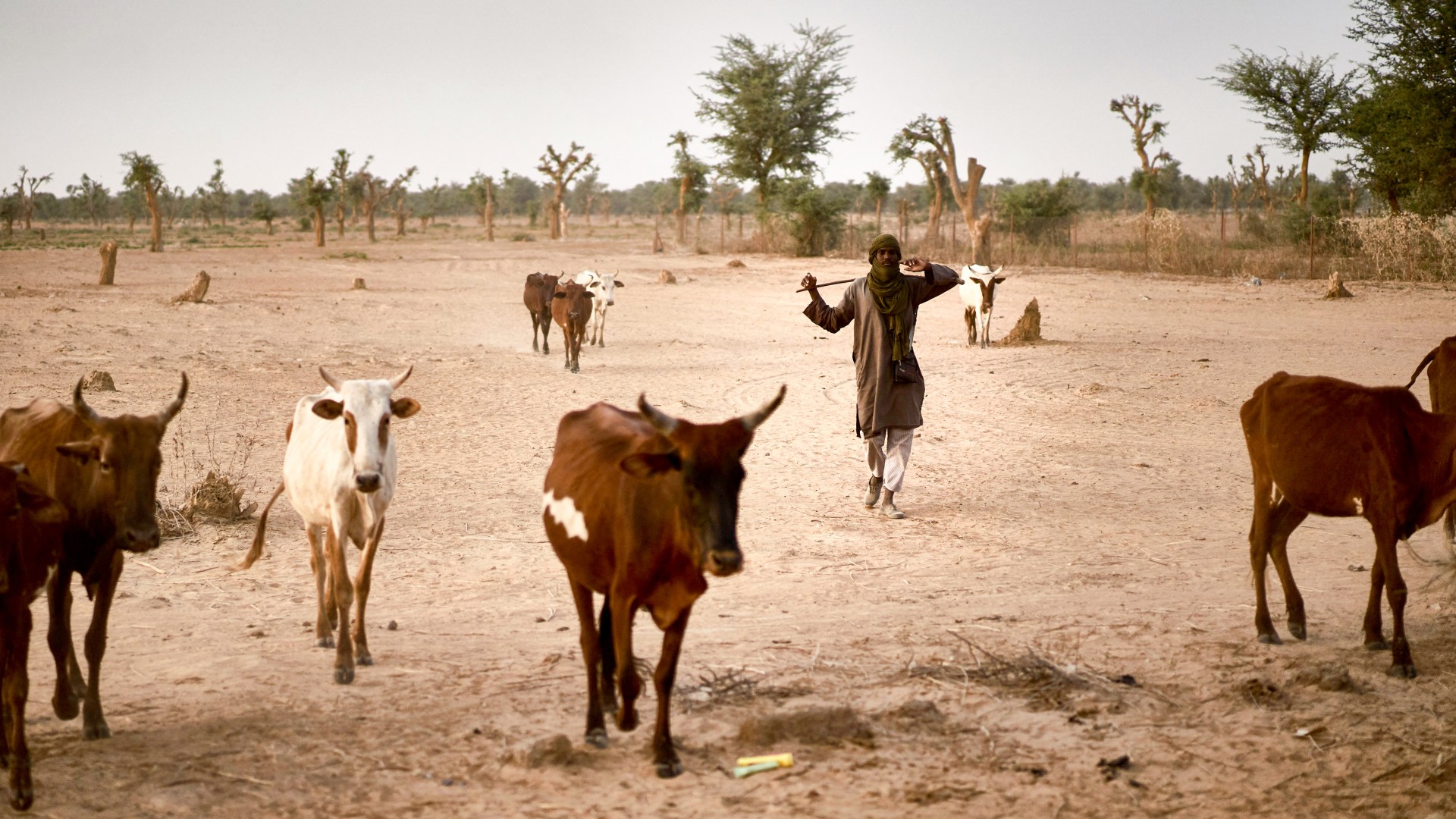
Abubakar grew up in a Fulani Muslim family in Daura, a town in Katsina State in northwest Nigeria. Like most Fulani men, he came from a family of farmers and cattle herders. Yet Abubakar’s father didn’t want his only son roaming with the cows, so he enrolled Abubakar in an Islamic school. Abubakar said the teachers there taught him to recite the entire Quran and hate Christians.
“They said it was wrong for us to offer Christians a handshake or eat with their plates,” he told CT. “They were unholy—relating with them was an abomination.”
No Christians lived in Daura then, according to Abubakar. He only began to understand Christianity after hearing Dangombe’s preaching in Jalingo and meeting two Christians, Tevi and Peter, when he searched for Dangombe but couldn’t find him. First, he saw Peter holding a Bible and approached him, then Peter introduced him to Tevi, a Christian evangelist who could better speak Abubakar’s language. Two years later, during another business trip to Jalingo, Tevi and Peter answered his questions about Jesus, leading him to become a Christian.
But changing his religion meant losing his community.
Fulani who convert to Christianity face “extreme discrimination and deadly violence” from their community, according to International Christian Concern. They also face skepticism and isolation from Christian communities. Because of the historical hostility between Fulani Muslim herders and Christian and animistic farmers, Fulani Christians often find themselves caught between their culture and their faith. Of the 17 million Fulani in Nigeria, 99 percent are Muslims—less than 1 percent are Christians.
When Abubakar converted to Christianity, he didn’t tell people about new faith right away. He explained the gospel to his wife, who also became a Christian, but otherwise kept quiet. Still, his actions exposed him. He said he stopped attending Islamic daily prayers and reciting the Quran and instead started attending Evangelical Church Winning All (ECWA), a new congregation of mostly out-of-town, non-Fulani traders and businessmen. He also quit womanizing and seeking revenge when others insulted him.
Abubakar said his in-laws demanded his return to Islam. When he refused, they took his wife and three daughters—then 7, 3, and 1. Abubakar recalled they married off the eldest girl at 12-years-old as the second wife of a Muslim man in his mid-20s. She died in childbirth at age 16. He said he recovered his younger two daughters a few years later but never saw his wife again.
The Muslim community “eventually took everything I owned. My wife, children, house, cows. Everything,” Abubaker said.
Abubakar’s father didn’t confront him about his conversion until members of the Izala society, a powerful Salafi (conservative, reformist movement with Sunni Islam) organization that fights against shirk (unbelief) and operates under sharia law, put pressure on him.
“The Izala guys saw me regularly attending the church,” Abubakar said. “They wondered why a Fulani was going to the church.”
One Sunday in 2008, the Izala whisked him away from church, locking him up in a small, dark police cell for five days. A non-Fulani Christian policeman snuck him bread through the tiny window at midnight, Abubakar told me.
The legal system didn’t protect Abubakar. The Izala took him to the chairman of the Mai’Adua local government area. The head of Daura village, Abubakar’s father, and two other men asked him to denounce his faith. He refused and instead preached the gospel. They then took Abubakar to a sharia court. The judge gave him three days to reconsider. Abubakar’s family and community labeled him an apostate.
Then Abubakar said a relative attacked and threatened to kill him. The next day, a neighbor warned his father of another pending attack, forcing Abubakar to flee to Jalingo with the help of ECWA church members. He sought refuge with Tevi, his Christian friend from the Tiv tribe, and stayed with him for seven years.
Tevi’s hospitality was an exception, Abubakar explained. Because of the violence many Nigerian Christians have experienced from Fulani herders and Islamic extremists, whether over farm resources or religion, Abubakar said many fear Fulani converts are spies trying to infiltrate churches and feed information back to those who wish to harm them.
Joshua Irondi, the senior pastor at International Revival Chapel in Aba, southeastern Nigeria, works with missionaries to the Fulani in the north. He said the gospel is for everyone—regardless of tribe—and that missionaries shouldn’t write anyone off.
“But with the way things are right now, you don’t just see someone on the road and feel comfortable with them,” Irondi said.
Though urban Fulani in Nigeria are more widely accepted and hold high positions in business and government—Nigeria’s late president Muhammadu Buhari was a Fulani from Daura—many Nigerian Christians see nomadic or seminomadic Fulani herders as entangled with terrorists.
Last June, heavily armed Fulani jihadists attacked Yelwata, a farming community in Benue State, slaughtering an estimated 100–200 Christian villagers. According to a 2023 study, more than 60,000 people died when Fulani herders clashed with farmers between 2001 and 2018.
Manasseh Adamu, pastor of an ECWA branch in Zonzon, Kaduna State, north-central Nigeria, has seen the trauma up close. He said residents are sometimes reminded of past pain at the sight of the Fulani herdsmen.
Still, Adamu calls for the church to open its doors: “When people come to us [and say] that they are Christians … we should accept them.”
Abubakar said some Christians began avoiding him when conflict between the Fulani herdsmen and farmers peaked in 2018, even though he had already been a Christian for 16 years by then. He acknowledges the violence perpetuated by the jihadists. Still, the stigma against Fulani Christians grieves him.
Abubakar encourages Christians to welcome them and first listen to their stories. He hopes that if more Christians understood the Fulani and built relationships with them, the violence could end and more Fulani would hear the gospel.
Olu Sunday, president of Royal Missionary Outreach International in Nigeria and Niger, told CT that weak government responses and radicalization have compounded deadly violence and cycles of attacks. He said missionaries are among the few willing to risk building relationships with the Fulani, adding that “they still have open doors in [the Fulani’s] hearts and communities.”
However, Sunday said the Fulani people’s traditional migration lifestyle makes evangelism and discipleship challenging. “Sometimes you get a convert; the next minute they are thousands of miles away,” he noted. “Follow-up is very difficult.”
Abubakar, now a 49-year-old church planter with Calvary Ministries (CAPRO), lets the Fulani come to him. He said he spends time during the week at a veterinary clinic where Fulani herders come to treat their ailing cattle. Herders ask him how he can be both Fulani and Christian.
“From there, a relationship begins,” Abubakar said. He shares the gospel one-on-one when he can.
On Sundays, Abubakar gathers with 12 other Fulani and Hausa—another primarily Muslim tribe—Christians in his church plant in Kishi, where they have created a new community after facing isolation and abandonment by many in their lives. Abubakar said that after losing everything to follow Jesus—only to face rejection and stigma from other Christians—many Fulani converts are tempted to return to their families and Islam to survive.
“The worst thing would be for them to go back,” Abubakar explained. “Sometimes that is the only option they are left with.”