This piece was adapted from the Mosaic newsletter. Subscribe here.
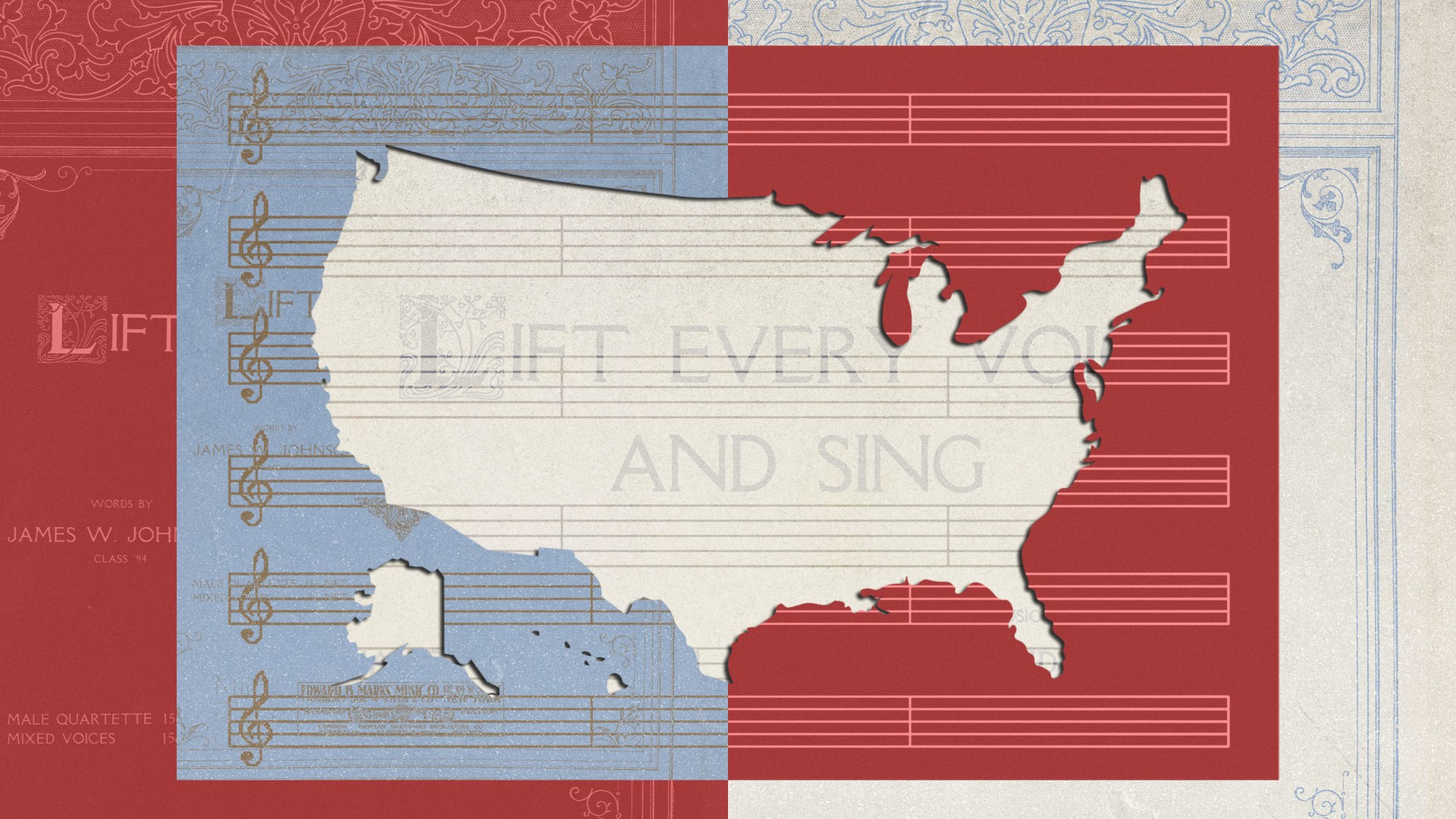
The hymn “Lift Every Voice and Sing” has officially been drafted into the culture war, becoming yet another prominent symbol of the political and racial divisions in the US.
For those who might not be aware of the ongoing controversy, here’s some background: The iconic hymn was composed in 1900 and has long been recognized by African Americans as a solemn yet hopeful anthem of our story. For more than a century, the song has been an integral part of Black culture. It then experienced a cultural resurgence of sorts in recent years, being sung at marches, concerts, and prominent football games, including the most recent Super Bowl.
Like almost every other cultural symbol and topic that has to do with race, the song’s growing presence quickly created fissures along racial and political lines. Some people on the left see it as a symbol of political resistance. On the right, many believe the song, especially when sung before or after the national anthem, divides the country and inappropriately draws attention to the nation’s troubled racial past during moments of civic pride.
But anyone who pays close attention to the hymn knows both views have flaws. The “Black national anthem,” as it is commonly known, is a song of gratitude, resilience, and covenantal memory. It speaks of faithfulness through suffering, of discipline through adversity, and of loyalty to a God who “has kept us thus far on the way.” It was not composed as a protest song and does not rage against the nation. Instead, it is a hymn of prayer for America to live up to its highest ideals and of praise for the considerable distance we have come on that long journey.
“It’s America’s music,” musicologist Naomi André said two years ago while discussing a federal bill that unsuccessfully sought to recognize the song as a national hymn. “If it were only sung by Black folks, then it would be limiting. This is music that’s not meant to divide people. In fact, it’s just the opposite: It’s about bringing people together.”
I agree with André. If the song is embraced by all Americans, as it has long been by a subset of the population, it could be one drop in a vast sea of changes that could inch us closer to reconciliation. I am not proposing that “Lift Every Voice and Sing” be designated as a co-anthem or displace any existing national symbol. But there is room within the rarified opus of deeply American music for one more song to be widely sung and shared.
For the hymn to serve as a bridge, however, sacrifice will be required from more than one side. Those who have come to love the song would need to allow it to belong to a broader audience and see it not as a partisan or ideological emblem but as a shared inheritance. They would also need to trust that allowing it to be an American (instead of a merely African American) song does not dilute its history.
On the other side, those who instinctively resist what they perceive as cultural displacement would need to embrace a hymn that’s not ingrained in their collective memory. They also need to see that the song does not champion splitting America into two nations. Instead, it draws us deeper into national unity by doing the almost impossible task of acknowledging suffering without denigrating the country.
It’s rare to see people lay down their arms like this in politics and culture. But it’s something our country needs to practice if we truly want a healthy public arena.
related


In some ways, the story of the song offers a model we can follow. The hymn was created by two brothers who had differing religious views but still worked together toward one goal.
James Weldon Johnson, who wrote the lyrics, grew up in a Christian home and later described himself as agnostic. Still, he was influenced by Christianity and wrote words that were filled with faith and hope. Meanwhile, his brother, J. Rosamond Johnson, composed the music and remained deeply rooted in the Black Protestant heritage.
The result is something remarkable: The song moves easily in secular spaces while carrying unmistakable biblical themes. The NAACP adopted it in the early 20th century, and it was sung in Black churches, civic gatherings, school assemblies, and movement meetings as a hymn of endurance and aspiration. The song offered theology without coercion and exemplified the kind of contribution biblical Christianity has historically made to American public life—not through domination but by helping us embrace new ways of thinking.
If you’re convinced so far, you might be wondering how exactly a song becomes part of America’s musical canon, at least culturally. What history shows is that it doesn’t happen too often, and it’s also not always immediate.
Take the national anthem: The 117-year journey of “The Star-Spangled Banner” from wartime poem to America’s official song was neither instant nor inevitable. Francis Scott Key wrote the verses in 1814, but the song did not become the official anthem until 1931. Its elevation unfolded gradually—through deep appreciation, popular adoption, and eventual political recognition.
Then, there are other songs that have helped define the American soundscape: “Hail, Columbia,” “My Country, ’Tis of Thee,” and “America the Beautiful.” None of them has erased the others. But each has added its own layer of meaning to our country’s evolving story. In the same way, we can add “Lift Every Voice and Sing” to the list.


Apart from its history, one reason I love the hymn so much is that it refuses despair—which is something our country, and even we as Christians, sorely need right now. We have become skilled at narrating our grievances, but less so at showing gratitude. We are fluent in accusation, but we lack shared aspirations with others, especially those with whom we ideologically disagree. This path, however, is not sustainable. A nation cannot indefinitely endure on critique alone. It must also cultivate thanksgiving and resolve among its people.
If America is to be more than a marketplace of grievances, we will need common practices that do not require total agreement. Singing together has historically been one of those practices, and singing this song together would require us to admit something humbling: that America’s story includes both glory and grave injustice, both aspiration and failure.
The hymn would require some to sing of a “dark past” they’d rather sanitize, minimize, or forget. It would ask others to sing about a turning of the page and the start of a hopeful “new day” in America that’s not defined by the horrors of our past. In an era of constant division, accomplishing that would be no small thing.
Chris Butler is a pastor in Chicago and the director of Christian civic formation at the Center for Christianity & Public Life. He is also the co-author of Compassion & Conviction: The And Campaign’s Guide to Faithful Civic Engagement