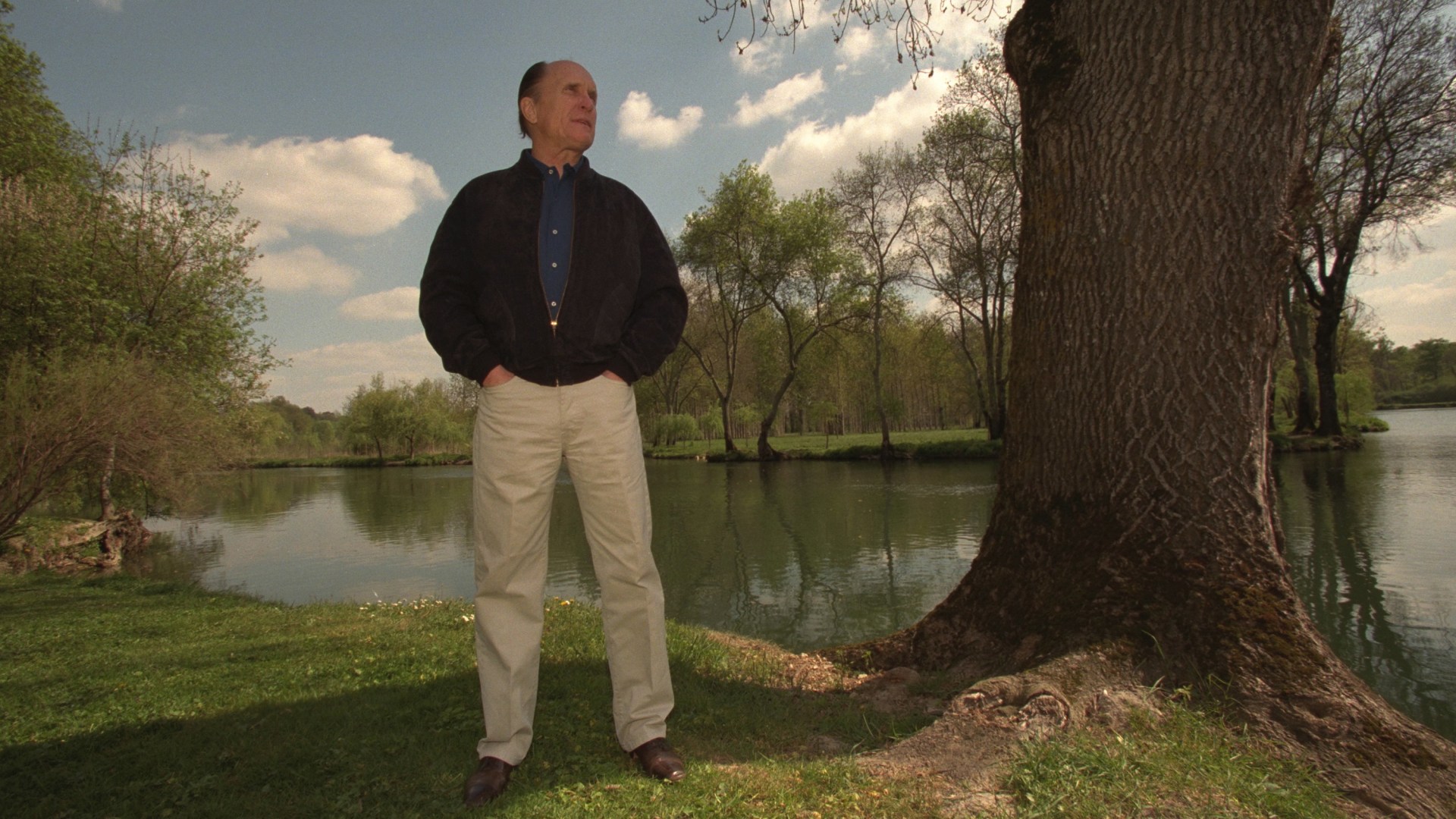
Robert Duvall died last week at the age of 95. An acting legend, he starred in memorable roles in classic films, such as The Godfather and Apocalypse Now. But Duvall was also an expert interpreter of American evangelicalism.
His 1997 film The Apostle, which he wrote, directed, and starred in, was far less popular than Francis Ford Coppola–directed blockbusters, and it almost wasn’t made. Duvall ended up spending $5 million of his own money to produce the film after initially failing to land Hollywood interest. I’m glad he forged ahead. For me, as a historian of American religion and someone who grew up in Southern evangelicalism, The Apostle remains a powerful example of how filmmaking can treat a religious subject with critical empathy.
The film centers on Sonny, a Pentecostal revivalist and pastor played by Duvall. Sonny has a successful preaching ministry and oversees a large church in southeastern Texas. He is also married to Jessie, played brilliantly by Farrah Fawcett, with whom he has two young children. Sonny discovers Jessie has been sleeping with a fellow minister and has orchestrated a takeover of the church, effectively removing him from leadership. He gets drunk and shows up to his son’s baseball game, whereupon he flies into a rage and, in a shocking scene, assaults his wife’s lover with a baseball bat. (We learn later the lover dies from his injuries.)
Sonny then goes on the run from the law. Ditching his car in a river along the way, he baptizes himself and takes the name Apostle E. F. He winds up in a rural Louisiana town and announces his intention to start a new church. The church welcomes both Black and white residents, becoming a site of belonging for townspeople on the margins (including the now-famous Walton Goggins in one of his first roles) and receiving the ire of a local white supremacist (played by Billy Bob Thornton). Sonny rebukes the racist, inspires his church community, serves those who are in need, and seems to have remade his own life and ministry in a humbler, gentler style. But eventually he is found out. He preaches one last sermon, then gives himself up to the police who wait outside the church.
What is most striking about the film is not the plot or even the rich character studies; instead, it’s Duvall’s depictions of Pentecostal worship and sophisticated explorations of Southern evangelical ministry and practice. Duvall not only acts well in the film, but he also cast and surrounded himself with actual Pentecostals.
“I didn’t want to come in and tell them what to do. I wanted them to show me what they do,” Duvall later said. In the film, he literally hands these men and women the microphone, and they preach, pray, and worship on camera as they would any given Sunday. Unlike most Hollywood depictions of evangelical faith, The Apostle’s “qualified realism,” as Patton Dodd has put it, lingers on the preachers and congregants in these moments, showcasing the beauty and rhetorical power of radical evangelical preaching and worship.
Sonny himself embodies evangelicals’ dispositions and ministry style. This is all the more remarkable given that Duvall hailed from a very different background, that of Christian Science. Yet he understood the weight and internal logic of classic evangelicalism.
This is clear in the film’s first few minutes, when Sonny and his mother (played by an elderly June Carter Cash) come upon a car wreck on the side of the road. Duvall runs to the crashed vehicle, Bible in hand, and prays with the seriously injured young driver. “I want you to know the Lord loves you,” he tells the man, before asking him to pray in his mind and ask Jesus into his heart so he might go to heaven. The man, in shock, barely able to speak and possibly on death’s door, nods in agreement with Sonny’s exhortations and whispers, “Thank you.”
On paper, this scene probably shouldn’t work. Indeed, it is fashionable to criticize American evangelicals for moments like these, where an individual’s simple moment of decision, offered as a kind of “get to heaven and out of hell” card, overlooks the much more expansive vision of the Christian life in its practical, communal, and complex fullness. Many evangelicals and ex-evangelicals alike have been burned by exactly this kind of exhortation, laser-focused on the afterlife, to get right with God by asking Jesus into your heart. But The Apostle shows in this moment the deep power of evangelical faith for confronting the most wrenching of horrors, even death itself. It doesn’t matter if you have never thought a wit about God; when the chips are down, Jesus stands ready to receive you still.
God can do it for the man in the car. And, the film suggests, God can do it for Sonny—though whether he accepts that call is another matter. In Duvall’s hands, the evangelical conversion experience is something to be not lampooned or deconstructed but marveled at.
At the same time, The Apostle showcases evangelical violence and harm. This is true not only of Sonny’s deadly assault on a fellow minister but also of his relationships with others, especially women. Though he rages against his wife’s infidelity, Sonny admits he has been unfaithful himself. He also pursues a younger woman later in the film, trying (though never succeeding) to sleep with her. Sonny might be a skilled preacher with a remarkable church, but as my students have said to me when I show them the film, he is also a major creep. And given his own dishonesty and reluctance to disclose his past, it’s not a stretch to say his entire ministry is built on lies.
Sonny’s ongoing sinfulness, as well as the fact that he never takes responsibility for it, indicates that this is not a simple story of redemption, a term that comes up time and again in early reviews of the film. But I don’t think that is quite right. Duvall clearly understood something about the constant temptations evangelicals face in the realms of sex and worldly power—and in the flexibility of evangelical self-definition, of never having to say sorry.
I have often wondered whether the marketers behind the film hoped evangelical audiences would overlook this fact, given that some of the movie’s promotion branded it as a feel-good, redemptive Christian story, with Steven Curtis Chapman as the lead single on the soundtrack to boot.
Though some viewers may see the story as pro-Christian propaganda, and others as a takedown, The Apostle is a powerful film that holds up because it doesn’t try to escape these tensions. It offers a mirror: Evangelicals are Christians with spiritual gifts to offer a hurting world, and they are sinners with their own temptations and patterns of corruption. Duvall gave us a gift with The Apostle, not because it celebrates or bashes evangelicals but because it shows us as we are.
Aaron Griffith is Assistant Professor of American Church History at Duke Divinity School. He is the author of God’s Law and Order: The Politics of Punishment in Evangelical America.