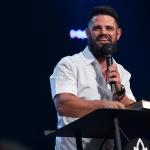
Elevation Church—a multisite megachurch founded by Steven Furtick and based in Matthews, North Carolina—announced the launch of Elevation College in November 2025. The new hybrid institution is for “traditional college-aged students who feel called to ministry and want to earn an accredited degree” while receiving onsite training and experience at the church. Elevation College plans to welcome its first class of students in fall of 2026.
Students who attend Elevation College can live in on-campus housing and participate in practicum courses at Elevation Church, but the degrees will be granted by Southeastern University (SEU), an Assemblies of God–affiliated institution based in Lakeland, Florida. The college will offer both two and four-year degrees, including an associate’s degree in ministerial leadership, a bachelor of science in worship ministries, a bachelor of science in biblical studies, and a bachelor of science in production ministry. According to the Elevation College website, the yearly cost of attendance (including tuition, a site fee, and housing) will be a little over $19,000.
Steve Saccone, vice president of the SEU Ministry Network, told CT that the launch of Elevation College follows years of collaboration between the two organizations.
“We believe that there’s nothing like hands-on experience. If you want to be a leader, you have to lead something,” Saccone said. “We feel like we’re restoring that vision, of embedding academics in the local church.”
SEU has been offering distance coursework for Elevation staff for several years, and Elevation’s production team recently helped the university build a new digital production class for SEU students. According to Saccone, Elevation approached SEU about developing an accredited degree program to supplement its existing apprenticeships and internships.
Elevation currently has 19 campuses and had an average 17,373 weekly in-person attendees in 2024. Until 2023, Elevation was a member of the Southern Baptist Convention. It left just after two other congregations were expelled over female pastoral leadership, but it did not publicly state the reasons for its departure.
Its partnership with an Assemblies of God university demonstrates the softening of some long-standing divisions between Pentecostal-charismatic churches or networks and conservative Reformed or Baptist organizations. Both SEU and Elevation are influential institutions in the worship music industry, and their partnership is an example of the ways contemporary worship music and the subculture around it has become an ecumenical space where new alliances are taking shape and gaining power.
Elevation Worship, Elevation’s influential worship artist collective, became a dominant force in the worship music industry in the early 2010s. The group’s 2021 collaborative album with Maverick City Music, Old Church Basement, won a Grammy. Its most recent album, So Be It, features prominent worship artists Brandon Lake, Chandler Moore, and Leeland Mooring. In 2024, Elevation Worship’s music had more than 2.3 billion streams across platforms and 161,243 people attended its “Worship Nights” tour.
SEU has its own popular worship music collective in SEU Worship. The group includes SEU students, alumni, and staff and is signed to Essential Worship (a Sony label). It has over 2 million monthly listeners on Spotify and was part of the 2025 Winter Jam tour. SEU alum Tiffany Hudson is now one of Elevation Worship’s lead vocalists.
For both Elevation and SEU, the worship music production affiliated with the institutions helps attract attendance and raise public profile. The millions of livestream viewers of Elevation Church’s services have access to professionally produced musical worship and high-energy performances. Students interested in a college where they might get to participate in the production of new worship hits may consider SEU because of the success of its worship collective.
Service production, trendy worship music, and the popularity of lead pastor Steven Furtick have made Elevation an attractive church home for young Christians who are looking for cultural relevance and emotional intensity. Nearly 8,000 volunteers serve across its campuses on a weekly basis—a large pool of potential students who might be interested in earning a degree or taking a class as they contribute to weekly operations.
SEU has helped other churches turn their existing volunteer arrangements, apprenticeships, and internships into degree programs. In 2022, it established a degree-granting site at The Belonging Co in Nashville (another megachurch with a worship team turned artist collective that produces its own worship music). It also helped establish degree programs and distance learning partnerships at Vous Church in Miami, Impact Church in Phoenix, and Bayside Church in Sacramento.
According to Saccone, these church partnerships take shape organically, relying on relationships rather than denominational affiliations. The biggest share of SEU’s church partners are affiliated with the Assemblies of God, but they also work with Baptist, nondenominational, and (Association of Related Churches) ARC congregations.
“We want to partner with the local church,” Saccone said. “We’re not going around policing theology.”
One selling point of the programs SEU establishes in local churches is that the degrees cost less than traditional bachelor’s degrees from residential private schools. Another is that they allow students to pursue ministry training in the context of the church they want to attend and maybe work for in the future. This kind of context-specific training has value and limitations, say some educators.
“Church is a great place to get discipleship and leadership training, but it’s not always a great place to improve musicianship,” said Casey Corum, a producer, songwriter, and instructor at Biola University. Corum works with undergraduate students pursuing degrees in music and has worked closely with Vineyard Worship. He says there are tradeoffs students should consider when looking into degree programs that are so closely tied to a particular church.
“When it comes to music ministry training, I see a lot of value in going to a college or university where you’ll be in classes with the best musicians from all over. You get a different breadth of peer relationships and exposure to different traditions,” Corum said. “I would hope that a worship training experience would provide some depth of training across genres and styles of music.”
But Corum also noted that students interested in a music degree have good reason to consider less-expensive options like Elevation College. For a church musician who doesn’t have aspirations to play with the New York Philharmonic, in-house training can be a good fit and provides specific instruction and spiritual support that one wouldn’t receive in a traditional (and far more expensive) conservatory-style music program.

He also pointed out that, for young people attracted to contemporary worship music and the churches and collectives that have become its standard bearers, Elevation College may be the ideal place to study ministry, especially in areas like music and production.
“The model Elevation is teaching toward is transferable, to an extent,” Corum said. Because Elevation’s music has been so widely used in American churches for over 15 years now, its ministry model and musical style both reflects and shapes worship practices outside its 19 campuses.
Worship Leader Research (WLR), a collaborative of scholars and practitioners studying trends and influential producers in the worship music industry, refers to Bethel, Hillsong, Passion, and Elevation as “The Big Four” but argues that only Elevation has managed to build momentum and grow in musical influence during the first half of the 2020s, while it appears the reach of the other three is waning.
According to Saccone, Elevation College received hundreds of inquiries from interested students in the months after the church announced its program launch. The number of students admitted for fall 2026 hasn’t been made public yet. Students entering the program this fall will be taking online classes paired with practicum work. Elevation College has not yet received approval from the state of North Carolina to allow SEU to hire adjunct faculty to teach in-person classes onsite.
The past five years have seen a wave of closures of small Christian colleges across the country, but SEU is bringing its degree programs to students in a format that is more experiential than exclusively online programs and more reputable than dubious unaccredited programs such as the now-defunct IHOP University. SEU’s church partnerships are an experiment in lower-cost, hybrid ministry training and theological education. It may be that megachurches are the future of Christian higher ed.