Andrée McDonald was 48 years old and losing her battle with uterine cancer when she chose to end her life through euthanasia. Her husband and parents found out about her decision on a Friday. By Monday afternoon, she was gone. A doctor had administered lethal drugs through an IV, causing McDonald’s heart and lungs to stop. About an hour after she died, her husband told their two teenage boys what had happened. Andrée did not want them to know she had chosen euthanasia, but her husband insisted that they know the truth.
In Canada, where Andrée lived, her decision is officially called Medical Assistance in Dying, or MAID. Her parents call it “state-sponsored execution.”
“I watched her die,” her father, Roderick McDonald, said. As Andrée left this world, he told her repeatedly that Jesus was with her. Andrée’s mother, Louise McDonald, was not present. The couple is Catholic, and church teachings call euthanasia “a crime against human life.” Catholics are not permitted to witness death by euthanasia, the process by which a medical professional directly administers a fatal dose of drugs to a patient.
Andrée’s doctors said she had nine months to live when they diagnosed her cancer in 2018. She underwent radiation and lived for two more years. But when the cancer came back with a vengeance in 2020, the outlook was grim. So was the hospice care landscape. Andrée wanted to leave the hospital and receive palliative care at home, but the COVID-19 pandemic meant nurses could not enter the family’s house.
The McDonalds say their daughter had bipolar disorder but was not receiving medication for her mental illness when she chose to end her life. Her doctors were concerned about drug interactions.
Roderick, a retired English teacher, once wrote poetry about his little daughter splashing on the beach in her Wonder Woman bathing suit. After Andrée’s death on November 30, 2020, he wrote about watching her die.
I am left with a death mask,
and my beautiful daughter’s
porcelain body.
The room is empty.
They have skittered
like rats.
Since Canada legalized euthanasia a decade ago, the movement has quickly picked up steam, with some describing it as a runaway freight train. Assisted suicide now accounts for 1 in 20 Canadian deaths. This year, the country is expected to reach a total of 100,000 people killed through the program since its inception.
Originally permitted only for people with terminal illnesses, the country’s MAID policy was expanded five years ago to include chronically ill or disabled Canadians who weren’t dying. Next year, Canada plans to allow those with mental illness to be euthanized. Furthermore, a vocal group within the country is campaigning to allow “mature minors”—also known as children—to legally die by assisted suicide.
Euthanasia is legal in a handful of other countries, including the Netherlands, Spain, and most of Australia, but the related practice of physician-assisted suicide has expanded faster. With physician-assisted suicide, a doctor prescribes the lethal drugs, but the patient must self-administer them.
Canada allows both forms of suicide and has increasingly become a poster child for these programs. Some lawmakers in other countries have looked to the North American nation as a cautionary tale, even as arguments in favor of assisted suicide—described by proponents as “death with dignity”—gain momentum. Currently, some form of assisted suicide is legal in nearly a dozen countries, most of them in Europe, as well as 11 US states and Washington, DC. More than a dozen other states are considering legalizing physician-assisted suicide.
Many Christians spoke out against assisted suicide in the 1990s when Dr. Jack Kevorkian became a household name for participating in dozens of suicides in Michigan. Since then, evangelical passion against assisted suicide seems to have waned. While evangelicals have left a void in many public spaces regarding end-of-life issues, the Catholic church has often stood in the gap. As more states and countries consider legalizing the practice, believers must raise their voices together in defense of life.
Christians who oppose assisted suicide affirm that life is sacred. God created human beings in his image (Gen. 1:27), and we do not have the right to destroy ourselves or each other. Theologian Brad East wrote for CT,
The church’s moral teaching has always held that murder—defined as the intentional taking of innocent life—is intrinsically evil. It follows that actively intending the death of an elderly or sick human being and then deliberately bringing about that death through some positive action, such as the administration of drugs, is always and everywhere morally wrong.
Christianity also holds a countercultural view of suffering. As people who worship a Savior who willingly suffered and died, Christians are called to endure suffering and to love and care for those who suffer. Autonomy is not a Christian word. Rather, we are called to radical interdependence as we walk the narrow path toward eternal life, where suffering will cease to exist.
Fighting assisted suicide naturally lines up with the pro-life views many evangelicals are known to champion. But these days, the Catholic church is arguably the most consistent voice in the fight against euthanasia and other forms of suicide.
A June 2025 Catholic Herald headline declared, for example, “Christian churches are shamelessly leaving Catholics to fight alone against UK’s assisted suicide Bill.” The article took aim at Anglican, Baptist, and Methodist leaders in the UK for not fighting hard enough for life.
However, there was some evangelical opposition to the UK bill, which passed in the House of Commons last year. The measure is still under debate in the House of Lords, which can amend or delay the bill but cannot override it.
The policy is “the biggest proposed change to our social fabric in a generation,” said Gavin Calver, CEO of the UK-based Evangelical Alliance. He further warned that it would normalize suicide as a positive choice and place “the most vulnerable at risk of abuse and coercion.”
But the pro-life message is not the only one coming from churches in the UK and elsewhere. Many churchgoers support assisted suicide, which has been framed by some church leaders as a compassionate Christian choice. In the UK, the group Dignity in Dying has the support of George Carey, the former archbishop of Canterbury. “Doing whatever we can to relieve needless suffering and bring peace is a profoundly Christian act,” Carey said. (He resigned as a priest in 2024 after an investigation found he had failed to protect children from abuse.)
In the US, it’s common to read about Catholic opposition to assisted suicide, but efforts from Protestants seem to make fewer headlines. Take my home state, New York, which recently became the latest US state to permit assisted suicide after Governor Kathy Hochul signed the Medical Aid in Dying Act into law in February.
In my own sampling of top news articles about the bill, 80 percent mentioned opposition from New York’s Catholic bishops. The other 20 percent didn’t include a religious perspective. Zero stories mentioned opposition from evangelicals or any other Christians.
About a quarter of New Yorkers are Protestants, and 10 percent identify as evangelicals. Are these believers ignoring assisted suicide, or is it more of a public relations problem?
Jason McGuire, the executive director of New York Families Action, which represents the state’s evangelicals, told me one reason the Catholic voice is heard more often comes down to hierarchy structures. Communication flows efficiently from the top down, and the messaging tends to be consistent. But that’s not the only explanation.
“I will acknowledge—and let’s not sugarcoat it—that one of my fights is trying to get pastors across the state to pay attention to various legislative or public policy issues, and this is a little tougher one,” McGuire said. He mentioned that it took years for evangelicals to catch up with Catholics on the issue of abortion, and he’s seeing the same kind of delay with assisted suicide. “[Evangelicals] are fighting beginning-of-life issues,” he said, “but they have not yet fully embraced the fight against the end-of-life issues.”
A 2024 CT report noted few evangelical pastors in Canada had addressed euthanasia with their congregations. Even pro-life clergy often were not well-informed on the ins and outs of the country’s assisted suicide laws.
“The silence has been deafening,” said Heidi Janz, a specialist in disability ethics who has multiple disabilities and uses a voice synthesizer to deliver public statements. She has spoken to Christian audiences but hasn’t seen much of a response. “We’re just collectively shrugging our shoulders,” she told CT. “I think we’re going to have a lot to answer for.”
Not all evangelicals are on the sidelines. Some Canadian pastors are speaking out and seeing changed hearts. Across the border in New York, McGuire told me, assisted suicide has been on his organization’s radar for years, as state legislators repeatedly tried and failed to legalize it. He added that thousands of Christians across the state joined the fight by contacting their lawmakers and spreading the word to their church communities. Many others, however, were not aware of the legislation until it was too late.
McGuire’s group is part of a coalition called the New York Alliance Against Assisted Suicide, which includes Catholics, Protestants, Jews, and secular groups like Feminists Choosing Life of New York (FCLNY). Michele Sterlace-Accorsi, FCLNY’s executive director, told me that her Christian faith informs her activism, but the group she leads is intentionally nonsectarian and nonpartisan. She wants people to know they don’t have to ascribe to a certain faith to oppose assisted suicide, which she calls “state-endorsed violence” that amounts to “legalizing drug overdoses.” But she would welcome more involvement from Christians.
Sterlace-Accorsi became a lawyer to help the poor and marginalized, and she’s deeply concerned that the mostvulnerable New Yorkers, including the disabled, will be disproportionately affected by assisted suicide. She also cited studies showing an increase in overall suicide rates in places where medically assisted suicide is legal, with women disproportionately affected.
“One could argue that suicide, like abortion, is anti-women,” Sterlace-Accorsi said. “It’s just another way to degrade women, along with all the vulnerable populations.”
FCLNY isn’t often highlighted in news reports about assisted suicide. Neither are the disability rights groups that adamantly oppose the law. These omissions, according to McGuire, are strategic.
“Our opponents on this issue will often portray this to the media as ‘Well, the Catholics are opposed.’ And they do that for a reason,” he said. “They can set up the argument and say, ‘It is just a faith-based argument. It is just the Catholics.’ And that narrative begins to get steam.”
One recent news report from a CBS affiliate in Albany included a telling quote from New York assemblywoman Amy Paulin, who sponsored the state’s assisted suicide bill.
“It’s a little worrisome, because I don’t think there’s much opposition to this bill,” Paulin said. “The opposition is coming from one place. It’s the Catholic Church and Catholic Conference. There’s no other opposition. We have widespread support from the populace. We have support from the New York State Bar, from the doctors, Medical Society of the State of New York (MSSNY). There’s no aspect in an organized way, except for the Catholic Church, that’s against it.”
But that was a lie. In fact, members of the Alliance Against Assisted Suicide have repeatedly spoken out in opposition of the bill. Doctors, patient advocates, people with disabilities, and a biomedical ethicist all testified against assisted suicide before the New York State Assembly’s Standing Committee on Health, which Paulin chairs.
“Frankly, I’m tired of having to point out the fallacies in the proponents’ rhetoric—intended to brainwash the media,” said Eve Slater, a cardiologist and internist at Columbia University Irving Medical Center in New York City who once served as assistant secretary for the Department of Health and Human Services.
A few years ago, Slater formed a group of doctors and nurses opposed to assisted suicide after hearing Lydia Dugdale, a Columbia University professor and ethicist, speak against the practice. Assisted suicide, Dugdale wrote for CT in 2024, “is not about flourishing while dying, nor is it about nurturing life and community. Rather, it is about control and leveraging the goods of medicine to inflict death.”
Dugdale has been a vocal opponent of assisted suicide bills in New York and elsewhere, writing that the practice “relieves people of their responsibility to care for dying family members. It releases communities from their duty to address social isolation and absolves health care systems of their obligation to provide support services to the dying or those living with disabilities.”
Dugdale’s words convinced Slater to join the fight. “I became horrified by what could happen” in New York, she said. Slater’s group began with fellow medical professionals at Columbia but has since expanded to other New York hospitals.
Now called the New York Biomedical Roundtable, her group includes hundreds of Christians, Jews, Muslims, and the nonreligious from several notable hospitals.
“It’s the marginalized, the disabled, people without a whole lot of social resources, without a doctor of their own—it’s those people who are going to … get crushed and unnecessarily sacrificed by these laws,” Slater said.
She traveled to the state capital to lobby against New York’s Medical Aid in Dying Act and said the proponents of assisted suicide were well funded, well organized, and zealous for the cause. And their strategy worked.
“The advocates are very, very passionate,” Slater said, “and they seem to have as their own religion, so to speak, this issue of personal autonomy.”
For Christians considering this issue, it’s hard to ignore the Bible’s many mandates to love and care for one another (John 13:34; Rom. 12:10), to bear each other’s burdens (Gal. 6:2), and to value equally every member of the body of Christ (1 Cor. 12; Eph. 4:16). This picture of communal care clashes with the unbridled autonomy pushed by many proponents of assisted suicide. People who are suffering can make a permanent, lethal decision without consulting a single person who knows them.
In Canada, two medical professionals must approve a MAID request, and one independent witness must sign off on it. The doctors and the witness need not know anything about a person’s beliefs, background, family, or mental health. They have no obligation to contact family members or friends of the person seeking to end his or her life.
New York’s assisted suicide bill will work similarly and would legally only apply to adults who have a terminal condition and less than six months to live.
But Slater said there is not a widely accepted definition for terminal condition. The bill’s language, she explained, would allow for a diabetic who stops taking insulin to be considered terminally ill and qualify for medically assisted suicide. In an age when many people do not have a family doctor, Slater and many other physicians see numerous opportunities for unscrupulous providers to take advantage of the vulnerable.
The doctors who stand against assisted death cannot reconcile the practice with their promise to “do no harm.” The American Medical Association agrees: “Physician-assisted suicide is fundamentally incompatible with the physician’s role as healer, would be difficult or impossible to control, and would pose serious societal risks.” Slater said, “It is counter to the oath I took, for sure.”
James “Jim” Phillips secretly planned his death with his nurse practitioner in April 2023. His daughter, Colleen De Vos, says his barber signed the euthanasia paperwork behind closed doors at her dad’s home in Delhi, Ontario.
An only child, De Vos remembers swimming with her dad on the shore of Lake Erie, sharing a raft and jumping waves together. Phillips served with the Royal Canadian Artillery before becoming a police officer and then governor of the local jail. De Vos loved riding in her dad’s police car to the ice cream shop.
“He always got a triple-decker with two scoops of chocolate and a scoop of vanilla,” she said. “Chocolate on the bottom, vanilla on the top.”
Phillips grew up in a tobacco town and smoked from the age of 14. By the time he reached his 80s, he suffered from severe chronic obstructive pulmonary disease (COPD). His doctor said the disease would soon kill him if he didn’t stop smoking.
“My dad was always a man about town,” De Vos said. He would go to the convenience store each day and chat with the guy behind the counter or head to the bank “to tell some jokes to the girls.”
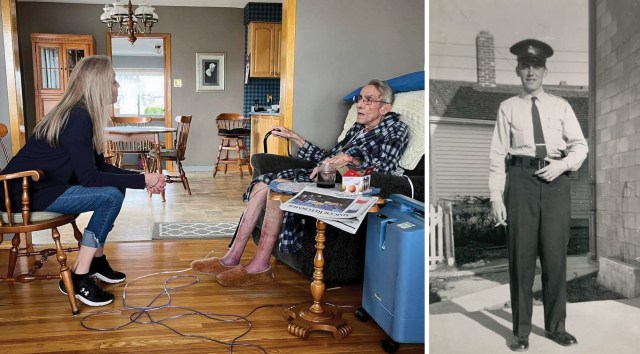 Images courtesy Ashlen De Vos
As his need for oxygen grew, “his world became more and more restricted,” De Vos said, “and he was faced with those hard decisions, which I think also appealed to his pride.”
De Vos helped her dad to apply for hospice care, but the request was initially denied. The family was told his condition wasn’t severe enough for the government-run health care system to pay for hospice. But under Canada’s laws, it was severe enough for a doctor to take his life.
His daughter was shocked to learn that Phillips had conspired with his nurse practitioner when he decided to end his life by euthanasia. She and her husband pleaded with him to change his mind, but he was immovable.
A few days before her dad’s scheduled euthanasia—“It was like booking a hair appointment,” De Vos said—a white delivery van pulled up to his house with a large cardboard box bearing a MAID sticker. “Just like if you ordered something from Amazon.”
Full of sterile tubes and lethal poison, the death box sat where De Vos stashed it in her dad’s basement until the appointed time. “Out of sight, but not out of our minds,” De Vos said. “It was an ominous box in the basement, a long four days.”
On April 25, 2023, a red convertible pulled into the driveway. De Vos said a young woman stepped out and calmly went about the business of ending her father’s life. De Vos could not stay to watch him die. Instead, she took refuge in her church, where her priest had left the side door open for her. Horrified by the way her father was dying, she cried out to God.
“I couldn’t get to that church fast enough,” De Vos said, “and I literally fell on my knees, and my husband came with me and held my hand.” At 3 p.m., she knew her dad was gone. “I had so many people praying at the same time, and I just felt such tremendous grace and mercy.”
I met De Vos after Slater, the NYC doctor, encouraged me to check out Canada’s Euthanasia Prevention Coalition (EPC). I sat in on a group video call with about 60 people on a Wednesday night last November and listened to stories from families who had lost loved ones to euthanasia. De Vos and Roderick and Louise McDonald were among the speakers.
The EPC is a secular group, but De Vos and the McDonalds were quick to mention their faith. They seemed to hold a fragile hope in the midst of their grief and anger.
The McDonalds have also been featured on a Canadian Catholic television station and together have written a book of poetry called The Execution. They donated the book to the EPC to help raise money and awareness about euthanasia.
“I was going to end my poem about how I’m ashamed to be a Canadian because of what’s happening in our country,” Louise McDonald told me. “Welcome to Canada, where the doctor will kill you.”
I asked the McDonalds what they think is behind their country’s rapid acceleration of assisted death. Louise didn’t hesitate: “Satan.”
That does not appear to be the predominant opinion in Canada among the public or the Christian community. De Vos told me she recently attended a “dying with dignity” meeting hosted by a local mainline Protestant church. At the event, she said, the closing remarks were offered by the priest, who made euthanasia sound comforting and acceptable within a Christian worldview.
Listening to the priest and others championing assisted suicide reminded her of the musical Chicago and Richard Gere’s performance as the crooked lawyer Billy Flynn. “ ‘Let’s razzle-dazzle ’em,’ you know? ‘Let’s make it really attractive,’ ” De Vos said. “The language that they use … it’s very comforting. It’s very warm and shiny and beautiful. But the harsh reality of someone choosing to die in that way is completely opposite to what they are presenting.”
Aside from sharing her story on the EPC call and at a local Catholic event, De Vos hasn’t spoken publicly about her father’s euthanasia.
“I haven’t even really spoken to my colleagues at work,” she said. “I’ve kept it to a very small circle, and I think that’s quite commonplace for a lot of folks who have gone through such an experience.”
Watching a minister of God endorse the practice seems to have lit a new fire inside of her. She said she is getting bolder about sharing her story and refusing to sugarcoat it.
With competing narratives coming from pulpits and fellowship halls, McGuire, the former pastor who has spent years lobbying against assisted suicide in New York, says preachers who believe in the sanctity of life need to speak up. And soon.
They can “develop a sermon that talks about the redemptive purpose of suffering,” said McGuire, who is currently battling cancer. “Frame it as an end-of-life issue. Help people to understand that just because we are going through a difficult or even a painful experience does not mean that it is something that should be avoided or is wrong for us to go through. There are plenty of biblical examples that illustrate how God does not waste anything and uses even suffering for his redemptive purposes.”
De Vos has noticed that proponents of assisted suicide seem to have commandeered the word compassion. Allowing people to die “on their own terms,” they argue, is the compassionate thing to do.
“But unless we are able to care for those who we love, who are suffering … how will we learn to become a compassionate people?” De Vos said. “I think it’s a great loss if we aren’t able to be in those tender last moments together. And it doesn’t mean it’s going to be easy. I just pray for strength when it’s my time.”
Kristy Etheridge is a features editor at Christianity Today.