When discussing the biggest problems in life, Christians are understandably eager to present Jesus as the solution.

Sometimes this looks like basic fidelity to Scripture, which depicts Christ as the source of all wisdom, the one in whom “all things hold together” (Col. 1:17). Regrettably, it often looks more like the dreaded “Jesus juke”—an awkward, heavy-handed, or manipulative attempt to shove faith into a conversation. (Yes, I worry about the Iran war. But in the end, I’m more concerned about the war to win souls for Christ.)
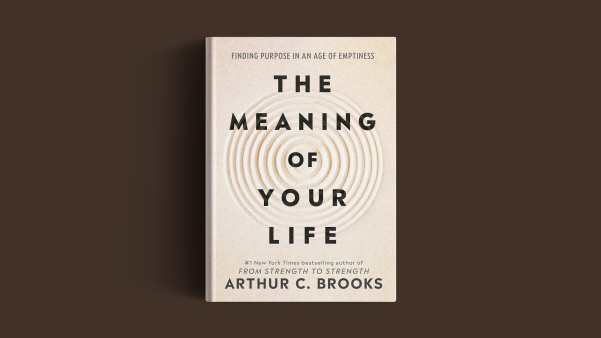
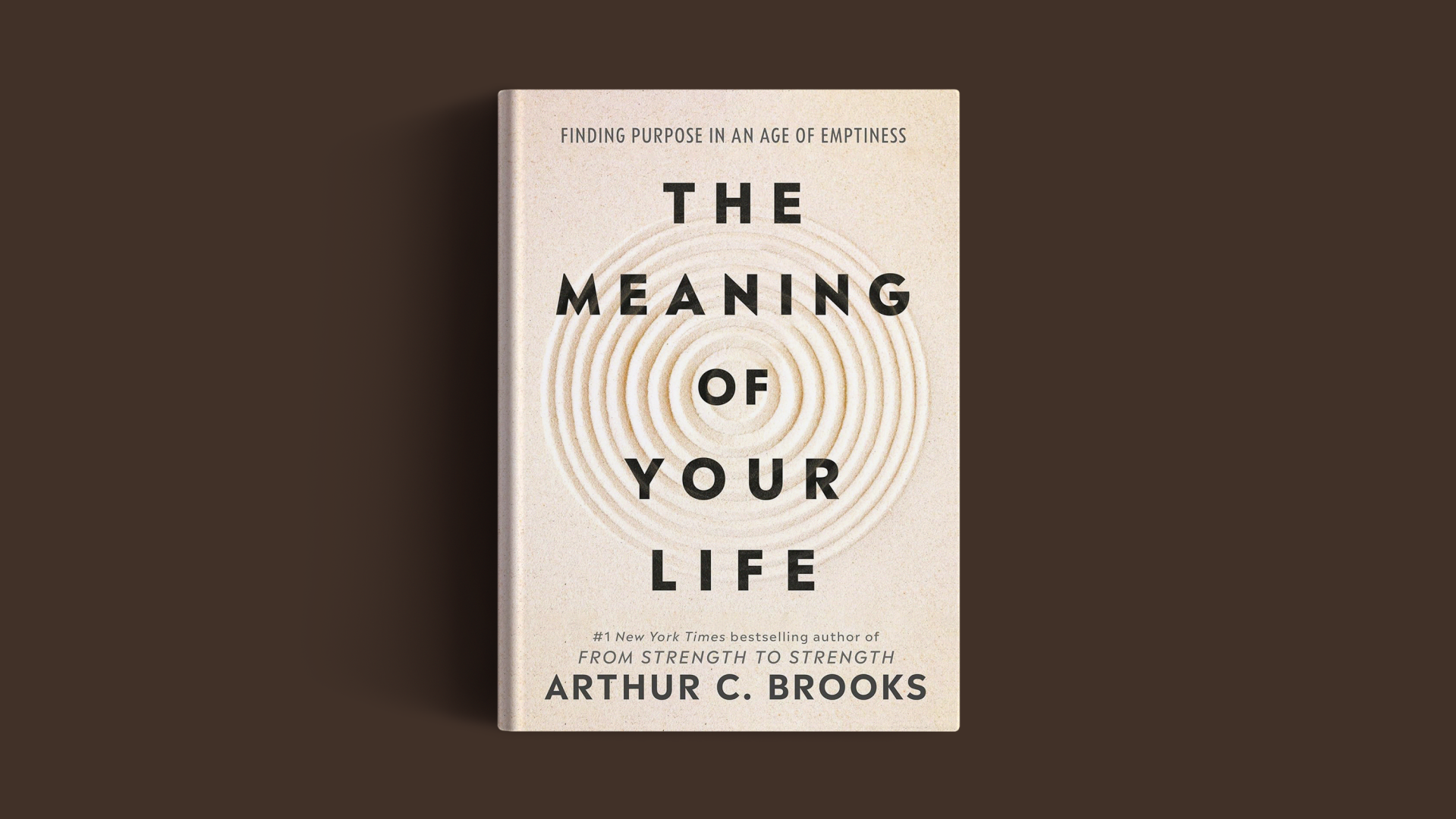
I fought mightily to restrain this altar-call impulse while reading Arthur C. Brooks’s newest book, The Meaning of Your Life: Finding Purpose in an Age of Emptiness. A Harvard University professor and leading expert on happiness, Brooks specializes in social science, and his book leans on insights from this field as it investigates why so many people enjoying outwardly enviable lives struggle with loneliness, anxiety, and aching dissatisfaction. But as much as I long to answer such existential worries with Jesus’ self-attestation as the way, the truth, and the life (John 14:6), I wanted to honor Brooks’s expertise and his chosen analytical framework.
And it’s not as though Brooks ignores the place of Christianity in illuminating life’s meaning. Far from it: He writes candidly about his own Catholic faith and often bolsters social-scientific findings with complementary strands of Christian wisdom, alongside samplings from other theological and philosophical traditions.
Still, the further I read, the more trouble I had quieting my inner Billy Graham. I can understand why Brooks issues a generous, inclusive invitation, proposing pathways to deeper meaning that anyone can pursue, regardless of religious beliefs (or lack thereof). There are virtues to mapping out the good life with ecumenical expansiveness. Yet I’m loathe to settle for anything less than acknowledging Christianity as the map itself.
related


Before plunging into those waters, let’s back up a little. The Meaning of Your Life addresses a specific dimension of the social crisis playing out in parts of American society. Many researchers have studied the mental health burdens weighing on younger generations, raising alarms about their disordered attachments to smartphones and social media. Others have dug into data concerning Americans without college degrees and steady paychecks who fall away from family and community, get hooked on drinking and drugs, and succumb to premature “deaths of despair.”
Brooks aims his appeal at the high-achieving end of the bell curve, toward members of America’s “striver” class. Blessed with superior gifts and unceasing energies, these strivers are continually scaling mountains of personal, educational, professional success—always pushing, in the words of one interview subject, to earn “the next gold star.” But Brooks observes a void in their lives. As their accolades and material wealth pile up, they wonder whether their labors amount to anything worthwhile, especially after counting the cost in strained relationships, harried psyches, and punishing daily grinds.
Brooks sees these tendencies in his Harvard students. He sees them in personal and professional acquaintances. And he sees them, perhaps most profoundly, in himself. An incurable striver from childhood onward, Brooks excelled as a classical musician before pivoting to triumphs as a professor, nonprofit boss, and public intellectual. He resonates on an intimate wavelength with misgivings about workaholic zeal crowding out deeper questions of meaning. Much of his happiness research, he admits, doubles as an avenue of “me-search.”
With that record, Brooks might seem like an insufferable showoff, custom-engineered to arouse envy in mere mortals (like me). But I think regular Joes will find his manner disarmingly down-to-earth. The book features the same genial, plainspoken, and self-effacing style on display in his advice essays for outlets like The Atlantic and The Free Press. For anyone seeking practical, relatable guidance on happiness, I can imagine him making a delightful conversation partner.
Such guidance abounds in The Meaning of Your Life, in which Brooks distills decades of research and reflection. The “problem of meaning has vexed me more than any other in my career,” he confesses, “and this is the hardest book I have ever written.”
Early on, Brooks recounts a conversation that provided a flash of conceptual clarity: One anxious striver described feeling trapped in a “simulation” where cheap, two-dimensional stage props replaced the rich architecture of authentic life. That image struck a chord, and subsequent interviews echoed a similar refrain: “Life felt unreal,” Brooks reports, “full of false rewards, empty accomplishments, therapeutic talk, and fake experiences, all curated to pass the time as painlessly as possible.”
Eventually, Brooks concluded that what “was missing was the one thing that can never be simulated: meaning. Again and again, people said that life was busy but not meaningful. That experiences and relationships felt meaningless. Or that they didn’t know what they were meant to do in work and life.”
As Brooks observes, strivers can often identify and lament this absence of meaning. But they’re tempted to respond in counterproductive ways, soaking up the screen-based diversions of our digital age. Time and again, the book introduces fine specimens of on-the-clock industriousness who fritter away their leisure hours with aimless scrolling. The ensuing dopamine briefly numbs their discontent, but their sadness returns soon enough, piling guilt atop their weary souls while leaving the fundamental problem unresolved.


Escaping this “doom loop,” Brooks argues, is the first step toward getting a firmer grasp on what life is all about. Yet what strivers need most, he suggests, is an awakening jolt to parts of their neural circuitry too often stuck on sleep mode.
As Brooks theorizes, the people most adept at climbing ladders of power and prestige tend to operate within the brain’s analytical centers. What they often lack is a receptivity to signals sent from the brain’s opposite hemisphere, a fertile soil for ruminations on mystery, beauty, divinity, and other proverbial staples of late-night dorm-room debates. This is where meaning dwells most richly, Brooks suggests, in the “numinous” realms that defy rational explanation.
How do you open new passageways to these neglected regions? This question guides most of Brooks’s chapters, which offer concrete strategies for “ignit[ing] the right hemisphere of your brain” and training it to recognize what matters most.
He asks readers to make regular assessments of the coherence and direction of our lives, invites us to pursue romantic love and committed friendship, and calls us to look beyond our own needs, cultivating an openness to spiritual realities. He teaches us to orient our working hours to something beyond money and our leisure hours to something beyond fleeting or trivial pleasure. He encourages us to immerse ourselves in natural, aesthetic, and moral beauty. And he reminds us that our suffering, while inevitable, need not be in vain.
By and large, this is wise (and sometimes urgently needed) counsel. If you’re struck in a metaphysical rut, you can hardly go wrong hearing an orchestra, hitting a hiking trail, taking someone on a date, catching up with a friend, or—who knows?—even darkening the doors of a church. I have my quibbles with certain arguments and illustrations, as anyone might. But Brooks’s core recommendations seem broadly congruent with basic Christian teachings.
related


Speaking of which … uh-oh, here it comes. Let’s call it a Jesus juke lite. Don’t say you weren’t warned.
Scripture, of course, doesn’t say much about the brain’s precise cartography or the happiness principles that flow from diagramming it rightly. But it says plenty about what makes meaning genuinely meaningful.
Drawing on a definition proposed by psychologists Frank Martela and Michael F. Steger, Brooks pictures meaning as a cord of three strands: coherence, purpose, and significance. You’ll notice the glaring absence of any anchoring in objective realities or moral truths. Plenty of false religions and grotesque ideologies check these three boxes. Perhaps their adherents enjoy a secure sense of meaning, but it rests on a foundation of illusions and lies.
In his determination to liberate meaning from the cramped perspective of rationalistic strivers, Brooks risks liberating it from anything solid and stable. At one point, he approvingly cites psychiatrist Carl Jung, who wrote, “The greatest and most important problems of life are all fundamentally insoluble.” Which requires getting comfortable with philosophical and experiential loose ends, rather than demanding some program or paradigm to tie them together.
But Christians believe the Bible spells out both our greatest problem (sin and alienation from God) and an efficacious solution (Christ’s death and resurrection). Yes, our faith embraces mystery and transcendence. It proclaims realities so unfathomable—a triune God, a divinely ordered cosmos, a virgin birth, a kingdom that has no end—that our puny minds can scarcely comprehend them. But it tethers the sublime grandeur of redemption to decidedly non-numinous claims of historical fact.
In 1 Corinthians 15, Paul gives them a workmanlike rundown: “that Christ died for our sins according to the Scriptures, that he was buried, that he was raised on the third day according to the Scriptures, and that he appeared to Cephas, and then to the Twelve,” and then to a further succession of disciples and apostles, including Paul himself (vv. 3–8). If these statements are untrue, he insists, then our “faith is futile,” and “we are of all people most to be pitied” (vv. 17, 19).
If Brooks’s conception of meaning lacks a firm grounding in objective truth, it also lacks a firm grounding in the binding stories, communities, and traditions that have structured lives and shaped consciences for most of human history. In other words, it lacks a firm grounding in the authoritative meaning we inherit, rather than the subjective meaning we find and choose for ourselves.


Even as Brooks exhorts us to look outward and forge relationships of reciprocal care and concern, the book’s overall thrust remains curiously individualistic. It’s right there in the title, which speaks of the meaning of your life, not life in general. Words like search and journey get heavy workouts, suggesting more of a lonely quest than a baptism or initiation into an established community.
In fairness, Brooks does include a moving epilogue tied to his experience walking the famed Camino de Santiago with other Christian pilgrims. Here he stresses how meaning can find us rather than us finding it. For most of the book, however, the onus seems to fall on individual seekers, who need only drop their phones and reprogram their brains by doing “what your grandparents did in the course of their ordinary lives.”
In fact, I was surprised that Brooks didn’t pay more attention to broader trends of institutional and communal decay. If people today are starved of meaning, perhaps that’s because an atomized society isn’t satisfying their hunger to belong.
Here, again, is where Christianity helpfully enlarges the frame. Scripture doesn’t deny the subjective dimension of meaning derived from relationships, responsibilities, talents, and callings that vary from person to person. But it weaves those threads into a single all-encompassing story of redemption showing all people, in all ages and places, as well as who they are, where they’ve come from, and where God in Christ wills to take them.
There are lots of things worth saying to anyone doubting the significance of their life and work, and Brooks says many of them clearly and effectively. But here’s what I’d like to say most: Step into the story of redemption. Put your trust in its author and perfecter. Look forward to its consummation in the new heavens, the new earth, and the multiethnic multitudes gathered to worship Christ forevermore.
Discovering the meaning of your life, of all life, really is every bit as simple—and infinitely, gloriously complex—as that.
Matt Reynolds is a writer and a former CT editor. He lives with his wife and son in the suburbs of Chicago.
Related