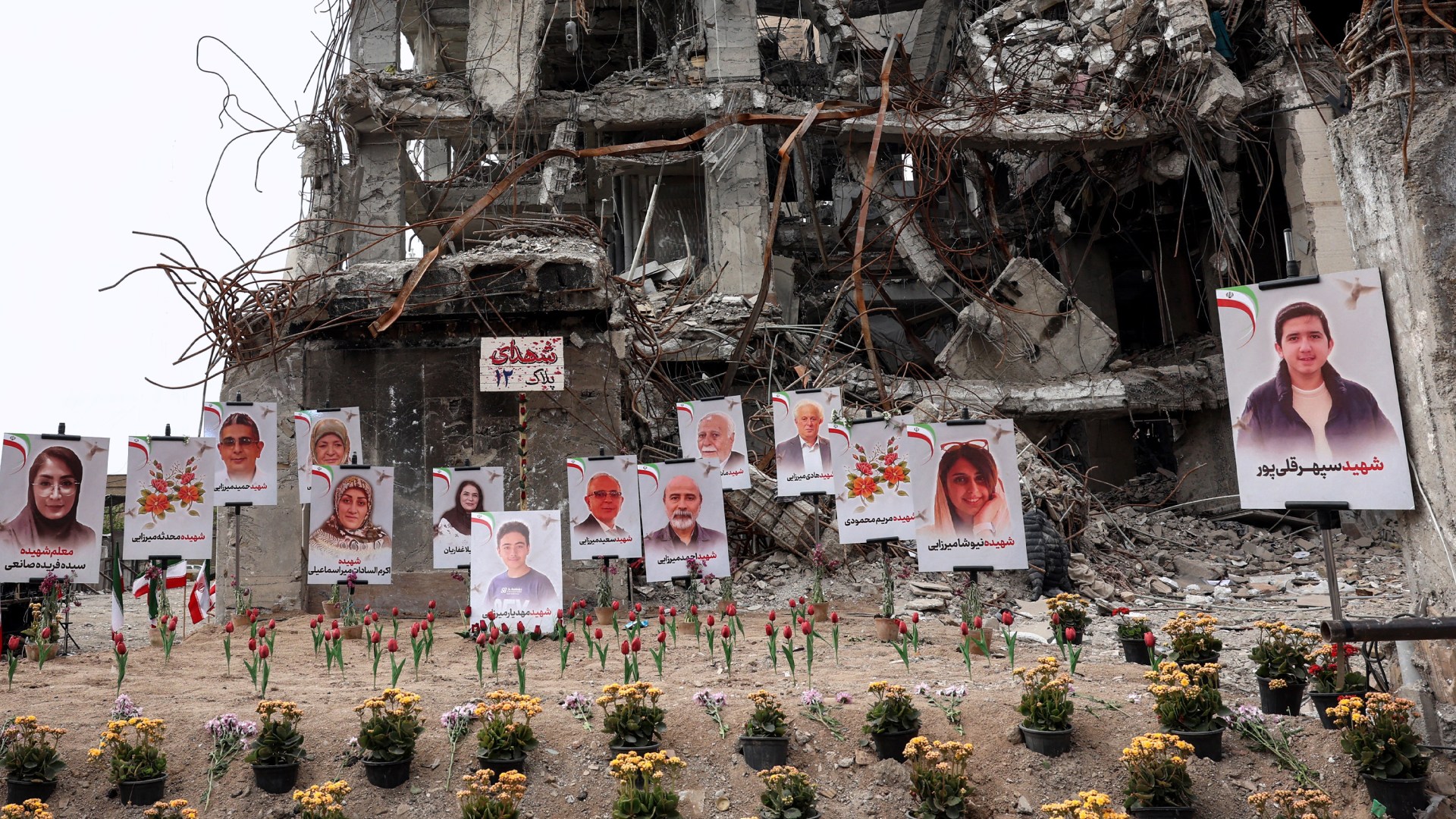
Early in the morning on February 28, Ed Martin awoke in his home in Lancaster, Pennsylvania, rolled over in bed to check his phone, and let out a slow sigh. The United States and Israel had attacked Iran. With a sense of resignation, the 78-year-old went to the computer in his bedroom office to learn more. Following weeks of negotiation and military buildup, in the first 24 hours the allied nations dropped at least 1,200 bombs on hundreds of targets across the country.
Martin worried about his friends in Iran.
“I felt awful,” he said. “But I wasn’t surprised.”
Most grandfathers in rural Pennsylvania do not have friends in Tehran. But Martin has spent more than two decades seeking peace between the geopolitical enemies. As Mennonites who know the pain of religious violence—he traces his ancestry to Swiss Christians fleeing persecution in the 17th century—he and his Anabaptist brethren have tried to promote interfaith relationships between North America and the Islamic republic.
Their efforts have gone mostly ignored and sometimes criticized. That morning, they found out they had failed.
They had made a last-ditch overture for peace just three weeks earlier. An interfaith group Martin cofounded, called the Luke 10 Foundation, issued an antiwar statement in early February. Fourteen Americans, including the director of Churches for Middle East Peace, three Muslim imams, and three Jewish rabbis, joined seven Iranian leaders, including an ayatollah, to “implore” their governments to seek reconciliation.
Short on specific criticisms, they called on politicians to oppose tyranny and “to uphold universal human rights.” Luke 10, which is based in the United States and was founded during COVID-19 to aid Iranians hit hard by economic sanctions, sent the statement to the American and Iranian governments one day before officials met in Oman for indirect negotiations. It made hardly a blip in US media but was published in English and Farsi by the official Islamic Republic News Agency, perhaps to show that some Americans were also against the war.
“Governments will do what they do in terms of propaganda,” said John Hartley, an early evangelical participant in Luke 10, which takes its name from the biblical passage containing the parable of the Good Samaritan. “We must seek the human good, not a political agenda.”
Mennonites have rarely put their trust in princes. They originate from a 16th-century reform movement in Europe attempting to model the early Christian community. The church developed three core religious commitments, according to Doug Hostetter, cofounder of Luke 10: First, faith is not inherited but must be chosen freely as an adult. Second, believers must take literally Jesus’ command to love their enemies. And third, allegiance to God overrides any government order to go to war on behalf of the state. In 2019, he outlined these convictions to professors at the University of Tehran.
Yet some in the Iranian diaspora, as well as Christians and Jewish groups, have criticized the Mennonites’ interactions with Iran, claiming they are justifying a repressive regime that uses dialogue to polish its image. Amnesty International cites the widespread use of torture, unjust trials, and the denial of education to women who refuse to veil. Open Doors ranks Iran No. 10 on its World Watch List for Christian persecution, primarily for its jailing of converts from Islam.
The Mennonites’ engagement with Iran was born from tragedy. In June 1990, an earthquake originating 125 miles northwest of Tehran killed an estimated 40,000-50,000 Iranians. At the time, Martin was director of the central and southern Asia program at the Mennonite Central Committee (MCC), the denomination’s humanitarian arm.
Since the United States ended diplomatic relations with Iran in 1980, Martin turned to the MCC’s office in Canada, which enabled him to work through the Iranian Red Crescent Society (the Muslim world partner to the Red Cross) to provide aid. Six months later, in January 1991, he took his first of 34 trips to Iran. Together the Mennonites funded construction of 15 health clinics and subsequently assisted with aid for floods, droughts, and the influx of refugees from Iraq and Afghanistan until the MCC’s program ended in 2013.
Yet Martin sought to address more than Iranians’ physical needs.
As the Cold War ended, he and colleagues sensed that political Islam had replaced communism as the perceived enemy of the West, with Tehran displacing Moscow as the center of antagonism. Earlier, in 1979, the Islamic Revolution installed a theocratic government that held 52 Americans hostage for 444 days. And in 1983, Iranian-linked attacks on the US Embassy and Marine barracks in Beirut killed 290 Americans. President Donald Trump recently mentioned this history as part of his rationale for war, saying, “The Iranian regime seeks to kill.”
Martin believed MCC could not only help suffering people but also build bridges of understanding between US and Iran. Through MCC’s consistent service, Martin developed a network in Tehran, which led to significant opportunities.
He proposed a student-exchange program, and in 1997 MCC negotiated an agreement between the Toronto School of Theology and the Imam Khomeini Education and Research Institute, located in the holy Shiite city of Qom, Iran. Four Mennonite couples studied in Iran, and two Iranians completed their PhDs in the philosophy of religion.
Other exchanges followed, and in 2002, Toronto hosted the first of eight Mennonite-Shiite conferences. Two years later, Qom received an Anabaptist delegation for their second gathering, with countries rotating roughly every two to four years. Topics have included revelation and authority, peace and justice, and religious spirituality.
Martin advised Mennonite students to return home if they felt drawn to Islam. It takes a strong Christian, he said, to engage in true dialogue. Yet while the academic exchange was formal and rigorous, over tea breaks and meals participants got to know each other—even as Iranian authorities filmed most interactions.
Surveillance was tight. Interrogation was frequent. And on Martin’s last visit in 2023, authorities sent him home. They were afraid, he gathered from their questions, that the US was using interfaith dialogue to soften the ground for eventual regime change.
I asked Martin if the dialogue was genuine.
“For the scholars it is,” he said.
“And for the government?” I followed. He paused, folding his hands under his chin for several seconds.
“I never really thought about it,” he replied.
Yet Martin spoke warmly of Shiite students he brought to US peace-building trainings who later rose in diplomatic service. He described curious Iranians wanting to learn about America and Christianity. And he revealed how his own theoretical love for a supposed enemy became authentic in real friendship. He had only one regret.
“Had I known I would spend so much time in Iran,” Martin said, “I would have learned Farsi.”
Both Martin and Hostetter were shaped by living in Asia—Nepal and Vietnam respectively—while doing alternative service as conscientious objectors to the Vietnam War. This led to further service overseas, where they befriended Buddhists, Hindus, and Muslims. They both say that while they consider themselves disciples of Jesus, they do not believe in the exclusivity of Christianity.
“I’m not very orthodox,” Hostetter said. “But I am very Mennonite.”
Such theological openness makes many evangelicals uncomfortable in interfaith-dialogue circles. Even those who might question the wisdom of the Iran war might not be able to sign the Luke 10 statement, which encourages all to follow the shared Golden Rule that it says came “from God speaking directly to Abraham, Moses, Jesus and Muhammad.”
Yet the seeds sown from Mennonite academic engagement led also to high-level political interactions. In 2000, an Iranian professor arranged for a student to study at Eastern Mennonite University’s Summer Peacebuilding Institute. Six years later, the student was an adviser to the Iranian president. When the president, Mahmoud Ahmadinejad, asked him who he should meet with during the upcoming United Nations General Assembly meetings in New York, the former student suggested Mennonites. Hostetter, then director of MCC’s UN advocacy office, coordinated arrangements.
Hostetter drew in Quakers and other Christians open to dialogue. Often these meetings were quiet and behind-the-scenes. But some encounters drew protest from Iranian diaspora academics, the Jewish Anti-Defamation League, and the National Council of Churches, which accused Mennonites of extending legitimacy to a repressive regime. In 2008, Richard Land, then-president of the Southern Baptist Ethics and Religious Liberty Commission, called participants “useful idiots who help [Ahmadinejad’s] evil causes by their witless complicity in meeting with him.”
During the COVID-19 pandemic, Martin and Hostetter started the Luke 10 Foundation to provide Iranians with vaccines, ventilators, and other emergency relief. They partnered with Moms Against Poverty, one of the few organizations that had an Office of Foreign Assets Control license given by the State Department for sanctions exemptions.
Recognizing the polarized religious and political environment, Hostetter wanted to involve evangelicals in Luke 10, as “they are closer to Republicans than most of us,” he said. In 2020, Martin found Hartley, who at the time was leading the World Evangelical Alliance’s task force on nuclear nonproliferation.
Hartley lived in Isfahan, Iran, from 2003 to 2007, where he founded Pathways for Mutual Respect, which sought to strengthen interfaith relations in more than 30 countries from Nigeria to Malaysia.
As a doctoral student at Yale supervised by Miroslav Volf, Hartley wrote his dissertation on how believers with an exclusive theology of salvation—Christian or Muslim—can nonetheless nurture inclusive social relations. Drawn to Luke 10’s focus on relief for Iranians, Hartley sought to ensure that the diverse initiative would not blur faith distinctions to appear as “one big happy religious family.”
Still, according to Hartley, all were united in humanitarian purpose.
“I’m not a pacifist, and I don’t know if this war is warranted,” Hartley said. “But we must always be serious about the human cost.”
During his time in Iran, he learned that many were afraid of US militarism. One day he entered his neighborhood money-exchange shop, and a middle-class Iranian couple asked, “Aren’t you afraid to be here?” While Hartley was prepared to give his stock answer about Iranian hospitality, the husband spoke first. “We are,” he said, explaining that they were buying dollars to travel abroad. “The Americans in Iraq are about to invade.”
Interrogated often by the authorities, Hartley kept his distance from Iranian Christians. The intelligence services assumed he had an evangelistic agenda, and they wanted him to lead them to underground churches. And while he was aware of the Mennonite dialogue efforts with Iran, he was never involved.
Yet Hartley said it was “beautiful” how Mennonites’ commitment to separate their love of people from politics created a ground for peace—and Christian witness. In one conference, an Anabaptist participant preached the gospel in a friendly, nonpolemic way. Though it made some on both sides uncomfortable, the opportunity came from Iranian trust in the Mennonite community.
Hartley related this to the Farsi word ashna, the “known people” who must be involved for an Iranian to feel comfortable in a complicated situation.
Hartley, formerly president of the Luke 10 board of directors, ended his participation in 2023 as its original humanitarian purpose waned. He commends its ongoing interfaith commitment while lamenting the “muddy waters” of this war. He has no desire for his Iranian friends to endure a military attack, but he wonders if the negotiations were earnest and if attacking Iran would actually stop the regime.
Both Mennonites wished former president Barack Obama’s nuclear deal with Iran had held. Trust must begin somewhere, they said, with each side addressing its gaps over time. Although both Iran and the US view the other as their enemy, they could at least keep talking.
God is disappointed in the actions of both sides, Martin believes: “They are fighting, not negotiating. Love your enemy.”
On the morning of February 28, Martin eventually rose from the computer in his bedroom. He went on a long drive with his daughter, enjoying the Amish beauty of Lancaster County. Returning home, he did what he could. He wrote a letter to his congressman, a graduate of the local Mennonite high school, who had issued a statement in support of the war.