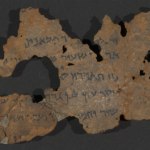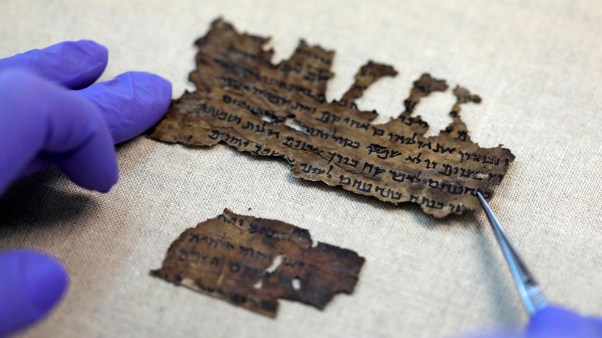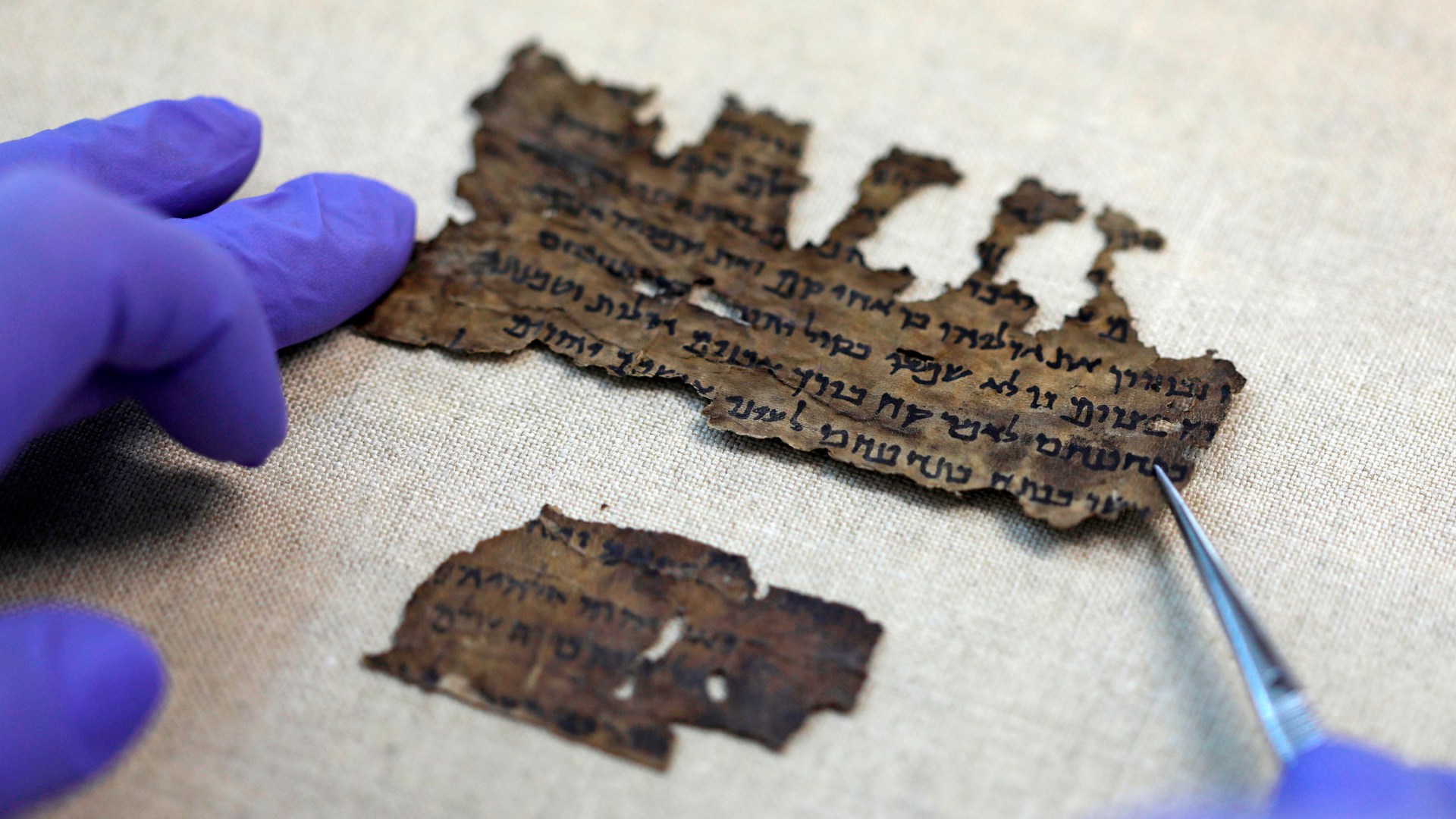
Most of the people who come to the Museum of the Bible in Washington, DC, to see the Dead Sea Scrolls can’t read the fragments that are on exhibit through September. The scrolls are written in Hebrew, or perhaps ancient Aramaic or Greek. But still people come.
“These are the oldest biblical texts ever discovered,” explained Robert Duke, the museum’s chief curatorial officer. “Our average guest is just blown away knowing that you’re looking at texts that were from the time when the disciples and Jesus were walking the earth.”
Portions of the Psalms, Numbers, and Lamentations that have never before been exhibited are currently on display, along with five nonbiblical texts. In May they will be swapped with a new set of texts, including a portion of Isaiah, provided by the Israel Antiquities Authority.
This is not the first time the Museum of the Bible has put up a display for the Dead Sea Scrolls. To have such ancient biblical documents in a museum dedicated to the Bible seems like a no-brainer. But much to the museum’s embarrassment, the scrolls it purchased to display when it opened almost a decade ago turned out to be fake.
The museum sponsored an in-depth scientific analysis, and the results of the tests are still found on its website.
This time, there’s no question that the current scrolls on display, owned by the Israel Antiquities Authority, are authentic. Archaeologists excavated them in Dead Sea Scroll caves; the museum didn’t purchase them on the antiquities market. The issue of modern forgeries has quieted down, but it’s still a problem, says Christopher Rollston, chair of the Department of Classical and Near Eastern Languages and Civilizations at George Washington University. He is frequently contacted by people who are convinced they have purchased authentic scroll pieces, and he finds they are almost always fake: “Modern forgeries continue to appear on the antiquities market all the time.”
First discovered in caves along the northwestern shore of the Dead Sea in 1947, mostly in fragmented condition and representing about 900 different documents, the Dead Sea Scrolls include parts of all the Old Testament books except Esther. Some nonbiblical texts were also recovered. The scrolls have given Bible scholars—and readers—a window into the biblical world just before and during the time of Christ.
Just as the Dead Sea Scrolls provide context to the Bible, the Israel Antiquities Authority, working with Running Subway Productions (the company behind Van Gogh: The Immersive Experience and a Lego display of scenes from Jurassic World), has included additional items in this traveling exhibit to give visitors the context of these particular scrolls made available to the public for the first time.
Risa Levitt, the executive director of Israel’s Bible Lands Museum, was one of the curators who assembled the additional artifacts and informational displays. “We want the public to understand place, geography, and historical context so that by the time you get to the scrolls themselves, you are able to understand them a little better,” she said.
Until 1947, the oldest available collections of Scripture were only about 1,000 years old. To have biblical texts twice as old puts Bible scholars that much closer to the original texts. “The Dead Sea Scrolls push us back more than a millennium,” Rollston said.
That’s not enough to answer all the questions scholars have about biblical texts, but the older texts cleared up some issues—the height of Goliath, for instance.
In your Bible, 1 Samuel 17:4 probably says Goliath was “six cubits and a span,” or perhaps nine and a half feet. That’s based on the Masoretic Hebrew text. The Septuagint (an early Greek translation) and the ancient historian Josephus both say four cubits and a span. A cubit is about 18 inches, and a span is about 8.75 inches.
People were smaller in those days, so six and a half feet could still be a giant. In fact, the Dead Sea Scrolls version of 1 Samuel says four cubits and a span. “That’s the sort of thing that the Dead Sea Scrolls can do,” Rollston said. “They provide us with some early textual material that will often refine the readings that we have in Masoretic texts.”
Most modern Bibles still haven’t reverted to the earlier version of 1 Samuel 17:4, much to Rollston’s disappointment. But at least some provide a footnote.
“If someone has a Bible translation that doesn’t reference Dead Sea Scroll readings, which are the earliest and often the best readings of the Bible that we have, that’s probably not a good translation to use if one wants to study the text in great depth,” he concluded.
Other parts of the exhibit include a paving stone on which people can actually walk—a stone from the Pilgrim’s Road, the recently excavated first-century street that led from the Pool of Siloam up to the temple—and the Magdala Stone, a beautifully decorated yet mysterious stone platform that may have been used to hold the Torah scroll in the first-century synagogue of Mary Magdalene’s hometown along the northwestern shore of the Sea of Galilee. Carved on one of its sides is a depiction of the menorah from the temple in Jerusalem.
As visitors find their way to the end of the museum’s Dead Sea Scrolls exhibit, they encounter one final artifact from Jerusalem, a 4,000-pound stone from the Temple Mount. Duke said they had to call in structural engineers to make sure the stone wasn’t too heavy for the museum’s floors.
“It’s situated in a way that people can actually leave notes, just like you would if you were at the Western Wall in Jerusalem,” he said. “And we see people standing there leaving notes, prayers, and other thoughts. This is a real spiritual experience for people, to see the texts that are our oldest texts ever discovered.”
What may not be as heavily promoted as the Dead Sea Scrolls is the fact that the museum still retains the previous special exhibit, the Megiddo Mosaic, a floor from the oldest church ever discovered, excavated in Israel two decades ago. It’s been moved to a different part of the museum, its stay extended until this coming December.
Duke says this may be the only time some of the oldest biblical texts in the world will be displayed in the same museum as the mosaic floor from the oldest church in the world. It is a remarkable combination that hasn’t gone unnoticed back in Israel.
Risa Levitt recalled a conversation just the other day with one of her fellow curators: “He said, ‘It’s ironic that you have to go to Washington, DC, to see this sort of breadth and depth of an exhibition of the scrolls. Something like this does not exist anywhere in Israel.’”