Lake of Fire, the much-anticipated abortion documentary from British director Tony Kaye (his first film since 1998’s searing American History X), has been touted as the “definitive” film about abortion. It has also been heralded as being aggressively even-handed—a documentary fair to both sides of the debate. Both of these claims, as it turns out, are a bit exaggerated. Lake of Fire is a remarkable film in some respects, but it is not groundbreaking or particularly definitive. And it is certainly not a fair take on the debate.
Coming in to the film, one expects (or at least hopes) that it will be a thoughtful consideration of the issues at stake in the ongoing abortion debate. Heaven knows we are desperate for a congenial sit-down in which all perspectives, arguments, and scientific evidence are presented and considered evenly—apart from personal attacks, cynicism and vitriol. But in this respect the film is a huge letdown—a wasted opportunity to truly consider the issue/act of abortion and its moral meaning.
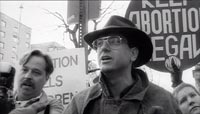
Instead, we get a lopsided parade of talking heads in which well-mannered, intellectual liberals (Noam Chomsky, Alan Dershowitz, Peter Singer) represent the pro-choice viewpoint and firebrand country bumpkin fundamentalists represent the pro-life side. Defenders of the film might point out that the brunt of screen time goes to Christians and pro-lifers, which is true. But the majority of time devoted to the “pro-life” contingent centers upon the fringe extremists who picket and sometimes bomb abortion clinics, and occasionally assassinate abortion doctors. This is the face of the pro-life movement, as represented in Lake of Fire.
The messages proclaimed by the Christians in this film are predominantly “turn or burn” in nature. Shouts of “woe to this evil generation” resound, as do warnings to “get back to the Bible” or face eternal torment in the Lake of Fire (mentioned by more than one pro-lifer in reference to the destiny of “death-lover” pagans and pro-choicers).

Among the colorful-if-skewed collection of “Christians” in the film are John Burt, a Pensacola-based Klansman-turned-abortion zealot; Paul Hill, executed in 2003 for killing an abortion provider; and Eric Rudolph, Olympic park bomber/abortion clinic terrorist. These are people convinced that abortion doctors must be executed, along with homosexuals and other blasphemers (a category which includes, as one Christian in the film says, anyone who says “God d— it”). These are people who earnestly pray for the death of abortion providers. As one particularly fiery Catholic priest remarks in the film: “We pray for the baby killer everyday. We want him to go to heaven … but we want him there SOON.”
This is just a taste of the freak show that is Christianity in this film. Sadly, all the footage and events depicted are real. We shouldn’t offer excuses for how bad Christianity looks in this film; we should only ask for forgiveness. Still, some blame must be laid at the feet of Tony Kaye, who purposefully avoids featuring any thoughtful, articulate, or moderate Christians in the film. Even the most peaceful and loving of the Christian figures in the film, such as Norma McCorvey (“Jane Roe,” who converted to Christianity in 1995 and is now a pro-life activist), are presented as mindless pawns in a larger and more malicious march toward theocracy. Thus, instead of being a profound inquiry into one of the most difficult questions of our time, Kaye’s film is simply an examination of the people most active in the debate—and all their psychological delusions and misguided neuroses.
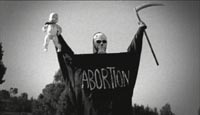
Though the film ultimately fails to deliver an even-handed, productive addition to the abortion discourse, it is at least an impressive film artistically. The film’s style resembles, but is superior to, like-minded documentaries like 2006’s Jesus Camp. Both films utilize an aesthetic that is dark, unsettling, and almost horror-film-esque. The music in Fire, like in Camp, is often thumping, dramatic, and tension-filled. The in-your-face editing style (lots of long, intimate close-ups and zooms) is also similar. Kaye’s photography (he’s the film’s cinematographer) is superior in Fire, however. His black-and-white palette and maneuver of focus helps to make the film a visual masterpiece, if nothing else.
The most effective sequence in the entire film comes at the very end of its exhausting, emotionally draining 160 minutes. Here we see an extended scene of a single woman in 1996, going through the whole process of getting an abortion (from check-in to pre-op counseling, through the actual procedure and finally the aftermath). Kaye’s camera focuses intensely on this woman’s scarred face (mangled from years of domestic abuse) as she explains why she is going through the abortion. We watch as a single tear falls down her cheek as the doctor sucks the baby out. Then we see her in the waiting room after it’s all done, as she tries to keep it together but ultimately breaks down. The film ends here, appropriately, in a deeply complex, human moment that puts everything else into perspective.
Abortion is not easy, and it has a very human cost. Kaye ends the film by bringing us back to this realization. We can fight about it all day, but ultimately we must deal with the reality of abortion: why they happen, and what we can do to love and counsel those mothers who feel them necessary. If only more of the film contained the humanistic grace and emotional resonance of the final scene, perhaps it would have lived up to some of the hype. As it is, though, Lake of Fire is just the latest in a long list of hyper-politicized, sensationalistic documentaries that are high on scare tactics and shock value, but low on progressive discourse.
Talk About It
Discussion starters- What can Christians do to remove the “Christian terrorist” image we have become associated with in regard to abortion? What are the other stereotypes in this film that we have to overcome?
- What do you make of Peter Singer’s comment that killing is only wrong when the person being killed consciously wants to go on living—so since babies can’t think, “I want to go on living,” we should have no qualms about ending their lives? What are the implications of this philosophy?
- Why do you think this issue has been such a violent, impassioned debate—far more than any other one issue in the past thirty years?
- Are there other ways to be “pro-life” besides trying to prevent abortions? How?
The Family Corner
For parents to considerLake of Fire is unrated, but would probably be given an R rating by the MPAA, mostly for its serious subject matter and a few wrenching scenes of explicit abortions. These particular scenes are terrible to watch, and include close-ups of dismembered baby fetuses. Additionally, there are some violent crime-scene images in which recently-shot bodies are strewn about (the result of violent attacks on abortion clinics). For these and other startling images, the film is appropriate only for adults, but even for adults, we urge caution. Certainly, it is not a film for young children.
Photos © Copyright THINKFilm
Copyright © 2007 Christianity Today. Click for reprint information.