A lone fisherman out in his boat on an overcast day pulls in his trawler’s nets and finds a huge surprise crashing into his quiet, mundane life: a woman. She’s barely alive, but the fisherman, Syracuse (Colin Farrell), revives her. Respecting her skittish and mysterious pleas to be kept hidden, he installs her in his recently deceased mother’s seaside cottage.
Syracuse shares his startling discovery with his plucky, wheelchair-bound daughter, Annie (Alison Barry), in the form of a fable to distract her during her weekly dialysis treatment. But the precocious girl sees right through her dad’s “fairy tale,” and secretly follows him until she spies the woman she suspects is a selkie, a mythical sea creature of Irish folklore.

Though Syracuse is troubled by this new woman in his life—the source of amusing conversations with his priest friend (Stephen Rea)—he’s also delighted by the good luck she seems to bring. When he takes her out on the boat with him, she sings—and suddenly his nets are overflowing with fish. The financial boost from these hauls is helpful as Syracuse is trying to get custody of Annie from his ex-wife, the drunken loudmouth he left when he sobered up two years ago.
Plus, this mystery woman, who says her name is Ondine (Alicja Bachleda), isn’t so bad to look at—especially when she’s constantly tromping her leggy self around dressed merely in oversized tops or just lacy underthings.
Syracuse and Annie both form attachments to Ondine—finding tentative but needed hope in her mysteriousness. This mystery seems the perfect antidote to their dreary lives—stuck in a wheelchair, or in a drab, lonely job, both in a difficult family situation.
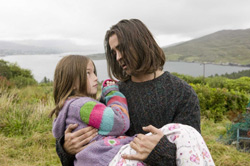
Ondine captures this dreariness well. The whole film has a windswept, murky, muted quality to it—fitting for the small Irish fishing village and for the folk story unfolding within it. Director Neil Jordan (The Crying Game, The Brave One) has offered moviegoers another enchanting fantasy world, peppered with delightful bits of humor.
That said, this is a film for those who can appreciate a bit of broody melancholy. It’s not a shiny, slick blockbuster—a fact that will draw some and repel others. Though I’m the sort who’s drawn to such cinematic moodiness, I did find some of the authentic, not-uber-controlled production values to be a tad distracting. I couldn’t always make out the windswept, thick Irish accents, and a few of the scenes got a bit choppy and sloppy toward the end.
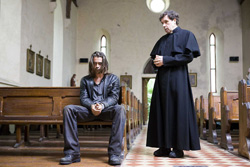
This sloppiness is no fault of the actors, who all shine in this dark tale. Colin Farrell is appropriately believable as a sobered-up bad-boy trying to make good. There’s a lovely scene where he’s confessing to the priest and admits his fear at his new-found feelings of hope. He offers a compelling range of emotion from tender love for his daughter to quiet angst at his ex.
Though the priest is only a minor character, he’s given a delightful bit of color and depth. He’s not the stereotypical moralistic finger-wagger; he’s funny and caring and wise.
Alicja Bachleda is lovely as Ondine, acting as much with her exotic angles, flowy hair, and lithe body as with the sparse dialogue she’s given. And newcomer Alison Barry as the plucky sick girl Annie is a breath of fresh air.
Of course, the main challenge with a fairy tale is the ending. Will it be a tragedy or a happy ending? Will reality invade the dream? Is Ondine really a selkie? Of course I’m not going to tell you here. But I will say the final quarter of the film isn’t as strong as the rest. The film gets uneven toward the end, though, thankfully, it doesn’t falter enough to ruin the overall effect.
In the end, Ondine is a smoky little gem for the art-house moviegoer—or for those who like their dramas/romances served with a bit of melancholy.
Talk About It
Discussion starters- Throughout most of the movie, do you believe Ondine is a selkie or not? Why? How do you feel about the actual ending?
- Why is Syracuse drawn to Ondine? Why is Annie drawn to her? Why is Ondine drawn to them? What do these characters need from each other?
- In one scene, Syracuse talks about his fear of hope. Have you ever been afraid to hope? What happened, and how did your faith come into play?
- Syracuse is a recovering alcoholic. Who helps and who hurts that recovery process? Have you ever overcome an addiction? If so, what has helped and hurt your efforts?
The Family Corner
For parents to considerOndine is rated PG-13 for some violence, sensuality, and brief strong language. Probably the biggest problem for parents is the fact that Ondine doesn’t wear a whole lot of clothes—and those she does wear seem to keep getting wet (and see-through). Ondine and Syracuse sleep together in one scene—though we don’t see any nudity or much of the action. Syracuse does confess this to his priest friend, though admits he isn’t really sorry and doesn’t plan to stop seeing her. Syracuse steals some clothes for Ondine. Annie sees her mom drunk in a couple of scenes. A car crash that kills a minor character, and another character poses a physical threat.
Photos © Magnolia Pictures
Copyright © 2010 Christianity Today. Click for reprint information.