
Celebrities talked about their relationships with God, and America listened.
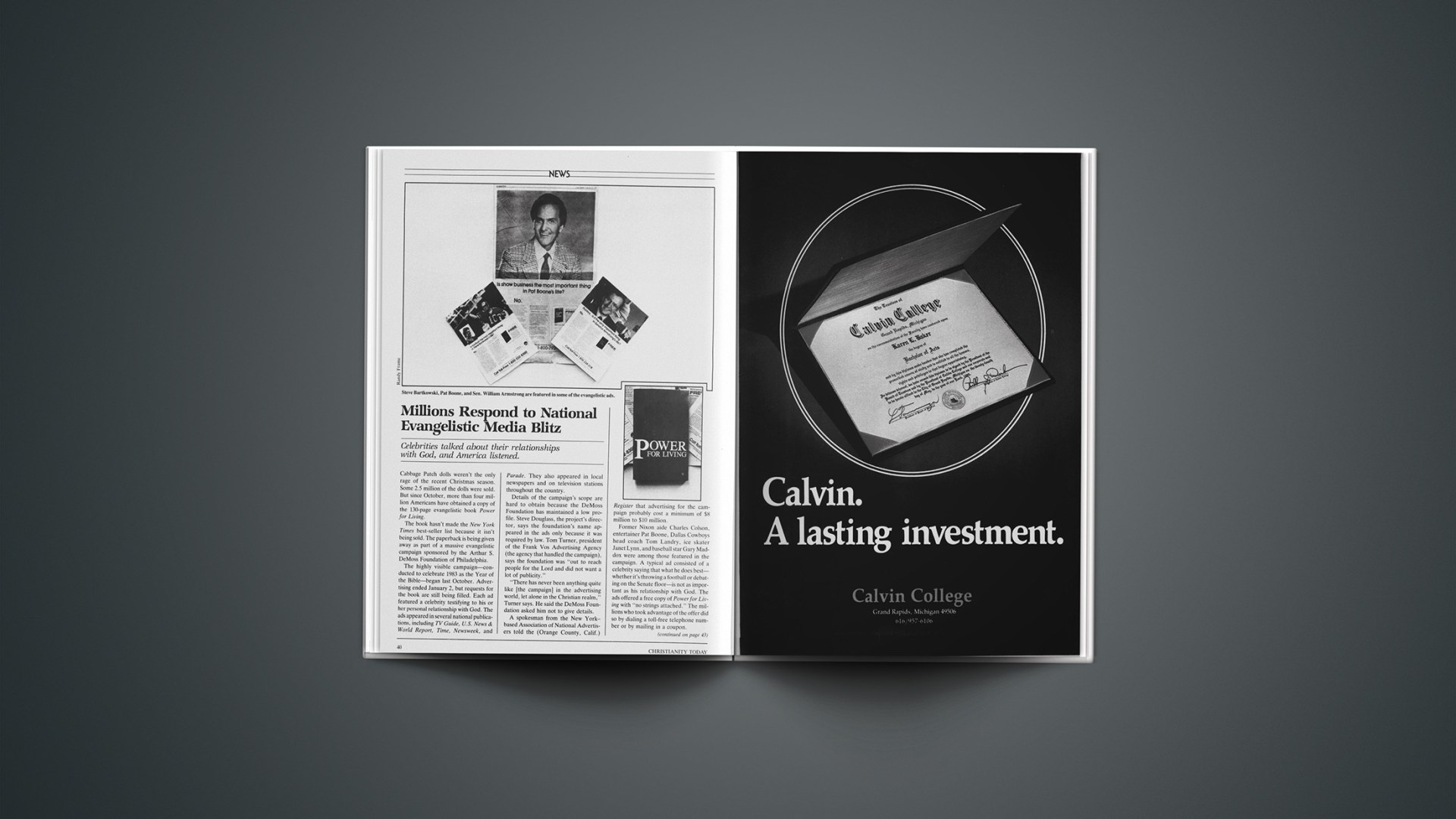
Cabbage Patch dolls weren’t the only rage of the recent Christmas season. Some 2.5 million of the dolls were sold. But since October, more than four million Americans have obtained a copy of the 130-page evangelistic book Power for Living.
The book hasn’t made the New York Times best-seller list because it isn’t being sold. The paperback is being given away as part of a massive evangelistic campaign sponsored by the Arthur S. DeMoss Foundation of Philadelphia.
The highly visible campaign—conducted to celebrate 1983 as the Year of the Bible—began last October. Advertising ended January 2, but requests for the book are still being filled. Each ad featured a celebrity testifying to his or her personal relationship with God. The ads appeared in several national publications, including TV Guide, U.S. News & World Report, Time, Newsweek, and Parade. They also appeared in local newspapers and on television stations throughout the country.
Details of the campaign’s scope are hard to obtain because the DeMoss Foundation has maintained a low profile. Steve Douglass, the project’s director, says the foundation’s name appeared in the ads only because it was required by law. Tom Turner, president of the Frank Vos Advertising Agency (the agency that handled the campaign), says the foundation was “out to reach people for the Lord and did not want a lot of publicity.”
“There has never been anything quite like [the campaign] in the advertising world, let alone in the Christian realm,” Turner says. He said the DeMoss Foundation asked him not to give details.
A spokesman from the New York-based Association of National Advertisers told the (Orange County, Calif.) Register that advertising for the campaign probably cost a minimum of $8 million to $10 million.
Former Nixon aide Charles Colson, entertainer Pat Boone, Dallas Cowboys head coach Tom Landry, ice skater Janet Lynn, and baseball star Gary Maddox were among those featured in the campaign. A typical ad consisted of a celebrity saying that what he does best—whether it’s throwing a football or debating on the Senate floor—is not as important as his relationship with God. The ads offered a free copy of Power for Living with “no strings attached.” The millions who took advantage of the offer did so by dialing a toll-free telephone number or by mailing in a coupon.
In addition to the book, they received a Living Bible paraphrase of the Gospel of John; an evangelistic tract; a copy of the congressional resolution declaring 1983 the Year of the Bible; a letter written by Nancy DeMoss, chairman of the foundation’s board; and a postcard to be returned for more information. Those who sent in the postcard received a devotional guide and a book, A Handbook for Christian Maturity, written by Bill Bright, national Year of the Bible committee chairman.
Not everyone received the same version of Power for Living. The first version of the book was produced by American Vision, a Christian communications organization based in Atlanta. The book was written primarily by American Vision staff writers and by writers associated with the Institute on Christian Economics (ICE), based in Tyler, Texas. The ICE writers were recruited by American Vision.
The second edition is similar to the first. However, two chapters were added, and two were deleted. The order of chapters was rearranged. Though some of the wording in the second edition is identical to that in the first, much of the language is reworked. But the only author credited in the second edition is Jamie Buckingham.
ICE writers Dave Chilton and Ray Sutton and others were credited as the authors of the first edition. Chilton and Sutton say the DeMoss Foundation proceeded with the second edition without informing them or seeking their permission to use what they had written.
In early October, the foundation asked Buckingham, a professional writer and an editor-at-large for Charisma magazine, to rewrite the book.
“We don’t care about our names not being listed in the second version,” Chilton says. “But we did not turn our material over in order for it to be gutted and radically changed theologically.
“What we wrote contained clearly identifiable, objective standards for what it means to be a Christian,” he says. “We feel that the second book tends to reduce Christianity to sentimentality.”
As an example, Chilton cites a sentence he wrote for the first version. The sentence states that living the Christian life “means you take your standards for your thoughts and actions from the Word of God, rather than from those around you.” In Buckingham’s version, the same sentence states that living the Christian life involves “staying attached to Jesus at all times.”
“It’s still an evangelistic book,” Buckingham says. He insists that the second edition is not significantly different from the first version theologically or doctrinally.
Buckingham says the DeMoss Foundation informed him in mid-December that 4.8 million people had requested copies of Power for Living. The foundation would not go beyond saying there were “several million” requests for the book.
Foes Of Abortion Start A Prolife Insurance Company
A person who opposes abortion probably doesn’t realize that his medical insurance premiums help pay for someone else’s abortion, since most companies offer the coverage.
To avoid that situation, a northern Illinois insurance agent and three doctors have formed an insurance company that won’t offer abortion coverage to any policyholder. Called the American Pro Life Assurance Society, the company was granted permission late last year to begin selling life insurance in Illinois. It has to sell 500 policies by November 7 before it can become a fully authorized insurance company. If it receives authorization, the company plans to sell medical insurance that would not violate the consciences of antiabortionists. Nearly 100 people already have signed up for the company’s life insurance coverage.
“We believe about one-third of the people in this country oppose abortions,” says John de Paul (Jack) Hansen, president of the new company. “If we can insure even a small percentage of them, we will be successful. We won’t get everyone, but we hope to enlist enough people to have a significant impact.”
An insurance salesman, Hansen founded the company with three doctors. Two of them served on the Chicago chapter of the National Federation of Catholic Physicians’ Guilds. The third is Robert S. Mendelsohn, a Jewish physician who writes “The People’s Doctor,” a nationally syndicated column. Hansen estimates that $250,000 in services and materials has been donated to start the prolife insurance company.