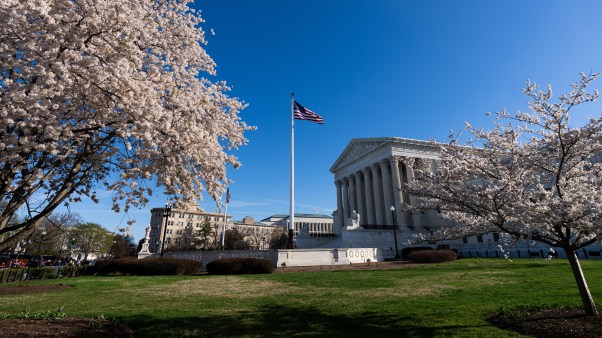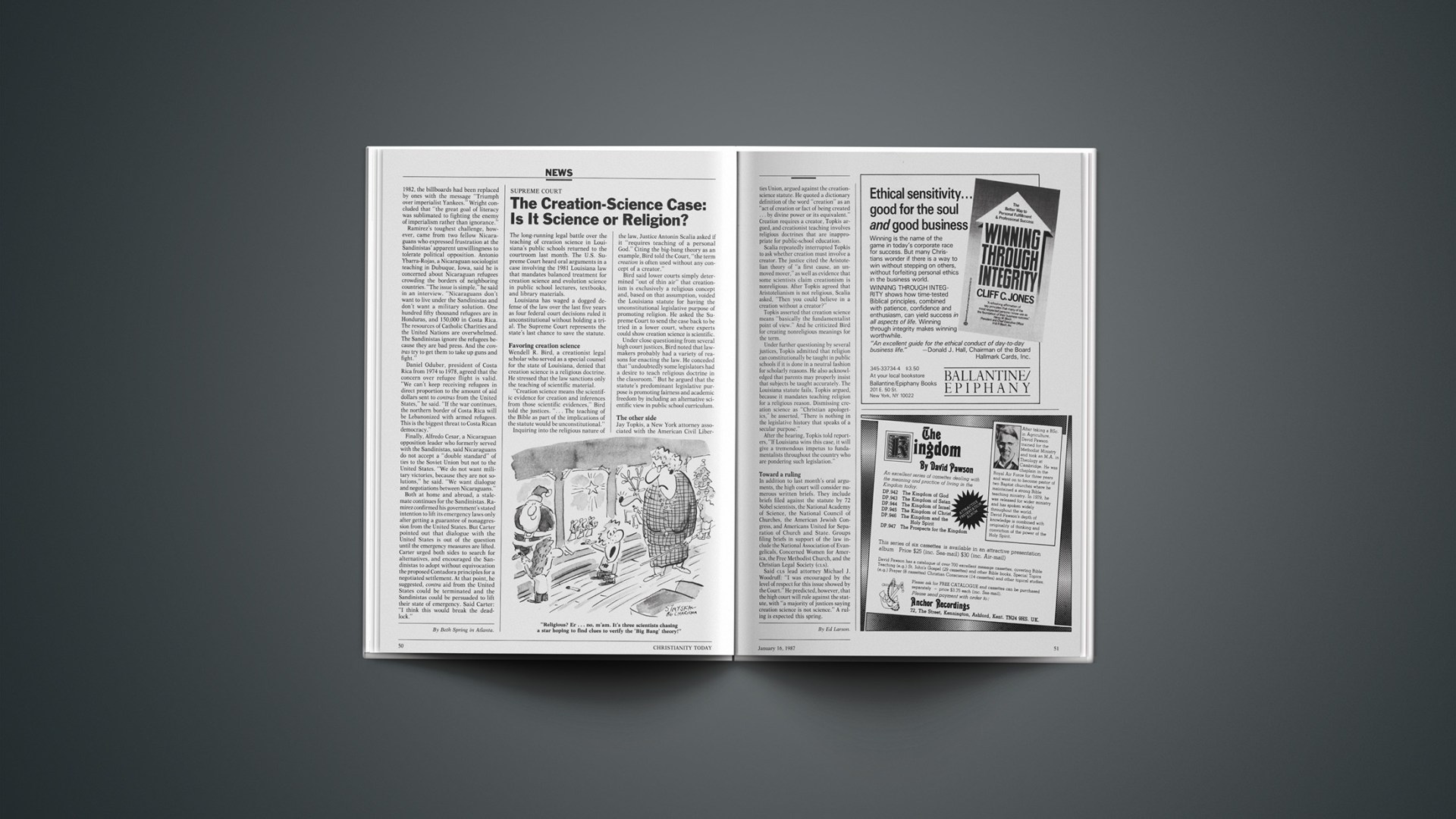

The long-running legal battle over the teaching of creation science in Louisiana’s public schools returned to the courtroom last month. The U.S. Supreme Court heard oral arguments in a case involving the 1981 Louisiana law that mandates balanced treatment for creation science and evolution science in public school lectures, textbooks, and library materials.
Louisiana has waged a dogged defense of the law over the last five years as four federal court decisions ruled it unconstitutional without holding a trial. The Supreme Court represents the state’s last chance to save the statute.
Favoring Creation Science
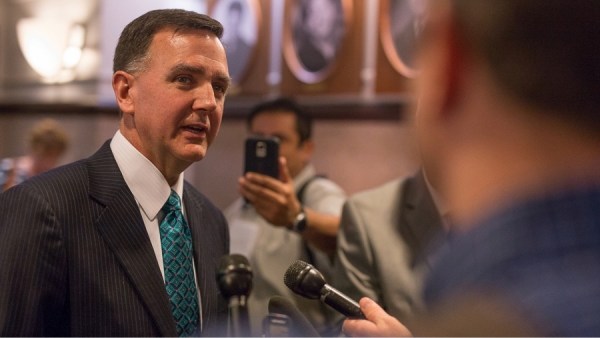
Wendell R. Bird, a creationist legal scholar who served as a special counsel for the state of Louisiana, denied that creation science is a religious doctrine. He stressed that the law sanctions only the teaching of scientific material.
“Creation science means the scientific evidence for creation and inferences from those scientific evidences,” Bird told the justices. “… The teaching of the Bible as part of the implications of the statute would be unconstitutional.”
Inquiring into the religious nature of the law, Justice Antonin Scalia asked if it “requires teaching of a personal God.” Citing the big-bang theory as an example, Bird told the Court, “the term creation is often used without any concept of a creator.”
Bird said lower courts simply determined “out of thin air” that creationism is exclusively a religious concept and, based on that assumption, voided the Louisiana statute for having the unconstitutional legislative purpose of promoting religion. He asked the Supreme Court to send the case back to be tried in a lower court, where experts could show creation science is scientific.
Under close questioning from several high court justices, Bird noted that lawmakers probably had a variety of reasons for enacting the law. He conceded that “undoubtedly some legislators had a desire to teach religious doctrine in the classroom.” But he argued that the statute’s predominant legislative purpose is promoting fairness and academic freedom by including an alternative scientific view in public school curriculum.
The Other Side
Jay Topkis, a New York attorney associated with the American Civil Liberties Union, argued against the creation-science statute. He quoted a dictionary definition of the word “creation” as an “act of creation or fact of being created … by divine power or its equivalent.” Creation requires a creator, Topkis argued, and creationist teaching involves religious doctrines that are inappropriate for public-school education.
Scalia repeatedly interrupted Topkis to ask whether creation must involve a creator. The justice cited the Aristotelian theory of “a first cause, an unmoved mover,” as well as evidence that some scientists claim creationism is nonreligious. After Topkis agreed that Aristotelianism is not religious, Scalia asked, “Then you could believe in a creation without a creator?”
Topkis asserted that creation science means “basically the fundamentalist point of view.” And he criticized Bird for creating nonreligious meanings for the term.
Under further questioning by several justices, Topkis admitted that religion can constitutionally be taught in public schools if it is done in a neutral fashion for scholarly reasons. He also acknowledged that parents may properly insist that subjects be taught accurately. The Louisiana statute fails, Topkis argued, because it mandates teaching religion for a religious reason. Dismissing creation science as “Christian apologetics,” he asserted, “There is nothing in the legislative history that speaks of a secular purpose.”
After the hearing, Topkis told reporters, “If Louisiana wins this case, it will give a tremendous impetus to fundamentalists throughout the country who are pondering such legislation.”
Toward A Ruling
In addition to last month’s oral arguments, the high court will consider numerous written briefs. They include briefs filed against the statute by 72 Nobel scientists, the National Academy of Science, the National Council of Churches, the American Jewish Congress, and Americans United for Separation of Church and State. Groups filing briefs in support of the law include the National Association of Evangelicals, Concerned Women for America, the Free Methodist Church, and the Christian Legal Society (CLS).
Said CLS lead attorney Michael J. Woodruff: “I was encouraged by the level of respect for this issue showed by the Court.” He predicted, however, that the high court will rule against the statute, with “a majority of justices saying creation science is not science.” A ruling is expected this spring.
By Ed Larson.