
Three key decisions appear to have settled the question of the constitutionality of the death penalty itself.
The first, decided in 1972, involved a murder case from Georgia and two rape cases, one from Georgia and the other from Texas. It has come to be known as Furman v. Georgia.
The decision was hardly unambiguous. The Court was able to agree only on a brief opinion (and that by a five-to-four vote), with each justice writing his own lengthy concurring or dissenting opinion. Each attempted to clarify what was “cruel and unusual punishment.”
The brief opinion on which they did agree held that the death penalty was administered (under certain statutes) in such an arbitrary and capricious manner that it was cruel and unusual punishment and violated the Eighth and Fourteenth Amendments. In Justice Potter Stewart’s words, the death penalty was as “freakishly” imposed as if the defendant were “struck by lightning.” In so ruling, the Court invalidated death penalty statutes in 39 states and the District of Columbia, as well as sections of federal law, and forced state courts to resentence the more than 600 persons then on death row.
The opinion, however, did not conclude that the death penalty itself was unconstitutional. Several justices did suggest that the decline in death sentences in the 1960s demonstrated that the current “standards of decency” made execution cruel and unusual, but they were unable to get a majority of their brethren to agree.
Mandatory sentences and guided discretion
Over the next four years, 35 states adopted new death penalty statutes, attempting to address the issue of arbitrariness in one of two ways: Some, like North Carolina, passed mandatory death penalty statutes. This removed all discretion from the sentencer, and provided that a person convicted of a capital offense had to be executed. Others, like Georgia, established “guided discretion” statutes that clarified for the sentencer (usually a jury) the procedures that must be followed in imposing a death sentence, and which factors were appropriate to consider in making that decision.
In 1976, the Supreme Court ruled on the constitutionality of these new sentencing schemes in Gregg v. Georgia and four companion cases. For the first time, the Court held that the death penalty itself was not cruel and unusual punishment. Noting that most state legislatures had passed new death penalty statutes since its Furman decision, the Court ruled that execution had such substantial public support that it could not violate current “standards of decency.” “In part,” it held, “capital punishment is an expression of society’s moral outrage at particularly offensive conduct.” The Court conceded that evidence of deterrence was inconclusive, but held that the real issue was one of proportionality, and concluded that when compared to murder (all the cases before it involved murder), the death penalty could not be viewed as disproportionate.
The Court did rule mandatory death-penalty statutes unconstitutional. Once an offender was convicted of murder, it reasoned, mandatory imposition of capital punishment would treat “all persons convicted of a designated offense not as uniquely individual human beings, but as members of a faceless, undifferentiated mass.…”
It further noted that, historically, when the death penalty was mandatory, juries simply refused to convict individuals they thought should not be executed. Since there was no guidance to juries (and there could be none under the mandatory statutes) in determining which murderers should receive the death penalty, mandatory death sentences actually perpetuated arbitrary and capricious use of the death penalty.
On the other hand, “guided discretion” statutes were upheld as constitutional. Citing three protections in the Georgia statute, the Court concluded that juries would have an opportunity to hear all pertinent evidence, were provided with explicit factors that would lead to the death sentence, and could be overruled, in the event they made a mistake, by mandatory review by the Georgia Supreme Court.
One year later, in the third significant decision, Coker v. Georgia, the Court held that the death penalty was unconstitutional when imposed for the crime of rape, since in such cases it violated the requirement of proportionality.
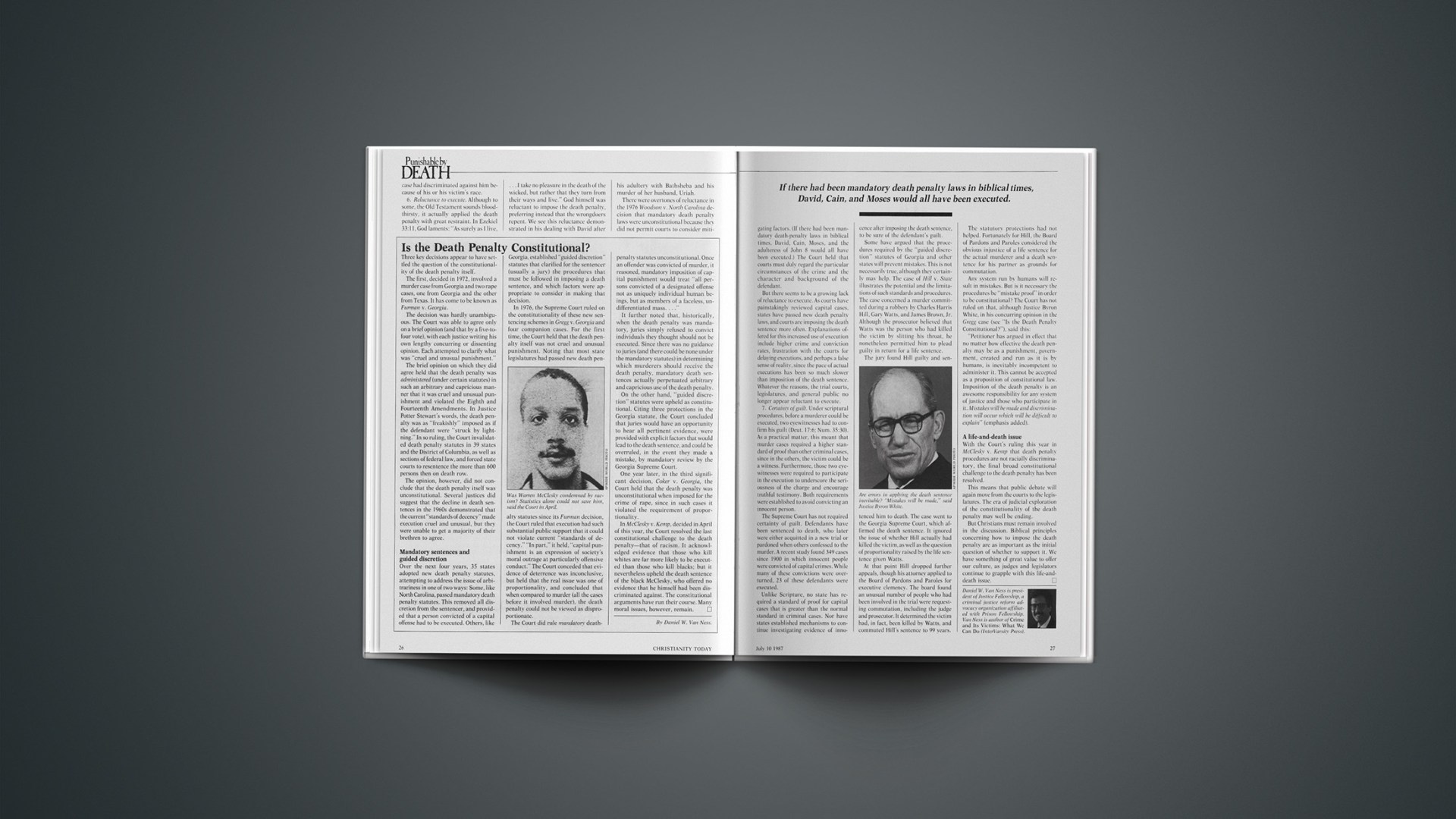
In McClesky v. Kemp, decided in April of this year, the Court resolved the last constitutional challenge to the death penalty—that of racism. It acknowledged evidence that those who kill whites are far more likely to be executed than those who kill blacks; but it nevertheless upheld the death sentence of the black McClesky, who offered no evidence that he himself had been discriminated against. The constitutional arguments have run their course. Many moral issues, however, remain.
By Daniel W. Van Ness.