
MINISTRY
Martin Luther, and Saint Augustine before him, maintained that it was impossible for deaf people to be saved because they were unable to hear the Word of God proclaimed. The church has certainly come a long way in its attitude toward the disabled. And although by most accounts the church still has a long way to go, advocates of ministry to the disabled believe the three-day Congress on the Church and the Disabled, held last month in Wheaton, Illinois, was a major step in a good direction.
Some 675 people associated with ministries to the disabled attended the first-of-its-kind event, sponsored by the Christian Fund for the Disabled (Joni and Friends) and the Billy Graham Center at Wheaton College. Among the registrants, who came from 40 states and four foreign countries, 12 were blind, 25 deaf, and 60 in wheelchairs.
Despite countless local church ministries to the handicapped, no umbrella organization exists for people involved in these ministries. Thus, the gathering provided an unprecedented opportunity for the exchange of ideas and resources.
Various speakers discussed ministry opportunities for churches—such as providing weekend breaks for parents of disabled children who require virtually constant attention. One father at the conference told of his 26-year-old child who has the mental capacity of a baby of 11 months. The leaders at one workshop discussed legal issues facing the disabled, such as the movement to allow severely handicapped infants to die. Attorney Paige Cunningham said this attitude toward life leads her to conclude that “if a handicapped newborn is at risk, so are handicapped adults.”
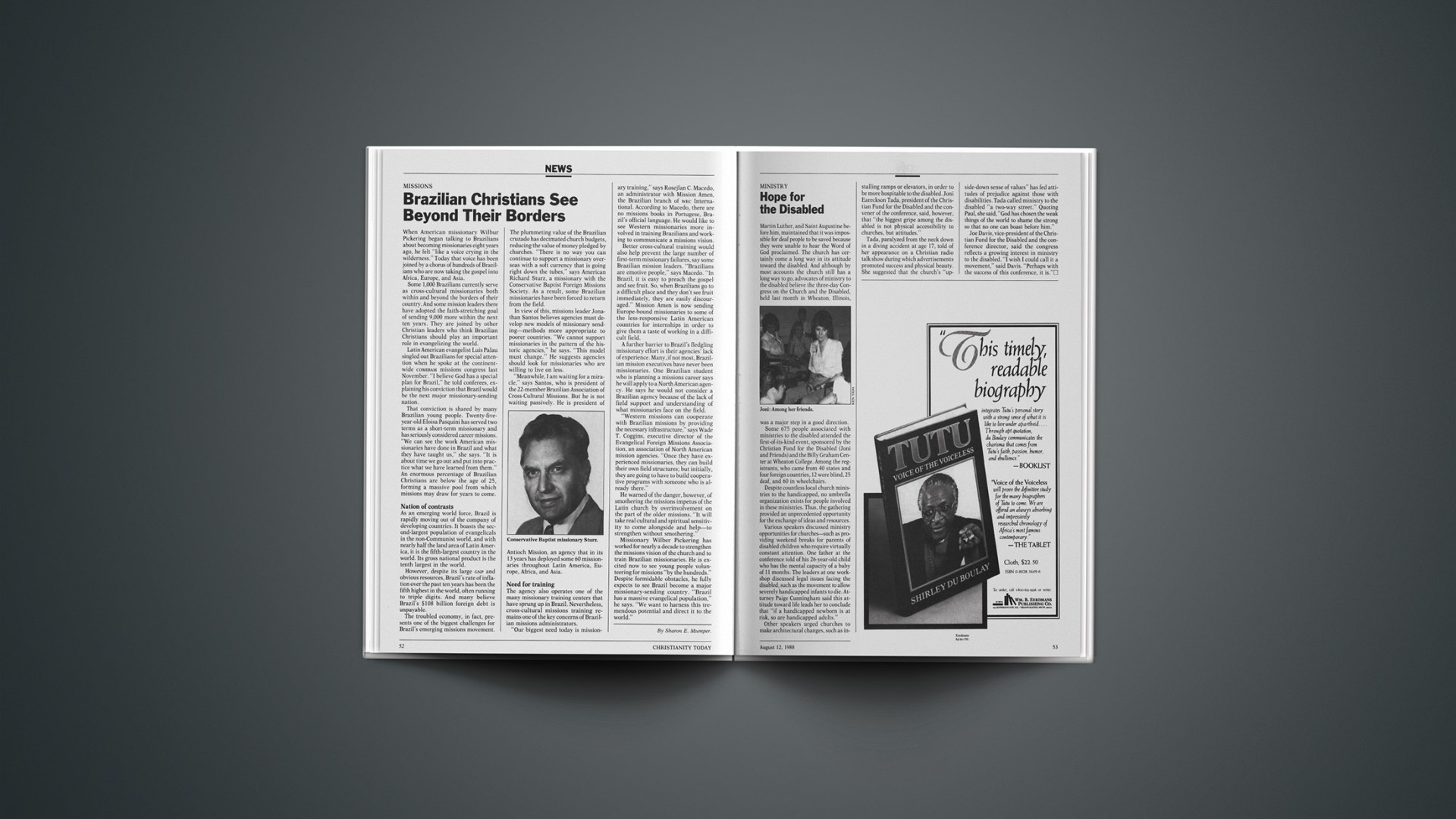
Other speakers urged churches to make architectural changes, such as installing ramps or elevators, in order to be more hospitable to the disabled. Joni Eareckson Tada, president of the Christian Fund for the Disabled and the convener of the conference, said, however, that “the biggest gripe among the disabled is not physical accessibility to churches, but attitudes.”
Tada, paralyzed from the neck down in a diving accident at age 17, told of her appearance on a Christian radio talk show during which advertisements promoted success and physical beauty. She suggested that the church’s “upside-down sense of values” has fed attitudes of prejudice against those with disabilities. Tada called ministry to the disabled “a two-way street.” Quoting Paul, she said, “God has chosen the weak things of the world to shame the strong so that no one can boast before him.” Joe Davis, vice-president of the Christian Fund for the Disabled and the conference director, said the congress reflects a growing interest in ministry to the disabled. “I wish I could call it a movement,” said Davis. “Perhaps with the success of this conference, it is.”