
The uproar over El Salvador's July decree that the Bible must be read daily in public schools came largely from the nation's pastors.
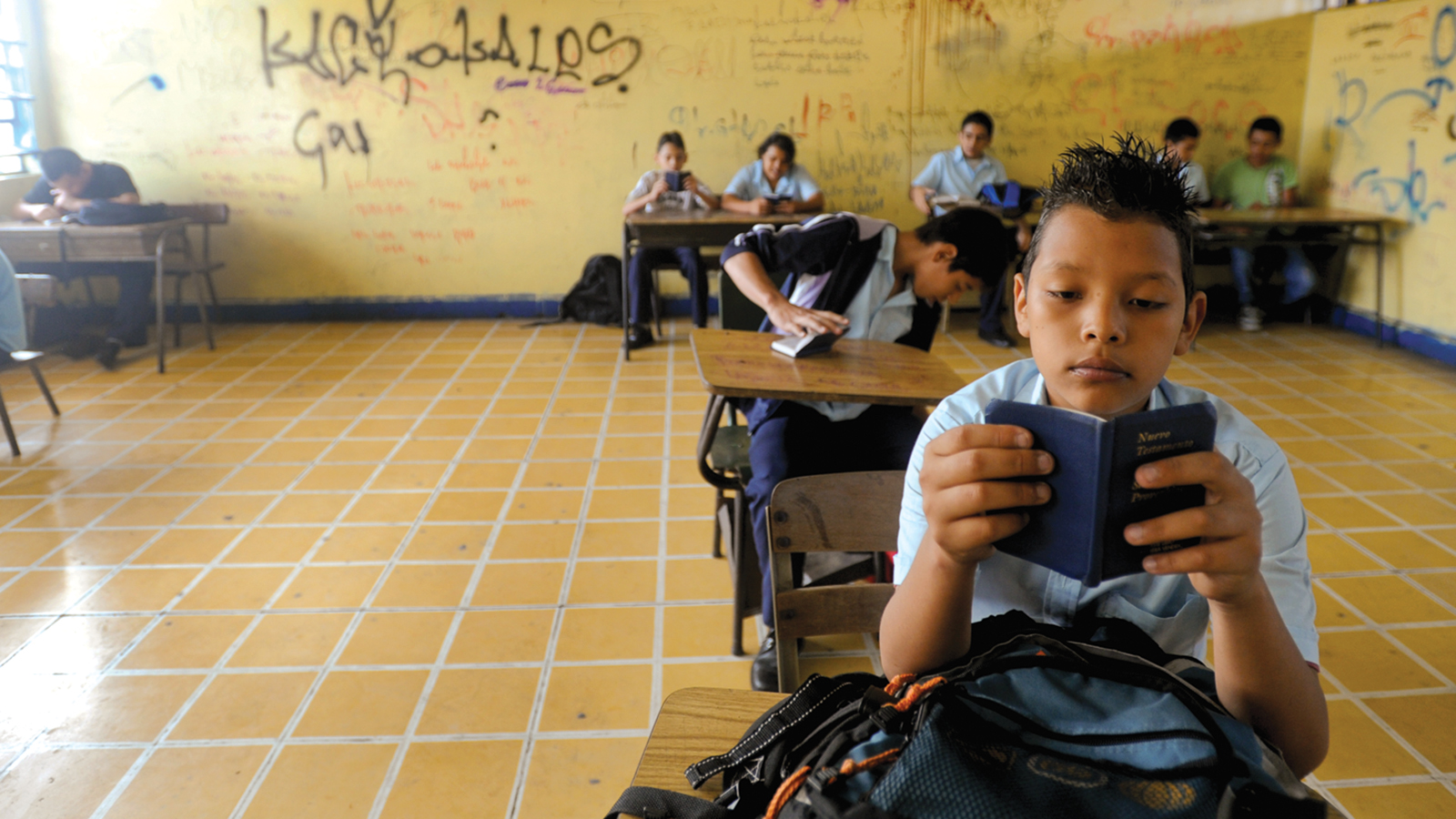
On July 1, the Legislative Assembly passed Decreto 411, mandating that schools begin each day with seven minutes of Bible reading without commentary. The goal: to teach morality to students to prevent them from joining the violent gangs plaguing the Central American nation of 6 million. Weeks before, a street gang set fire to a city bus traveling through the outskirts of San Salvador, burning 14 civilians to death.
The law provoked a heated public debate among church leaders.
"Salvadoran society is totally polarized. No gray exists—all is white or black," said Susana Barrera, El Salvador correspondent for the ecumenical news agency ALC. The Evangelical Alliance of El Salvador and many Pentecostal churches largely supported the measure, while Catholics, Anglicans, Lutherans, Baptists, and other historical church bodies largely opposed it.
Opponents said their concern wasn't with the Bible or the power of its words, but with the law. Decreto 411 was passed without consulting church leaders first, and left undefined who would read the Bible, what verses would be read, and which translation would be used. This left room for fears of Catholics and Protestants spinning the chosen texts in their respective favor and concerns about "proselytism."
"Reading the Scriptures can never be bad," said Medardo Goméz, bishop of the Salvadoran Lutheran Church. "[Yet] we believe reading the Bible is not magic."
Juan Carlos Hasbún, president of the Evangelical Alliance of El Salvador, discounted such concerns. "The idea was to read one proverb and one psalm every day, that's it," he said. "Public schools are where most youth [become] gang members. If you present hope, something different, you can impact their lives."
President Mauricio Funes initially supported the law but vetoed it on July 27, asking that religious groups be consulted.
Protestants, who now compose an estimated 40 percent of the historically Catholic nation's population, pushed for such a law twice in the past 12 years. Many want a national strategy for encouraging morality and civics but disagree over methods.
"The deeper issues undergirding the horrendous violence … are complex and demand more strategic intervention, policy, and budget," said Ruth Padilla DeBorst, general secretary of the Latin American Theological Fellowship. She labeled the law a "religious whitewash" that could obscure the Bible's "life-giving message" and "current relevance."
Hasbún acknowledges the complexities. "The Bible reading was not to solve the problem in one day; it was to establish values in the new generation—the guys who are out in the streets skateboarding, who still don't have guns in their hands."
As the government discusses the future of the law with church leaders, some have ideas of other places to start.
"An area where Bible reading must be promoted is the church itself," said Juan Carlos Cárcamo, World Vision coordinator for church relations. "A profound weakness in many churches is that Bible reading has been replaced by alternative liturgical expressions, which are not illegitimate but in terms of transforming lives leave large gaps."
"The problem in El Salvador is not religion; Salvadorans are poor and believers," said Jaime Wilfredo Peña, president of the Baptist Federation. "The problem [is] poverty, marginalization, and exclusion …. This requires more comprehensive [solutions] instead of trying to cover the sun with a finger."
Copyright © 2010 Christianity Today. Click for reprint information.
Related Elsewhere:
Previous coverage of El Salvador, Central America, and education can be found on our site.