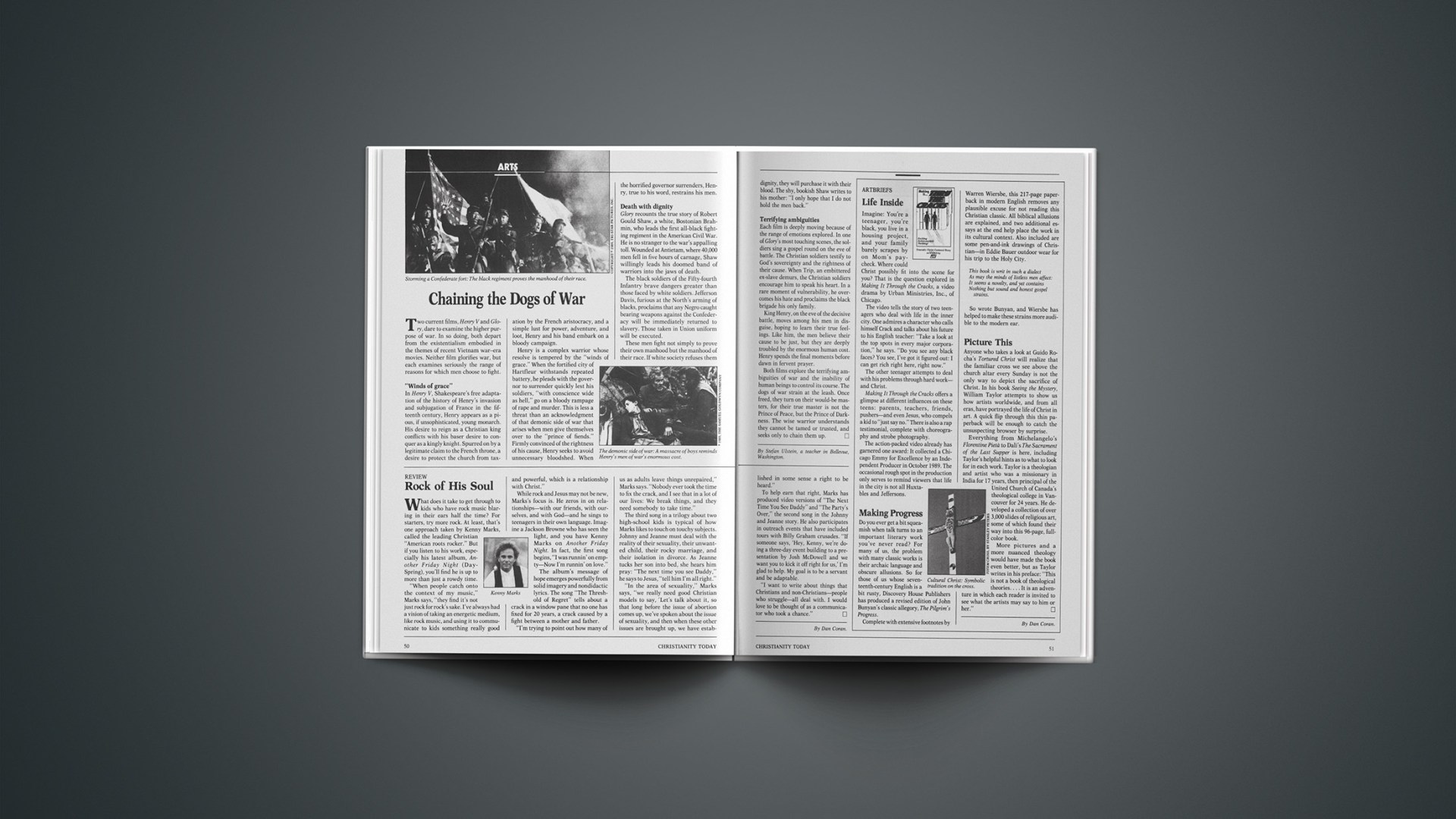

Two current films, Henry V and Glory, dare to examine the higher purpose of war. In so doing, both depart from the existentialism embodied in the themes of recent Vietnam war-era movies. Neither film glorifies war, but each examines seriously the range of reasons for which men choose to fight.
“Winds Of Grace”
In Henry V, Shakespeare’s free adaptation of the history of Henry’s invasion and subjugation of France in the fifteenth century, Henry appears as a pious, if unsophisticated, young monarch. His desire to reign as a Christian king conflicts with his baser desire to conquer as a kingly knight. Spurred on by a legitimate claim to the French throne, a desire to protect the church from taxation by the French aristocracy, and a simple lust for power, adventure, and loot, Henry and his band embark on a bloody campaign.
Henry is a complex warrior whose resolve is tempered by the “winds of grace.” When the fortified city of Hartfleur withstands repeated battery, he pleads with the governor to surrender quickly lest his soldiers, “with conscience wide as hell,” go on a bloody rampage of rape and murder. This is less a threat than an acknowledgment of that demonic side of war that arises when men give themselves over to the “prince of fiends.” Firmly convinced of the rightness of his cause, Henry seeks to avoid unnecessary bloodshed. When the horrified governor surrenders, Henry, true to his word, restrains his men.
Death With Dignity
Glory recounts the true story of Robert Gould Shaw, a white, Bostonian Brahmin, who leads the first all-black fighting regiment in the American Civil War. He is no stranger to the war’s appalling toll. Wounded at Antietam, where 40,000 men fell in five hours of carnage, Shaw willingly leads his doomed band of warriors into the jaws of death.
The black soldiers of the Fifty-fourth Infantry brave dangers greater than those faced by white soldiers. Jefferson Davis, furious at the North’s arming of blacks, proclaims that any Negro caught bearing weapons against the Confederacy will be immediately returned to slavery. Those taken in Union uniform will be executed.
These men fight not simply to prove their own manhood but the manhood of their race. If white society refuses them dignity, they will purchase it with their blood. The shy, bookish Shaw writes to his mother: “I only hope that I do not hold the men back.”
Terrifying Ambiguities
Each film is deeply moving because of the range of emotions explored. In one of Glory’s most touching scenes, the soldiers sing a gospel round on the eve of battle. The Christian soldiers testify to God’s sovereignty and the rightness of their cause. When Trip, an embittered ex-slave demurs, the Christian soldiers encourage him to speak his heart. In a rare moment of vulnerability, he overcomes his hate and proclaims the black brigade his only family.
King Henry, on the eve of the decisive battle, moves among his men in disguise, hoping to learn their true feelings. Like him, the men believe their cause to be just, but they are deeply troubled by the enormous human cost. Henry spends the final moments before dawn in fervent prayer.
Both films explore the terrifying ambiguities of war and the inability of human beings to control its course. The dogs of war strain at the leash. Once freed, they turn on their would-be masters, for their true master is not the Prince of Peace, but the Prince of Darkness. The wise warrior understands they cannot be tamed or trusted, and seeks only to chain them up.
By Stefan Ulstein, a teacher in Bellevue, Washington.