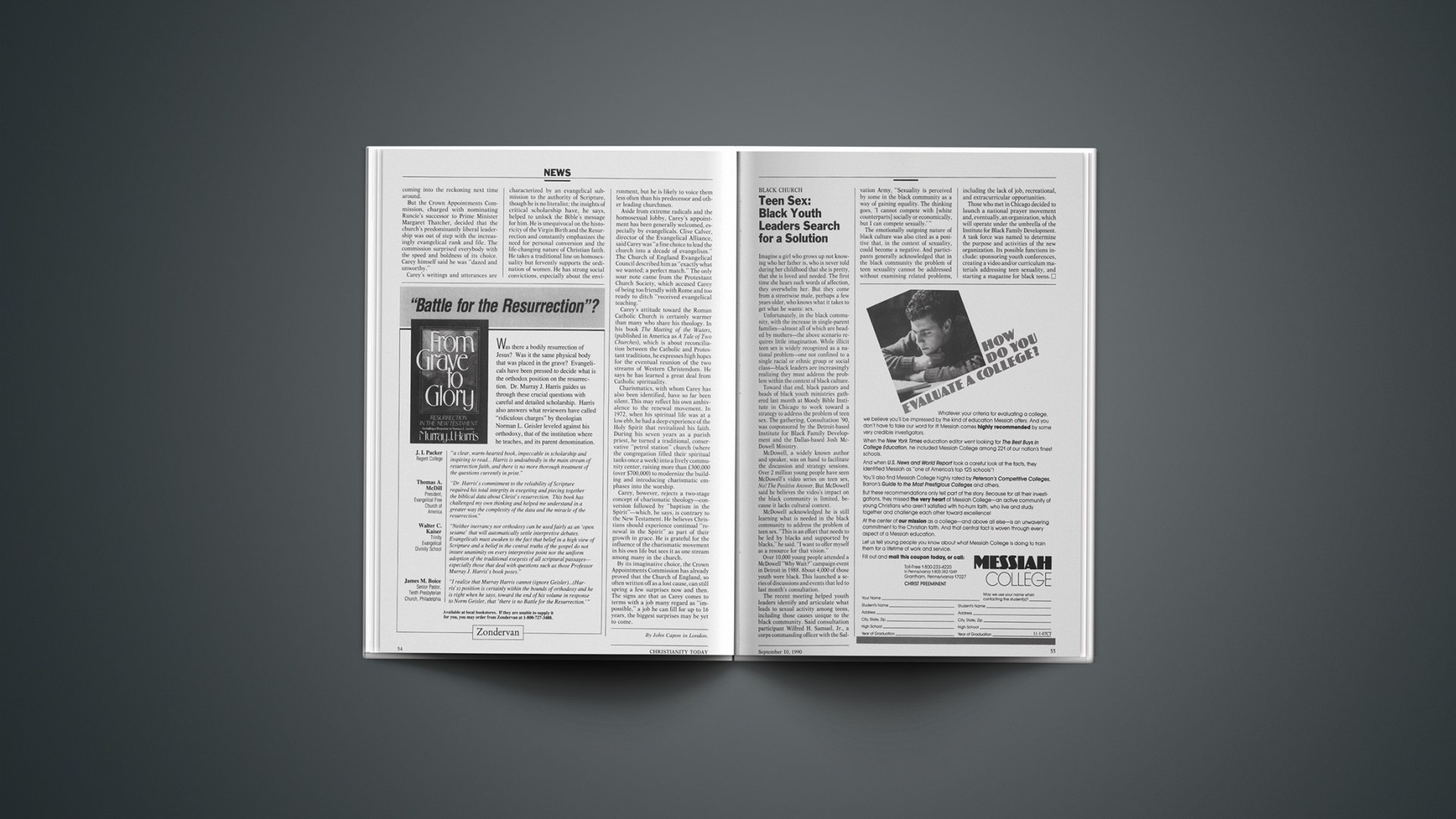

Imagine a girl who grows up not knowing who her father is, who is never told during her childhood that she is pretty, that she is loved and needed. The first time she hears such words of affection, they overwhelm her. But they come from a streetwise male, perhaps a few years older, who knows what it takes to get what he wants: sex.
Unfortunately, in the black community, with the increase in single-parent families—almost all of which are headed by mothers—the above scenario requires little imagination. While illicit teen sex is widely recognized as a national problem—one not confined to a single racial or ethnic group or social class—black leaders are increasingly realizing they must address the problem within the context of black culture.
Toward that end, black pastors and heads of black youth ministries gathered last month at Moody Bible Institute in Chicago to work toward a strategy to address the problem of teen sex. The gathering, Consultation ’90, was cosponsored by the Detroit-based Institute for Black Family Development and the Dallas-based Josh McDowell Ministry.
McDowell, a widely known author and speaker, was on hand to facilitate the discussion and strategy sessions. Over 2 million young people have seen McDowell’s video series on teen sex, No! The Positive Answer. But McDowell said he believes the video’s impact on the black community is limited, because it lacks cultural context.
McDowell acknowledged he is still learning what is needed in the black community to address the problem of teen sex. “This is an effort that needs to be led by blacks and supported by blacks,” he said. “I want to offer myself as a resource for that vision.”
Over 10,000 young people attended a McDowell “Why Wait?” campaign event in Detroit in 1988. About 4,000 of those youth were black. This launched a series of discussions and events that led to last month’s consultation.
The recent meeting helped youth leaders identify and articulate what leads to sexual activity among teens, including those causes unique to the black community. Said consultation participant Wilfred H. Samuel, Jr., a corps commanding officer with the Salvation Army, “Sexuality is perceived by some in the black community as a way of gaining equality. The thinking goes, ‘I cannot compete with [white counterparts] socially or economically, but I can compete sexually.’ ”
The emotionally outgoing nature of black culture was also cited as a positive that, in the context of sexuality, could become a negative. And participants generally acknowledged that in the black community the problem of teen sexuality cannot be addressed without examining related problems, including the lack of job, recreational, and extracurricular opportunities.
Those who met in Chicago decided to launch a national prayer movement and, eventually, an organization, which will operate under the umbrella of the Institute for Black Family Development. A task force was named to determine the purpose and activities of the new organization. Its possible functions include: sponsoring youth conferences, creating a video and/or curriculum materials addressing teen sexuality, and starting a magazine for black teens.