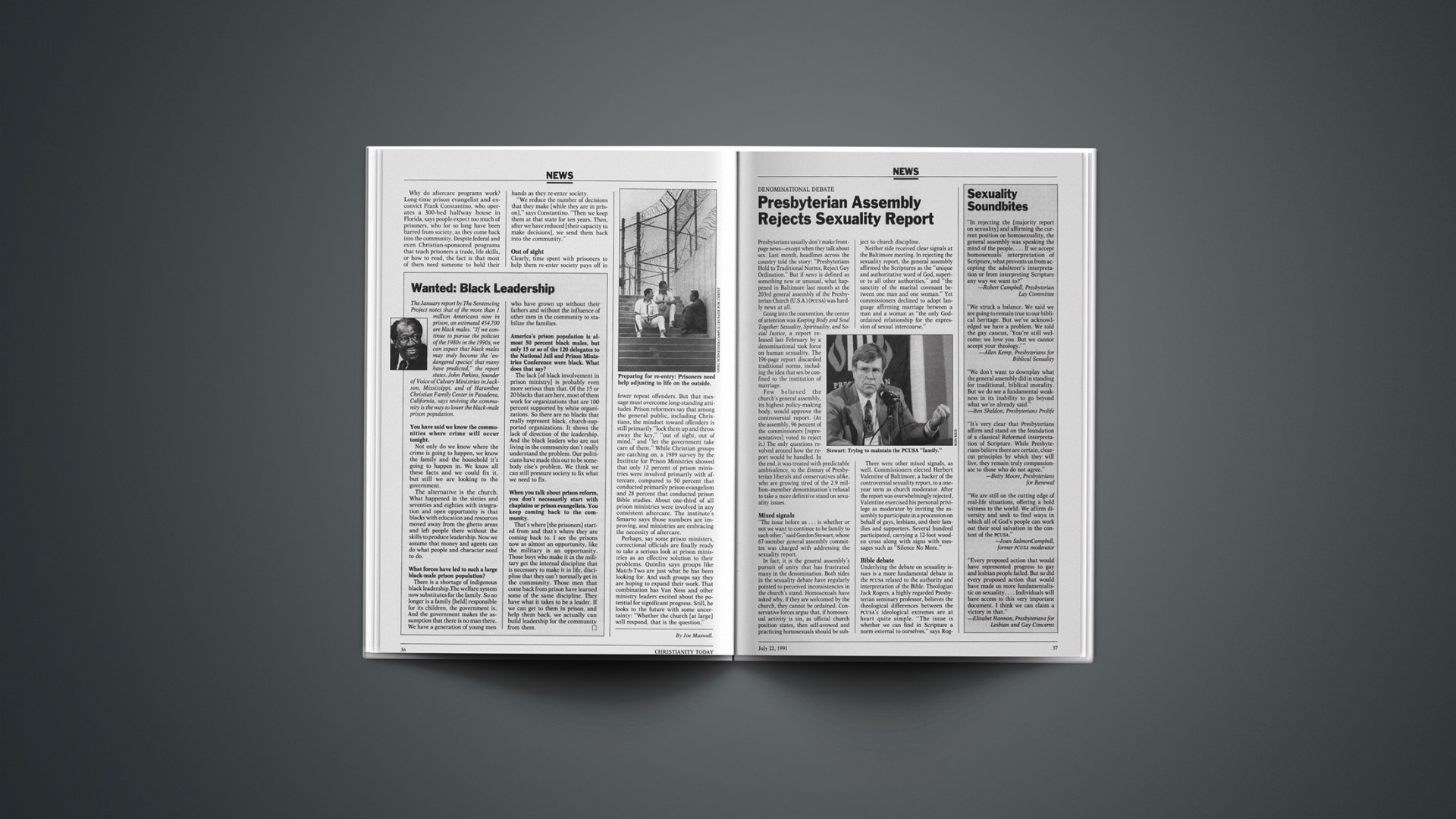

Presbyterians usually don’t make front-page news—except when they talk about sex. Last month, headlines across the country told the story: “Presbyterians Hold to Traditional Norms, Reject Gay Ordination.” But if news is defined as something new or unusual, what happened in Baltimore last month at the 203rd general assembly of the Presbyterian Church (U.S.A.) (PCUSA) was hardly news at all.
Going into the convention, the center of attention was Keeping Body and Soul Together: Sexuality, Spirituality, and Social Justice, a report released last February by a denominational task force on human sexuality. The 196-page report discarded traditional norms, including the idea that sex be confined to the institution of marriage.
Few believed the church’s general assembly, its highest policy-making body, would approve the controversial report. (At the assembly, 96 percent of the commissioners [representatives] voted to reject it.) The only questions revolved around how the report would be handled. In the end, it was treated with predictable ambivalence, to the dismay of Presbyterian liberals and conservatives alike, who are growing tired of the 2.9 million-member denomination’s refusal to take a more definitive stand on sexuality issues.
Mixed Signals
“The issue before us … is whether or not we want to continue to be family to each other,” said Gordon Stewart, whose 67-member general assembly committee was charged with addressing the sexuality report.
In fact, it is the general assembly’s pursuit of unity that has frustrated many in the denomination. Both sides in the sexuality debate have regularly pointed to perceived inconsistencies in the church’s stand. Homosexuals have asked why, if they are welcomed by the church, they cannot be ordained. Conservative forces argue that, if homosexual activity is sin, as official church position states, then self-avowed and practicing homosexuals should be subject to church discipline.
Neither side received clear signals at the Baltimore meeting. In rejecting the sexuality report, the general assembly affirmed the Scriptures as the “unique and authoritative word of God, superior to all other authorities,” and “the sanctity of the marital covenant between one man and one woman.” Yet commissioners declined to adopt language affirming marriage between a man and a woman as “the only God-ordained relationship for the expression of sexual intercourse.”
There were other mixed signals, as well. Commissioners elected Herbert Valentine of Baltimore, a backer of the controversial sexuality report, to a one-year term as church moderator. After the report was overwhelmingly rejected, Valentine exercised his personal privilege as moderator by inviting the assembly to participate in a procession on behalf of gays, lesbians, and their families and supporters. Several hundred participated, carrying a 12-foot wooden cross along with signs with messages such as “Silence No More.”
Bible Debate
Underlying the debate on sexuality issues is a more fundamental debate in the PCUSA related to the authority and interpretation of the Bible. Theologian Jack Rogers, a highly regarded Presbyterian seminary professor, believes the theological differences between the PCUSA’s ideological extremes are at heart quite simple. “The issue is whether we can find in Scripture a norm external to ourselves,” says Rogers, “a revelation that tells us what is right and wrong.”
He adds, “One side says ‘yes’ to this question. The other side tends to regard individual experience as normative and to interpret Scripture accordingly.”
“The bottom-line issue in this debate was not human sexuality,” said John Huffman, senior minister of Saint Andrew’s Presbyterian Church in Newport Beach, California. “It was and is biblical authority.”
Huffman was a candidate for moderator until a family illness caused him to withdraw. While commending the denomination’s willingness to tackle such a controversial issue, he said, “The rejected document was fatally flawed in the way in which it both implicitly and explicitly declared that what the Bible says is sin is no longer sin.”
James Anderson of Presbyterians for Lesbian and Gay Concerns, however, maintains the issue was not so simple as theological liberals versus conservatives. According to Anderson, people who hold to a high view of Scripture may understand its teaching on homosexuality differently.
Besides Sex
Although most of the commissioners’ attention was occupied by the sexuality debate, they did address other issues. The general assembly adopted a resolution petitioning the Cuban government for “a fuller respect of religious liberty” and requesting that Presbyterian delegations visiting Cuba express to Cuban officials their concern for religious liberty.
Two resolutions calling for “concrete help” for women in crisis pregnancies were adopted. The abortion issue also surfaced in discussion of pensions and benefits. Some Presbyterian pastors have risked losing their benefits by refusing to contribute to the church’s medical plan, which offers unrestricted coverage of abortion. The issue was referred to a special committee; in the meantime, those choosing not to participate in the plan do so without financial risk.
Commissioners also adopted two resolutions aimed at increasing diversity both in the makeup of denominational committees and in the viewpoints they express. “There seemed to be a mood [at the assembly] to re-examine the process by which we arrive at positions on controversial issues, to make that process more open and accountable,” said Allen Wisdom of Presbyterians for Democracy and Religious Freedom, adding that he was uncertain whether that mood will lead to substantive change.
By Randy Frame in Baltimore.
Sexuality Soundbites
“In rejecting the [majority report on sexuality] and affirming the current position on homosexuality, the general assembly was speaking the mind of the people.… If we accept homosexuals’ interpretation of Scripture, what prevents us from accepting the adulterer’s interpretation or from interpreting Scripture any way we want to?”
—Robert Campbell, Presbyterian
Lay Committee
“We struck a balance. We said we are going to remain true to our biblical heritage. But we’ve acknowledged we have a problem. We told the gay caucus, ‘You’re still welcome; we love you. But we cannot accept your theology.’ ”
—Allen Kemp, Presbyterians for Biblical Sexuality
“We don’t want to downplay what the general assembly did in standing for traditional, biblical morality. But we do see a fundamental weakness in its inability to go beyond what we’ve already said.”
—Ben Sheldon, Presbyterians Prolife
“It’s very clear that Presbyterians affirm and stand on the foundation of a classical Reformed interpretation of Scripture. While Presbyterians believe there are certain, clear-cut principles by which they will live, they remain truly compassionate to those who do not agree.”
—Betty Moore, Presbyterians for Renewal
“We are still on the cutting edge of real-life situations, offering a bold witness to the world. We affirm diversity and seek to find ways in which all of God’s people can work out their soul salvation in the context of the PCUSA.”
—Joan SalmonCampbell, former PCUSA moderator
“Every proposed action that would have represented progress to gay and lesbian people failed. But so did every proposed action that would have made us more fundamentalistic on sexuality.… Individuals will have access to this very important document. I think we can claim a victory in that.”
—Elisabet Hannon, Presbyterians for Lesbian and Gay Concerns