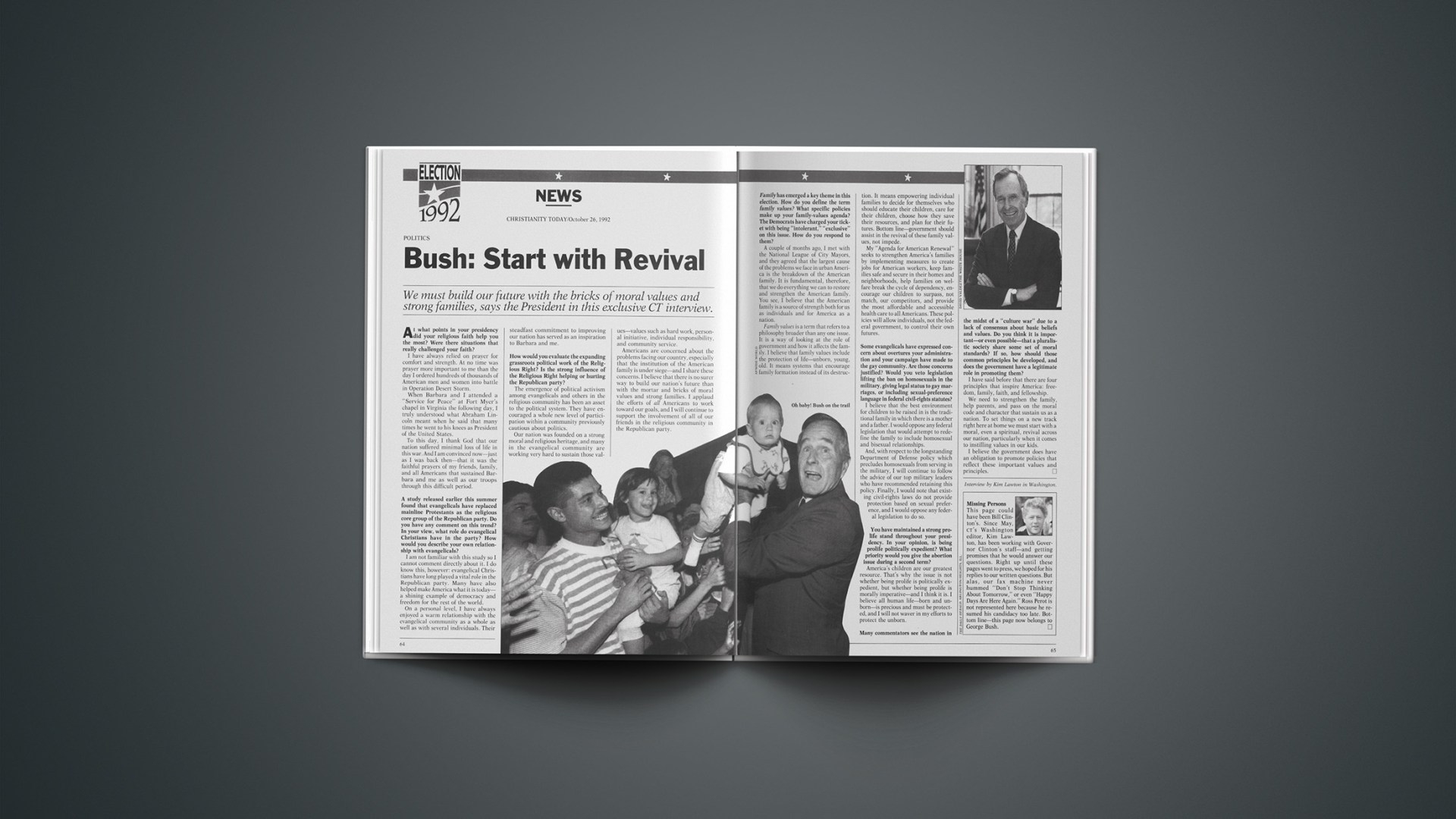

We must build our future with the bricks of moral values and strong families, says the President in this exclusive CT interview.
At what points in your presidency did your religious faith help you the most? Were there situations that really challenged your faith?
I have always relied on prayer for comfort and strength. At no time was prayer more important to me than the day I ordered hundreds of thousands of American men and women into battle in Operation Desert Storm.
When Barbara and I attended a “Service for Peace” at Fort Myer’s chapel in Virginia the following day, I truly understood what Abraham Lincoln meant when he said that many times he went to his knees as President of the United States.
To this day, I thank God that our nation suffered minimal loss of life in this war. And I am convinced now—just as I was back then—that it was the faithful prayers of my friends, family, and all Americans that sustained Barbara and me as well as our troops through this difficult period.
A study released earlier this summer found that evangelicals have replaced mainline Protestants as the religious core group of the Republican party. Do you have any comment on this trend? In your view, what role do evangelical Christians have in the party? How would you describe your own relationship with evangelicals?
I am not familiar with this study so I cannot comment directly about it. I do know this, however: evangelical Christians have long played a vital role in the Republican party. Many have also helped make America what it is today—a shining example of democracy and freedom for the rest of the world.
On a personal level, I have always enjoyed a warm relationship with the evangelical community as a whole as well as with several individuals. Their steadfast commitment to improving our nation has served as an inspiration to Barbara and me.
How would you evaluate the expanding grassroots political work of the Religious Right? Is the strong influence of the Religious Right helping or hurting the Republican party?
The emergence of political activism among evangelicals and others in the religious community has been an asset to the political system. They have encouraged a whole new level of participation within a community previously cautious about politics.
Our nation was founded on a strong moral and religious heritage, and many in the evangelical community are working very hard to sustain those values—values such as hard work, personal initiative, individual responsibility, and community service.
Americans are concerned about the problems facing our country, especially that the institution of the American family is under siege—and I share these concerns. I believe that there is no surer way to build our nation’s future than with the mortar and bricks of moral values and strong families. I applaud the efforts of all Americans to work toward our goals, and I will continue to support the involvement of all of our friends in the religious community in the Republican party.
Family has emerged a key theme in this election. How do you define the term family values? What specific policies make up your family-values agenda? The Democrats have charged your ticket with being “intolerant,” “exclusive” on this issue. How do you respond to them?
A couple of months ago, I met with the National League of City Mayors, and they agreed that the largest cause of the problems we face in urban America is the breakdown of the American family. It is fundamental, therefore, that we do everything we can to restore and strengthen the American family. You see, I believe that the American family is a source of strength both for us as individuals and for America as a nation.
Family values is a term that refers to a philosophy broader than any one issue. It is a way of looking at the role of government and how it affects the family. I believe that family values include the protection of life—unborn, young, old. It means systems that encourage family formation instead of its destruction. It means empowering individual families to decide for themselves who should educate their children, care for their children, choose how they save their resources, and plan for their futures. Bottom line—government should assist in the revival of these family values, not impede.
My “Agenda for American Renewal” seeks to strengthen America’s families by implementing measures to create jobs for American workers, keep families safe and secure in their homes and neighborhoods, help families on welfare break the cycle of dependency, encourage our children to surpass, not match, our competitors, and provide the most affordable and accessible health care to all Americans. These policies will allow individuals, not the federal government, to control their own futures.
Some evangelicals have expressed concern about overtures your administration and your campaign have made to the gay community. Are those concerns justified? Would you veto legislation lifting the ban on homosexuals in the military, giving legal status to gay marriages, or including sexual-preference language in federal civil-rights statutes?
I believe that the best environment for children to be raised in is the traditional family in which there is a mother and a father. I would oppose any federal legislation that would attempt to redefine the family to include homosexual and bisexual relationships.
And, with respect to the longstanding Department of Defense policy which precludes homosexuals from serving in the military, I will continue to follow the advice of our top military leaders who have recommended retaining this policy. Finally, I would note that existing civil-rights laws do not provide protection based on sexual preference, and I would oppose any federal legislation to do so.
You have maintained a strong prolife stand throughout your presidency. In your opinion, is being prolife politically expedient? What priority would you give the abortion issue during a second term?
America’s children are our greatest resource. That’s why the issue is not whether being prolife is politically expedient, but whether being prolife is morally imperative—and I think it is. I believe all human life—born and unborn—is precious and must be protected, and I will not waver in my efforts to protect the unborn.
Many commentators see the nation in the midst of a “culture war” due to a lack of consensus about basic beliefs and values. Do you think it is important—or even possible—that a pluralistic society share some set of moral standards? If so, how should those common principles be developed, and does the government have a legitimate role in promoting them?
I have said before that there are four principles that inspire America: freedom, family, faith, and fellowship.
We need to strengthen the family, help parents, and pass on the moral code and character that sustain us as a nation. To set things on a new track right here at home we must start with a moral, even a spiritual, revival across our nation, particularly when it comes to instilling values in our kids.
I believe the government does have an obligation to promote policies that reflect these important values and principles.
Interview by Kim Lawton in Washington.
Missing Persons
This page could have been Bill Clinton’s. Since May, CT’s Washington editor, Kim Lawton, has been working with Governor Clinton’s staff—and getting promises that he would answer our questions. Right up until these pages went to press, we hoped for his replies to our written questions. But alas, our fax machine never hummed “Don’t Stop Thinking About Tomorrow,” or even “Happy Days Are Here Again.” Ross Perot is not represented here because he resumed his candidacy too late. Bottom line—this page now belongs to George Bush.