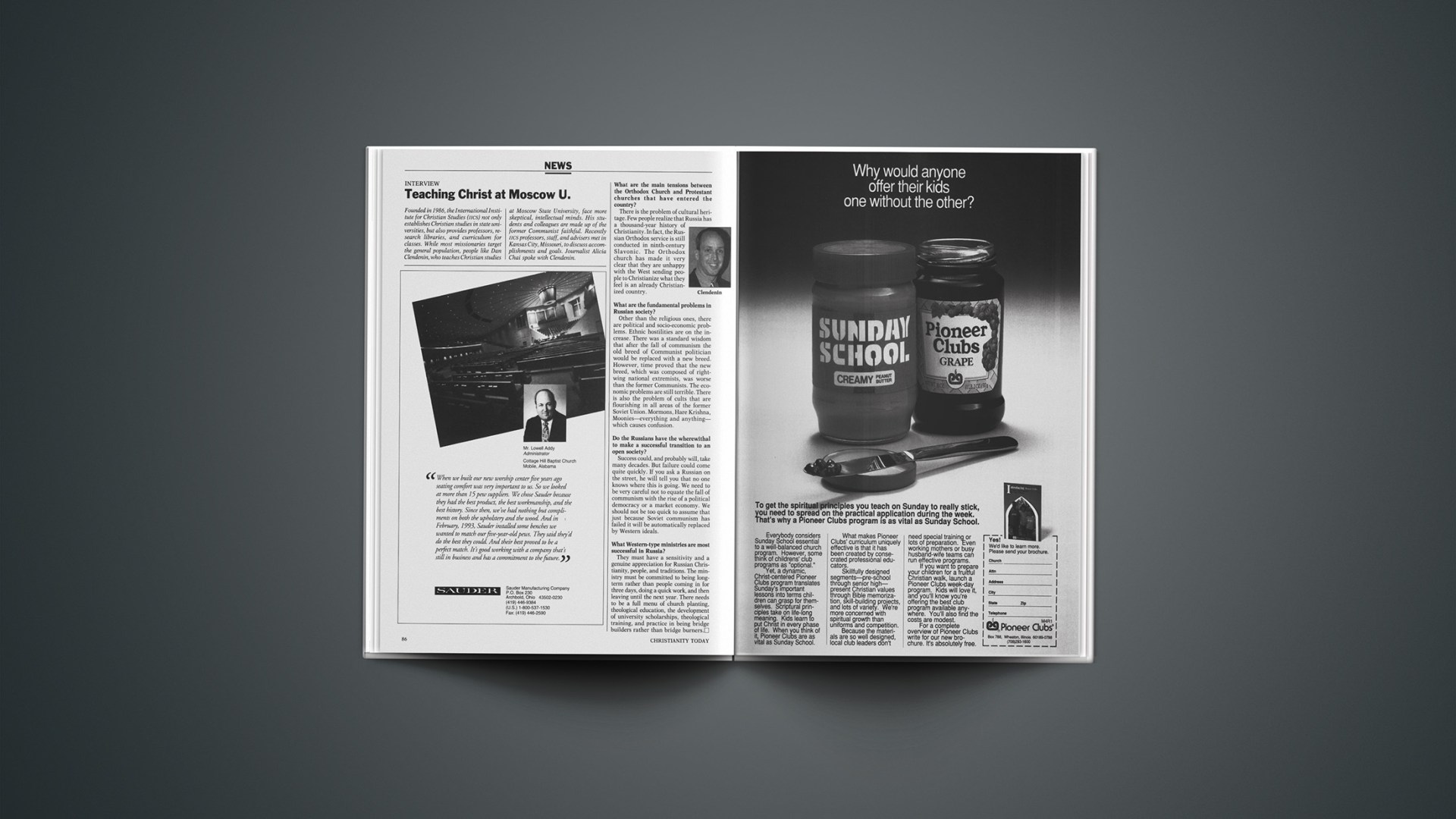

Founded in 1986, the International Institute for Christian Studies (IICS) not only establishes Christian studies in state universities, but also provides professors, research libraries, and curriculum for classes. While most missionaries target the general population, people like Dan Clendenin, who teaches Christian studies at Moscow State University, face more skeptical, intellectual minds. His students and colleagues are made up of the former Communist faithful. Recently IICS professors, staff, and advisers met in Kansas City, Missouri, to discuss accomplishments and goals. Journalist Alicia Chai spoke with Clendenin.
What are the main tensions between the Orthodox Church and Protestant churches that have entered the country?
There is the problem of cultural heritage. Few people realize that Russia has a thousand-year history of Christianity. In fact, the Russian Orthodox service is still conducted in ninth-century Slavonic. The Orthodox church has made it very clear that they are unhappy with the West sending people to Christianize what they feel is an already Christianized country.
What are the fundamental problems in Russian society?
Other than the religious ones, there are political and socio-economic problems. Ethnic hostilities are on the increase. There was a standard wisdom that after the fall of communism the old breed of Communist politician would be replaced with a new breed. However, time proved that the new breed, which was composed of right-wing national extremists, was worse than the former Communists. The economic problems are still terrible. There is also the problem of cults that are flourishing in all areas of the former Soviet Union. Mormons, Hare Krishna, Moonies—everything and anything—which causes confusion.
Do the Russians have the wherewithal to make a successful transition to an open society?
Success could, and probably will, take many decades. But failure could come quite quickly. If you ask a Russian on the street, he will tell you that no one knows where this is going. We need to be very careful not to equate the fall of communism with the rise of a political democracy or a market economy. We should not be too quick to assume that just because Soviet communism has failed it will be automatically replaced by Western ideals.
What Western-type ministries are most successful in Russia?
They must have a sensitivity and a genuine appreciation for Russian Christianity, people, and traditions. The ministry must be committed to being long-term rather than people coming in for three days, doing a quick work, and then leaving until the next year. There needs to be a full menu of church planting, theological education, the development of university scholarships, theological training, and practice in being bridge builders rather than bridge burners.