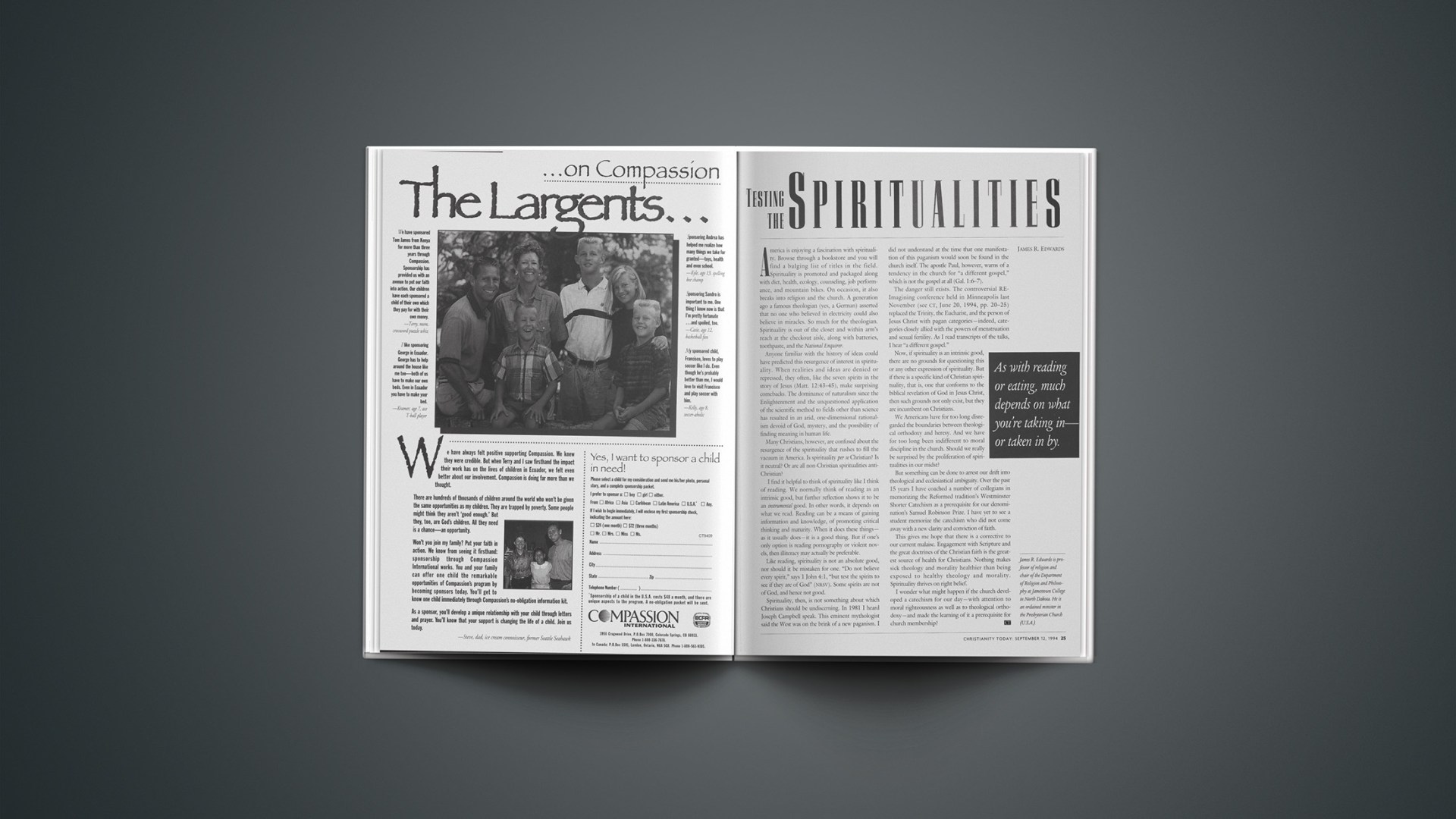

America is enjoying a fascination with spirituality. Browse through a bookstore and you will find a bulging list of titles in the field. Spirituality is promoted and packaged along with diet, health, ecology, counseling, job performance, and mountain bikes. On occasion, it also breaks into religion and the church. A generation ago a famous theologian (yes, a German) asserted that no one who believed in electricity could also believe in miracles. So much for the theologian. Spirituality is out of the closet and within arm’s reach at the checkout aisle, along with batteries, toothpaste, and the National Enquirer.
Anyone familiar with the history of ideas could have predicted this resurgence of interest in spirituality. When realities and ideas are denied or repressed, they often, like the seven spirits in the story of Jesus (Matt. 12:43-45), make surprising comebacks. The dominance of naturalism since the Enlightenment and the unquestioned application of the scientific method to fields other than science has resulted in an arid, one-dimensional rationalism devoid of God, mystery, and the possibility of finding meaning in human life.
Many Christians, however, are confused about the resurgence of the spirituality that rushes to fill the vacuum in America. Is spirituality per se Christian? Is it neutral? Or are all non-Christian spiritualities anti-Christian?
I find it helpful to think of spirituality like I think of reading. We normally think of reading as an intrinsic good, but further reflection shows it to be an instrumental good. In other words, it depends on what we read. Reading can be a means of gaining information and knowledge, of promoting critical thinking and maturity. When it does these things -as it usually does—it is a good thing. But if one’s only option is reading pornography or violent novels, then illiteracy may actually be preferable.
Like reading, spirituality is not an absolute good, nor should it be mistaken for one. “Do not believe every spirit,” says 1 John 4:1, “but test the spirits to see if they are of God” (NRSV). Some spirits are not of God, and hence not good.
Spirituality, then, is not something about which Christians should be undiscerning. In 1981 I heard Joseph Campbell speak. This eminent mythologist said the West was on the brink of a new paganism. I did not understand at the time that one manifestation of this paganism would soon be found in the church itself. The apostle Paul, however, warns of a tendency in the church for “a different gospel,” which is not the gospel at all (Gal. 1:6-7).
The danger still exists. The controversial RE-Imagining conference held in Minneapolis last November (see CT, June 20, 1994, pp. 20-25) replaced the Trinity, the Eucharist, and the person of Jesus Christ with pagan categories—indeed, categories closely allied with the powers of menstruation and sexual fertility. As I read transcripts of the talks, I hear “a different gospel.”
Now, if spirituality is an intrinsic good, there are no grounds for questioning this or any other expression of spirituality. But if there is a specific kind of Christian spirituality, that is, one that conforms to the biblical revelation of God in Jesus Christ, then such grounds not only exist, but they are incumbent on Christians.
We Americans have for too long disregarded the boundaries between theological orthodoxy and heresy. And we have for too long been indifferent to moral discipline in the church. Should we really be surprised by the proliferation of spiritualities in our midst?
But something can be done to arrest our drift into theological and ecclesiastical ambiguity. Over the past 15 years I have coached a number of collegians in memorizing the Reformed tradition’s Westminster Shorter Catechism as a prerequisite for our denomination’s Samuel Robinson Prize. I have yet to see a student memorize the catechism who did not come away with a new clarity and conviction of faith.
This gives me hope that there is a corrective to our current malaise. Engagement with Scripture and the great doctrines of the Christian faith is the greatest source of health for Christians. Nothing makes sick theology and morality healthier than being exposed to healthy theology and morality. Spirituality thrives on right belief.
I wonder what might happen if the church developed a catechism for our day—with attention to moral righteousness as well as to theological orthodoxy—and made the learning of it a prerequisite for church membership?
********************
James R. Edwards is professor of religion and chair of the Department of Religion and Philosophy at Jamestown College in North Dakota. He is an ordained minister in the Presbyterian Church (U.S.A.)
Copyright © 1994 Christianity Today. Click for reprint information.