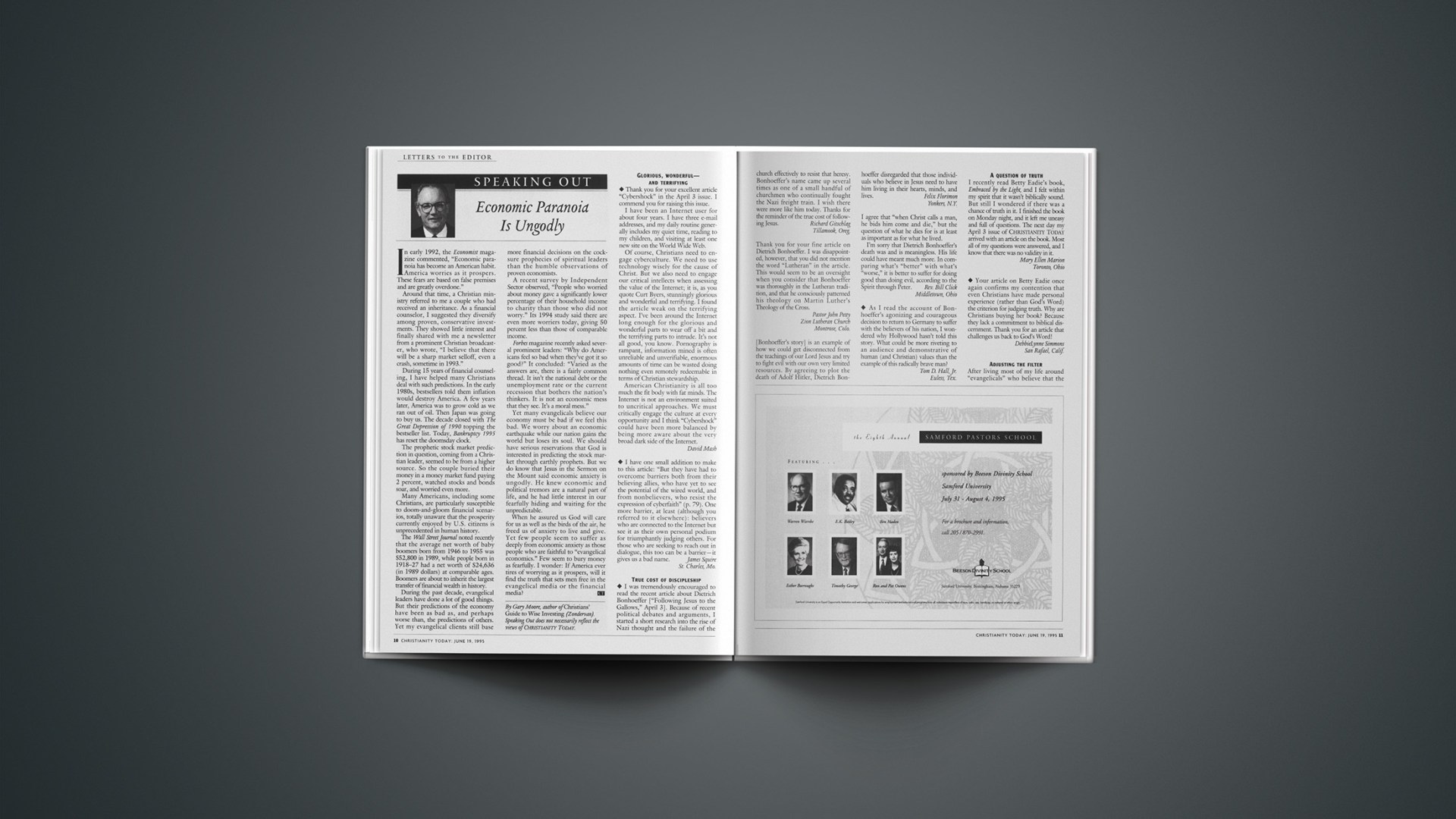

In early 1992, the Economist magazine commented, “Economic paranoia has become an American habit. America worries as it prospers. These fears are based on false premises and are greatly overdone.”
Around that time, a Christian ministry referred to me a couple who had received an inheritance. As a financial counselor, I suggested they diversify among proven, conservative investments. They showed little interest and finally shared with me a newsletter from a prominent Christian broadcaster, who wrote, “I believe that there will be a sharp market selloff, even a crash, sometime in 1993.”
During 15 years of financial counseling, I have helped many Christians deal with such predictions. In the early 1980s, bestsellers told them inflation would destroy America. A few years later, America was to grow cold as we ran out of oil. Then Japan was going to buy us. The decade closed with The Great Depression of 1990 topping the bestseller list. Today, Bankruptcy 1995 has reset the doomsday clock.
The prophetic stock market prediction in question, coming from a Christian leader, seemed to be from a higher source. So the couple buried their money in a money market fund paying 2 percent, watched stocks and bonds soar, and worried even more.
Many Americans, including some Christians, are particularly susceptible to doom-and-gloom financial scenarios, totally unaware that the prosperity currently enjoyed by U.S. citizens is unprecedented in human history.
The Wall Street Journal noted recently that the average net worth of baby boomers born from 1946 to 1955 was $52,800 in 1989, while people born in 1918-27 had a net worth of $24,636 (in 1989 dollars) at comparable ages. Boomers are about to inherit the largest transfer of financial wealth in history.
During the past decade, evangelical leaders have done a lot of good things. But their predictions of the economy have been as bad as, and perhaps worse than, the predictions of others. Yet my evangelical clients still base more financial decisions on the cocksure prophecies of spiritual leaders than the humble observations of proven economists.
A recent survey by Independent Sector observed, “People who worried about money gave a significantly lower percentage of their household income to charity than those who did not worry.” Its 1994 study said there are even more worriers today, giving 50 percent less than those of comparable income.
Forbes magazine recently asked several prominent leaders: “Why do Americans feel so bad when they’ve got it so good?” It concluded: “Varied as the answers are, there is a fairly common thread. It isn’t the national debt or the unemployment rate or the current recession that bothers the nation’s thinkers. It is not an economic mess that they see. It’s a moral mess.”
Yet many evangelicals believe our economy must be bad if we feel this bad. We worry about an economic earthquake while our nation gains the world but loses its soul. We should have serious reservations that God is interested in predicting the stock market through earthly prophets. But we do know that Jesus in the Sermon on the Mount said economic anxiety is ungodly. He knew economic and political tremors are a natural part of life, and he had little interest in our fearfully hiding and waiting for the unpredictable.
When he assured us God will care for us as well as the birds of the air, he freed us of anxiety to live and give. Yet few people seem to suffer as deeply from economic anxiety as those people who are faithful to “evangelical economics.” Few seem to bury money as fearfully. I wonder: If America ever tires of worrying as it prospers, will it find the truth that sets men free in the evangelical media or the financial media?
By Gary Moore, author of Christians’ Guide to Wise Investing (Zondervan). Speaking Out does not necessarily reflect the views of Christianity Today.
Copyright © 1995 Christianity Today. Click for reprint information.
ctjun95mrw5T7010566b