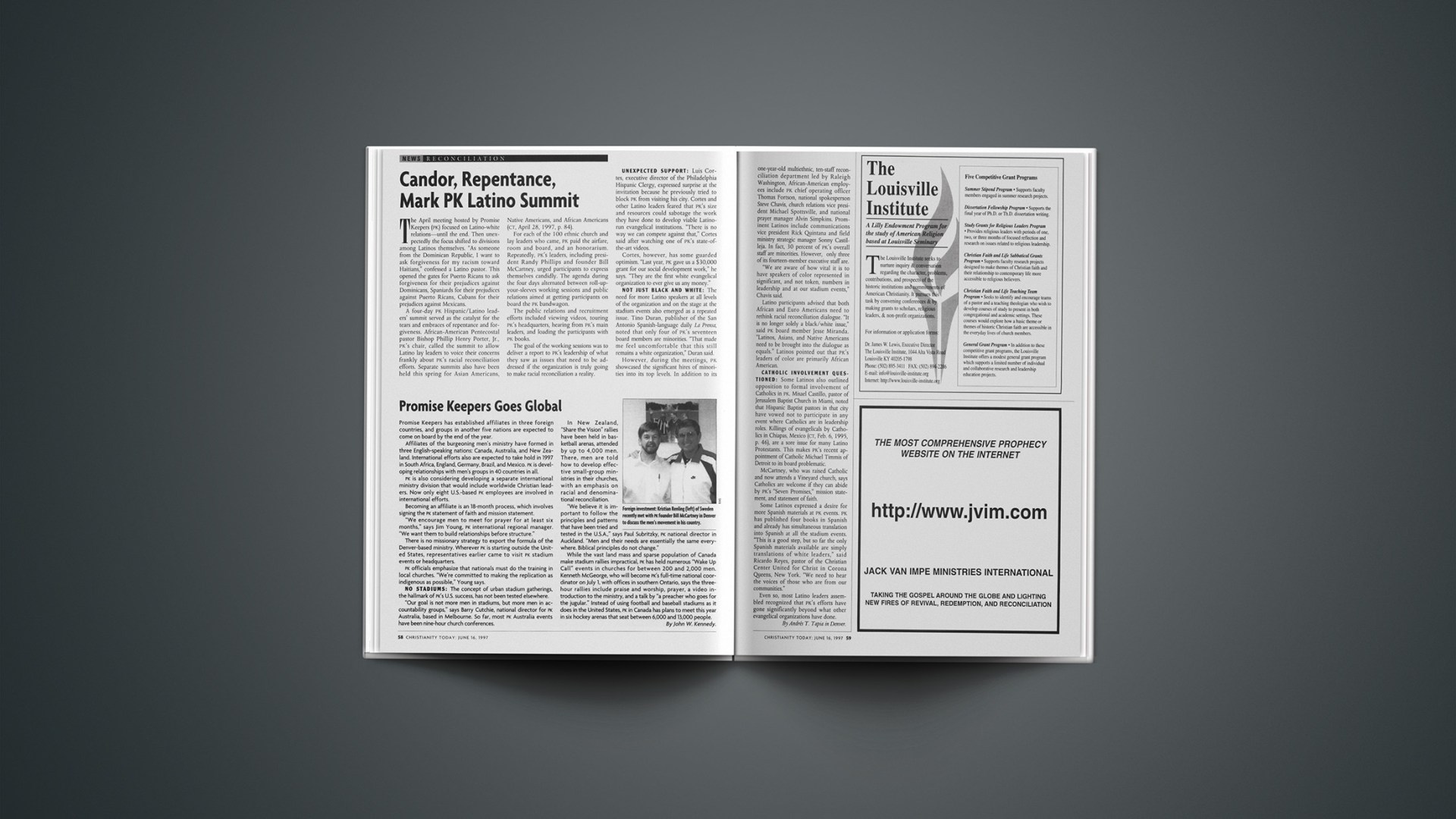

The April meeting hosted by Promise Keepers (PK) focused on Latino-white relations—until the end. Then unexpectedly the focus shifted to divisions among Latinos themselves. “As someone from the Dominican Republic, I want to ask forgiveness for my racism toward Haitians,” confessed a Latino pastor. This opened the gates for Puerto Ricans to ask forgiveness for their prejudices against Dominicans, Spaniards for their prejudices against Puerto Ricans, Cubans for their prejudices against Mexicans.
A four-day PK Hispanic/Latino leaders’ summit served as the catalyst for the tears and embraces of repentance and forgiveness. African-American Pentecostal pastor Bishop Phillip Henry Porter, Jr., PK’s chair, called the summit to allow Latino lay leaders to voice their concerns frankly about PK’s racial reconciliation efforts. Separate summits also have been held this spring for Asian Americans, Native Americans, and African Americans (CT, April 28, 1997, p. 84).
For each of the 100 ethnic church and lay leaders who came, PK paid the airfare, room and board, and an honorarium. Repeatedly, PK’s leaders, including president Randy Phillips and founder Bill McCartney, urged participants to express themselves candidly. The agenda during the four days alternated between roll-up-your-sleeves working sessions and public relations aimed at getting participants on board the PK bandwagon.
The public relations and recruitment efforts included viewing videos, touring PK’s headquarters, hearing from PK’s main leaders, and loading the participants with PK books.
The goal of the working sessions was to deliver a report to PK’s leadership of what they saw as issues that need to be addressed if the organization is truly going to make racial reconciliation a reality.
UNEXPECTED SUPPORT: Luis Cortes, executive director of the Philadelphia Hispanic Clergy, expressed surprise at the invitation because he previously tried to block PK from visiting his city. Cortes and other Latino leaders feared that PK’s size and resources could sabotage the work they have done to develop viable Latino-run evangelical institutions. “There is no way we can compete against that,” Cortes said after watching one of PK’s state-of-the-art videos.
Cortes, however, has some guarded optimism. “Last year, PK gave us a $30,000 grant for our social development work,” he says. “They are the first white evangelical organization to ever give us any money.”
NOT JUST BLACK AND WHITE: The need for more Latino speakers at all levels of the organization and on the stage at the stadium events also emerged as a repeated issue. Tino Duran, publisher of the San Antonio Spanish-language daily La Prensa, noted that only four of PK’s seventeen board members are minorities. “That made me feel uncomfortable that this still remains a white organization,” Duran said.
However, during the meetings, PK showcased the significant hires of minorities into its top levels. In addition to its one-year-old multiethnic, ten-staff reconciliation department led by Raleigh Washington, African-American employees include PK chief operating officer Thomas Fortson, national spokesperson Steve Chavis, church relations vice president Michael Spottsville, and national prayer manager Alvin Simpkins. Prominent Latinos include communications vice president Rick Quintana and field ministry strategic manager Sonny Castilleja. In fact, 30 percent of PK’s overall staff are minorities. However, only three of its fourteen-member executive staff are.
“We are aware of how vital it is to have speakers of color represented in significant, and not token, numbers in leadership and at our stadium events,” Chavis said.
Latino participants advised that both African and Euro Americans need to rethink racial reconciliation dialogue. “It is no longer solely a black/white issue,” said PK board member Jesse Miranda. “Latinos, Asians, and Native Americans need to be brought into the dialogue as equals.” Latinos pointed out that PK’s leaders of color are primarily African American.
CATHOLIC INVOLVEMENT QUESTIONED: Some Latinos also outlined opposition to formal involvement of Catholics in PK. Misael Castillo, pastor of Jerusalem Baptist Church in Miami, noted that Hispanic Baptist pastors in that city have vowed not to participate in any event where Catholics are in leadership roles. Killings of evangelicals by Catholics in Chiapas, Mexico (CT, Feb. 6, 1995, p. 46), are a sore issue for many Latino Protestants. This makes PK’s recent appointment of Catholic Michael Timmis of Detroit to its board problematic.
McCartney, who was raised Catholic and now attends a Vineyard church, says Catholics are welcome if they can abide by PK’s “Seven Promises,” mission statement, and statement of faith.
Some Latinos expressed a desire for more Spanish materials at PK events. PK has published four books in Spanish and already has simultaneous translation into Spanish at all the stadium events. “This is a good step, but so far the only Spanish materials available are simply translations of white leaders,” said Ricardo Reyes, pastor of the Christian Center United for Christ in Corona Queens, New York. “We need to hear the voices of those who are from our communities.”
Even so, most Latino leaders assembled recognized that PK’s efforts have gone significantly beyond what other evangelical organizations have done.
Copyright © 1997 Christianity Today. Click for reprint information.