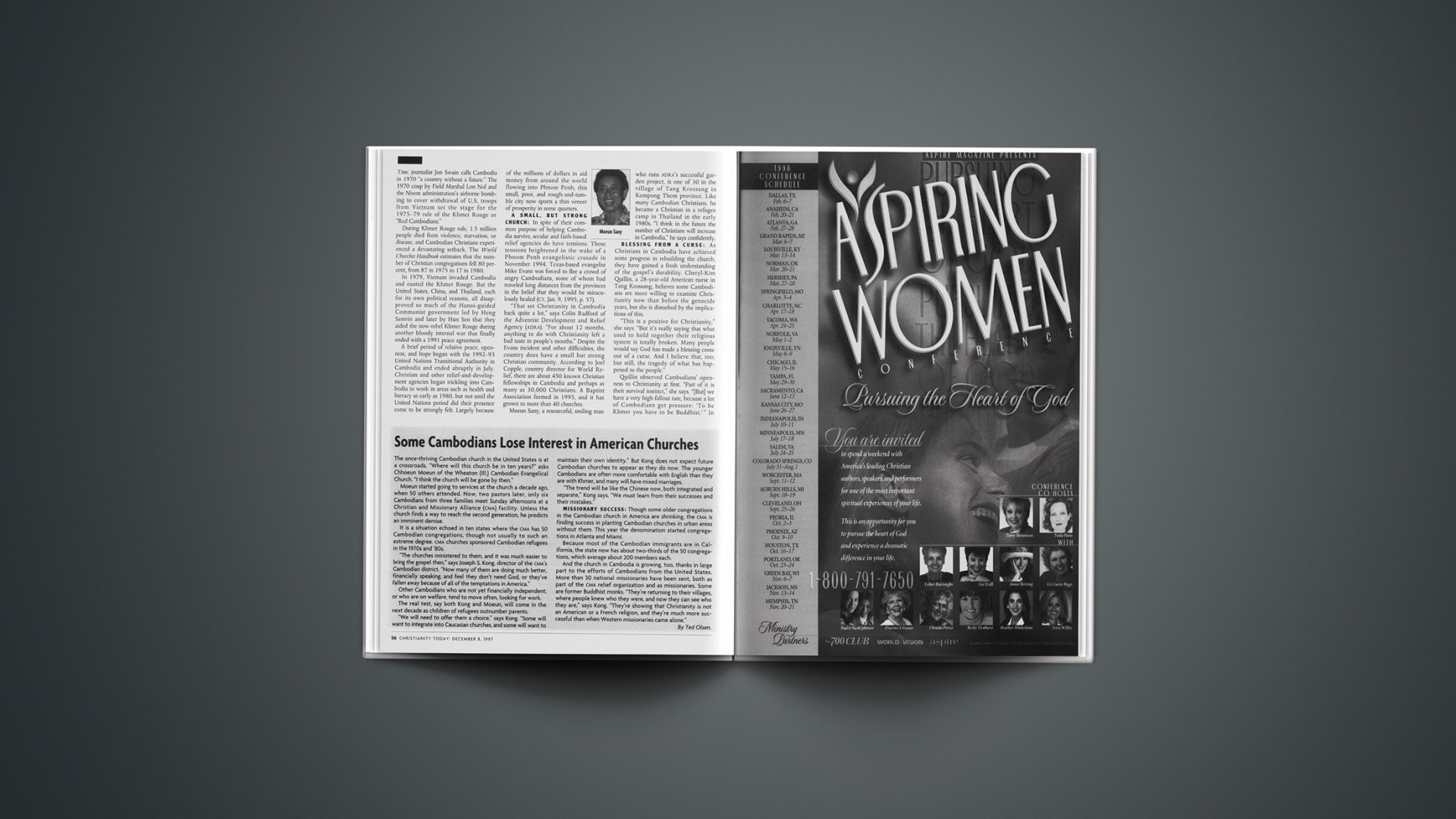

The once-thriving Cambodian church in the United States is at a crossroads. “Where will this church be in ten years?” asks Chhoeun Moeun of the Wheaton (Ill.) Cambodian Evangelical Church. “I think the church will be gone by then.”
Moeun started going to services at the church a decade ago, when 50 others attended. Now, two pastors later, only six Cambodians from three families meet Sunday afternoons at a Christian and Missionary Alliance (CMA) facility. Unless the church finds a way to reach the second generation, he predicts an imminent demise.
It is a situation echoed in ten states where the CMA has 50 Cambodian congregations, though not usually to such an extreme degree. CMA churches sponsored Cambodian refugees in the 1970s and ’80s.
“The churches ministered to them, and it was much easier to bring the gospel then,” says Joseph S. Kong, director of the CMA’s Cambodian district. “Now many of them are doing much better, financially speaking, and feel they don’t need God, or they’ve fallen away because of all of the temptations in America.”
Other Cambodians who are not yet financially independent, or who are on welfare, tend to move often, looking for work.
The real test, say both Kong and Moeun, will come in the next decade as children of refugees outnumber parents.
“We will need to offer them a choice,” says Kong. “Some will want to integrate into Caucasian churches, and some will want to maintain their own identity.” But Kong does not expect future Cambodian churches to appear as they do now. The younger Cambodians are often more comfortable with English than they are with Khmer, and many will have mixed marriages.
“The trend will be like the Chinese now, both integrated and separate,” Kong says. “We must learn from their successes and their mistakes.”
MISSIONARY SUCCESS: Though some older congregations in the Cambodian church in America are shrinking, the CMA is finding success in planting Cambodian churches in urban areas without them. This year the denomination started congregations in Atlanta and Miami.
Because most of the Cambodian immigrants are in California, the state now has about two-thirds of the 50 congregations, which average about 200 members each.
And the church in Cambodia is growing, too, thanks in large part to the efforts of Cambodians from the United States. More than 30 national missionaries have been sent, both as part of the CMA relief organization and as missionaries. Some are former Buddhist monks. “They’re returning to their villages, where people knew who they were, and now they can see who they are,” says Kong. “They’re showing that Christianity is not an American or a French religion, and they’re much more successful than when Western missionaries came alone.”
Copyright © 1997 Christianity Today. Click for reprint information.
December 8, 1997 Vol. 41, No. 14, Page 56