Dispatch from Lady Caroline: How Apin Akot Redeemed His Daughter

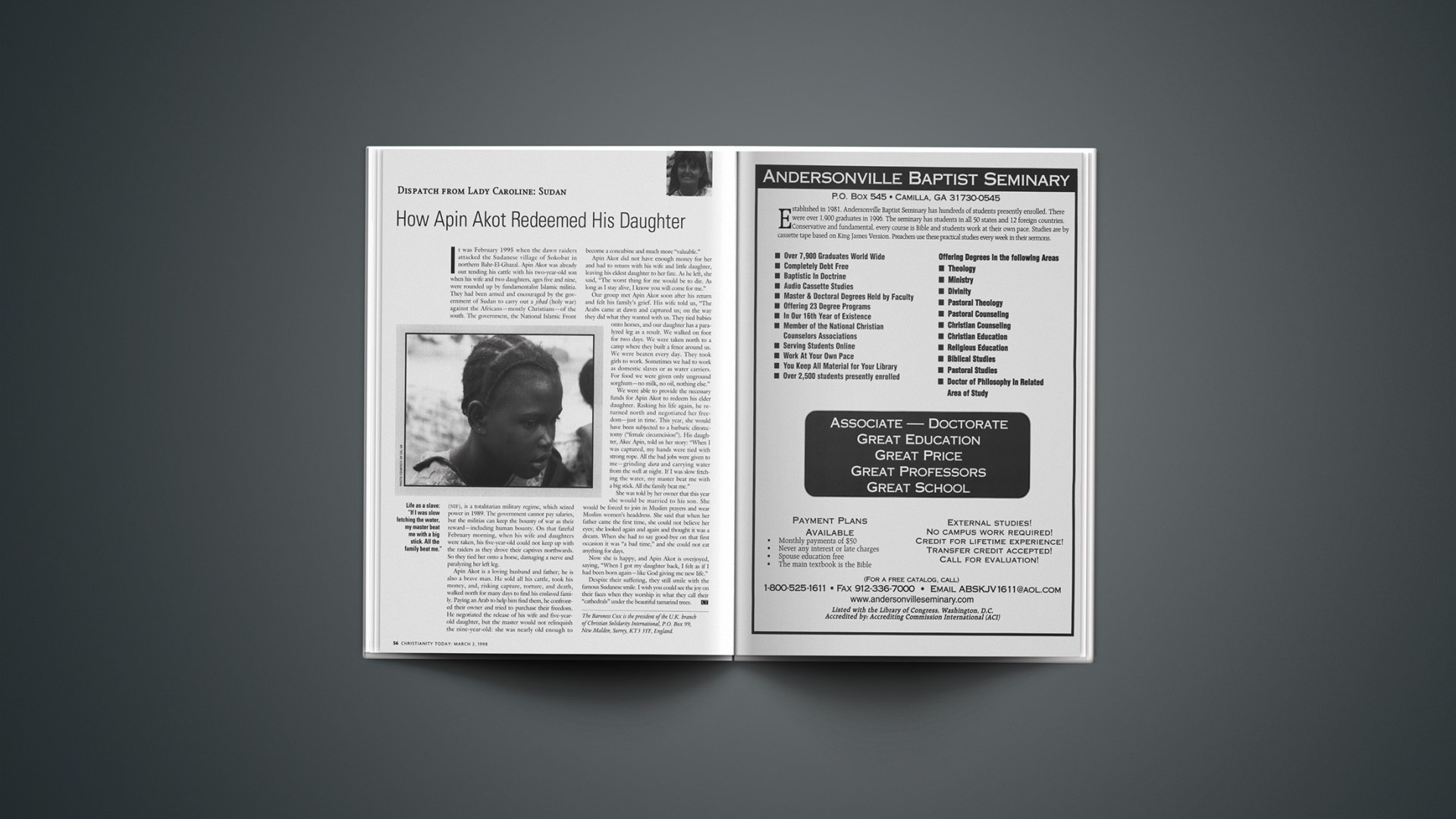
It was February 1995 when the dawn raiders attacked the Sudanese village of Sokobat in northern Bahr-El-Ghazal. Apin Akot was already out tending his cattle with his two-year-old son when his wife and two daughters, ages five and nine, were rounded up by fundamentalist Islamic militia. They had been armed and encouraged by the government of Sudan to carry out a jihad (holy war) against the Africans—mostly Christians—of the south. The government, the National Islamic Front (NIF), is a totalitarian military regime, which seized power in 1989. The government cannot pay salaries, but the militias can keep the bounty of war as their reward—including human bounty. On that fateful February morning, when his wife and daughters were taken, his five-year-old could not keep up with the raiders as they drove their captives northwards. So they tied her onto a horse, damaging a nerve and paralyzing her left leg.

Apin Akot is a loving husband and father; he is also a brave man. He sold all his cattle, took his money, and, risking capture, torture, and death, walked north for many days to find his enslaved family. Paying an Arab to help him find them, he confronted their owner and tried to purchase their freedom. He negotiated the release of his wife and five-year-old daughter, but the master would not relinquish the nine-year-old: she was nearly old enough to become a concubine and much more “valuable.”

Apin Akot did not have enough money for her and had to return with his wife and little daughter, leaving his eldest daughter to her fate. As he left, she said, “The worst thing for me would be to die. As long as I stay alive, I know you will come for me.”

Our group met Apin Akot soon after his return and felt his family’s grief. His wife told us, “The Arabs came at dawn and captured us; on the way they did what they wanted with us. They tied babies onto horses, and our daughter has a paralyzed leg as a result. We walked on foot for two days. We were taken north to a camp where they built a fence around us. We were beaten every day. They took girls to work. Sometimes we had to work as domestic slaves or as water carriers. For food we were given only unground sorghum—no milk, no oil, nothing else.”

We were able to provide the necessary funds for Apin Akot to redeem his elder daughter. Risking his life again, he returned north and negotiated her freedom—just in time. This year, she would have been subjected to a barbaric clitorectomy (“female circumcision”). His daughter, Akec Apin, told us her story: “When I was captured, my hands were tied with strong rope. All the bad jobs were given to me—grinding dura and carrying water from the well at night. If I was slow fetching the water, my master beat me with a big stick. All the family beat me.”

She was told by her owner that this year she would be married to his son. She would be forced to join in Muslim prayers and wear Muslim women’s headdress. She said that when her father came the first time, she could not believe her eyes; she looked again and again and thought it was a dream. When she had to say good-bye on that first occasion it was “a bad time,” and she could not eat anything for days.

Now she is happy, and Apin Akot is overjoyed, saying, “When I got my daughter back, I felt as if I had been born again—like God giving me new life.”

Despite their suffering, they still smile with the famous Sudanese smile. I wish you could see the joy on their faces when they worship in what they call their “cathedrals” under the beautiful tamarind trees.

The Baroness Cox is the president of the U.K. branch of Christian Solidarity International, P.O. Box 99, New Malden, Surrey, KT3 3YF, England.

Copyright © 1998 Christianity Today. Click for reprint information.

Also in this issue

Catching Up with a Dream: Evangelicals and race 30 years after the death of Martin Luther King, Jr.

Cover Story

Catching Up with a Dream

Splinter Groups Dismiss Leaders

Mark A. Kellner

Obituary: CT Editor Emeritus Lindsell

David E. Kucharsky, with Heather L. Johnson

God on the Box

Steve Rabey

Evangelism: Groups Battle over Catholic Outreach

Jackie Alnor in Sun Valley

Nigeria: Church Leaders Refocus on Ethics

Obed Minchakpu in Jos, Nigeria

Obituary: Racial Reconciler Spencer Perkins

Joe Maxwell in Jackson

President Disillusions Christians

Isaac Phiri

Do We Love Coke More Than Justice?

Christian Coalition Retrenches

Mexico: Words Against Weapons

Deann Alford, with additional reports from Compass Direct

Adventist Doctor Targets Smoking

Storm Disaster Galvanizes Church

Ginette Cotnoir in Quebec

Pro-Life Activist Ordered to Jail

Evangelicals Gain Legal Status

Government Recognition Demanded

Muslims Aim to End Televangelism

Obed Minchakpu in Jos, Nigeria

Drive-Through Church: Food for Soul

Clare Booth

Mormon Church Suspends Construction

Kenneth D. MacHarg in Quito, Ecuador

The Unfinished Mission to the 'Aucas'

Stephen E. Saint

News

News Briefs: March 02, 1998

The Burden of Spencer Perkins

Michael G. Maudlin, Managing Editor

Trucker’s Testimony

Editorial

Beware the Spotlight

Breaking the Black/White Stalemate

Still Wrestling with the Devil

Randall Balmer

Hospice Care Hijacked?

Art Moore

News

News Briefs: March 02, 1998

Jimmy Carter’s Lesson Plan

Adventures in Fasting

Ben Patterson

Comic Relief: Chocolate Theology

David Augsburger

Should We Give Up on Government?

Ronald J. Sider & Fred Clark

The Moral Minority

Sproul on the Will

Classic & Contemporary Excerpts from March 02, 1998

View issue

Our Latest

The Bulletin

Pete Hegseth’s Future, Farmers on Tariffs, and Religious Decline Stalls

Mike Cosper, Clarissa Moll

Hegseth scrutinized for drug boat strikes, farmers react to Trump’s tariffs, and a Pew report says religious decline has slowed.

The Debate over Government Overreach Started in 1776

Three books to read this month on politics and public life.

The Call to Art, Africa, and Politics

In 1964, CT urged Christians to “be what they really are—new men and women in Christ.”

Turn Toward Each Other and Away from the Screen

Perhaps technology has changed everything. But God is still here, still wiring humans for connection and presence.

Devil and the Deep Blue Sea

BONUS: Amanda Knox on the Satanic Panic and Wrongful Convictions

How elements of the satanic panic and conspiratorial thinking shaped a wrongful conviction.

Death by a Thousand Error Messages

Classroom tech was supposed to solve besetting education problems. The reality is frustrating for students and costly for taxpayers.

The Chinese Christian Behind 2,000 Hymns

X. Yang

Lü Xiaomin never received formal music training. But her worship songs have made her a household name in China’s churches.

The Surprising Joys of a Gift-Free Christmas

Ahrum Yoo

Amid peak consumerism season, I prayed for ways to teach my children about selfless giving.

Apple PodcastsDown ArrowDown ArrowDown Arrowarrow_left_altLeft ArrowLeft ArrowRight ArrowRight ArrowRight Arrowarrow_up_altUp ArrowUp ArrowAvailable at Amazoncaret-downCloseCloseEmailEmailExpandExpandExternalExternalFacebookfacebook-squareGiftGiftGooglegoogleGoogle KeephamburgerInstagraminstagram-squareLinkLinklinkedin-squareListenListenListenChristianity TodayCT Creative Studio Logologo_orgMegaphoneMenuMenupausePinterestPlayPlayPocketPodcastRSSRSSSaveSaveSaveSearchSearchsearchSpotifyStitcherTelegramTable of ContentsTable of Contentstwitter-squareWhatsAppXYouTubeYouTube