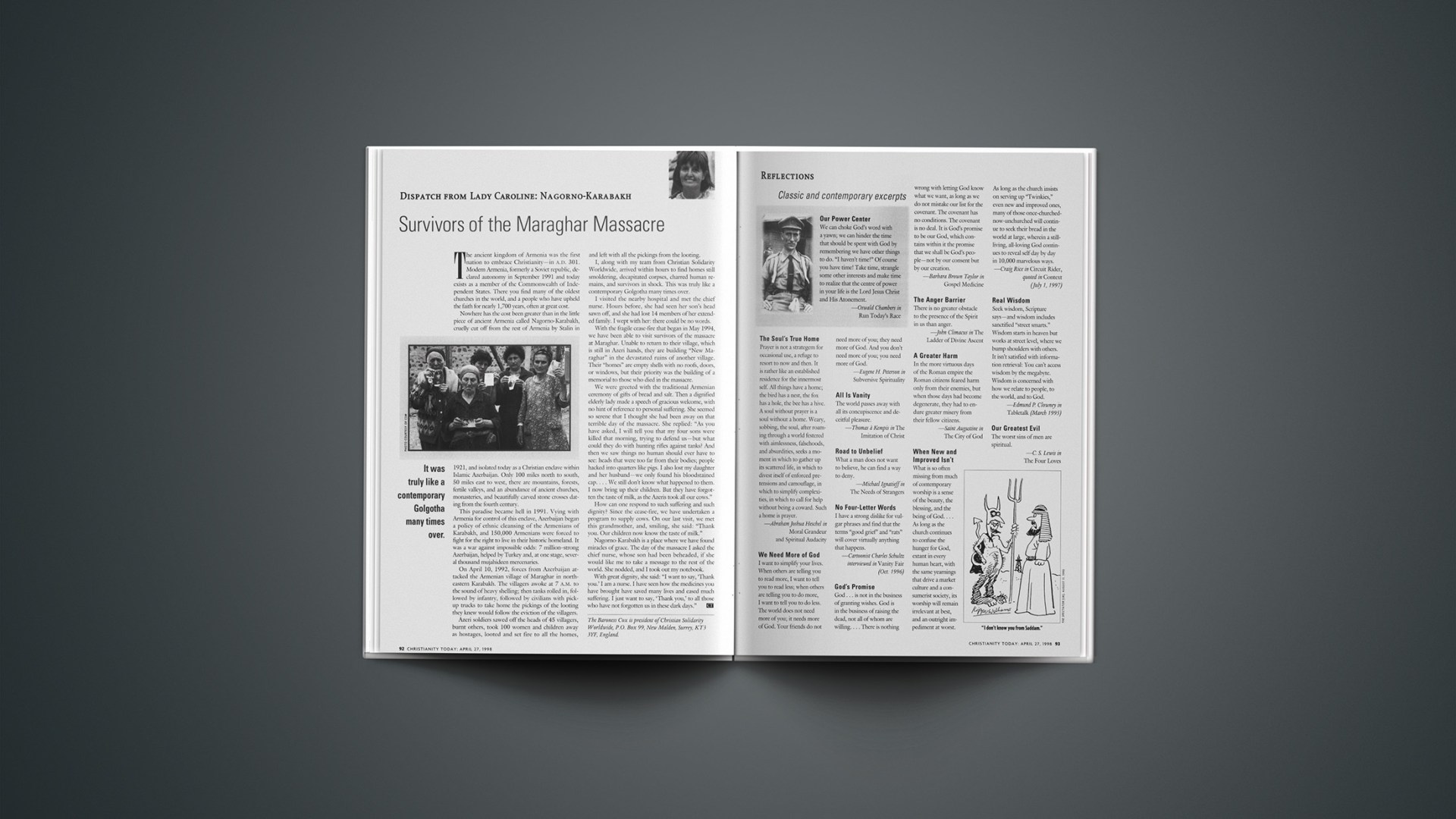

The ancient kingdom of Armenia was the first nation to embrace Christianity—in A.D. 301. Modern Armenia, formerly a Soviet republic, declared autonomy in September 1991 and today exists as a member of the Commonwealth of Independent States. There you find many of the oldest churches in the world, and a people who have upheld the faith for nearly 1,700 years, often at great cost.
Nowhere has the cost been greater than in the little piece of ancient Armenia called Nagorno-Karabakh, cruelly cut off from the rest of Armenia by Stalin in 1921, and isolated today as a Christian enclave within Islamic Azerbaijan. Only 100 miles north to south, 50 miles east to west, there are mountains, forests, fertile valleys, and an abundance of ancient churches, monasteries, and beautifully carved stone crosses dating from the fourth century.
This paradise became hell in 1991. Vying with Armenia for control of this enclave, Azerbaijan began a policy of ethnic cleansing of the Armenians of Karabakh, and 150,000 Armenians were forced to fight for the right to live in their historic homeland. It was a war against impossible odds: 7 million-strong Azerbaijan, helped by Turkey and, at one stage, several thousand mujahideen mercenaries.
On April 10, 1992, forces from Azerbaijan attacked the Armenian village of Maraghar in northeastern Karabakh. The villagers awoke at 7 a.m. to the sound of heavy shelling; then tanks rolled in, followed by infantry, followed by civilians with pick-up trucks to take home the pickings of the looting they knew would follow the eviction of the villagers.
Azeri soldiers sawed off the heads of 45 villagers, burnt others, took 100 women and children away as hostages, looted and set fire to all the homes, and left with all the pickings from the looting.
I, along with my team from Christian Solidarity Worldwide, arrived within hours to find homes still smoldering, decapitated corpses, charred human remains, and survivors in shock. This was truly like a contemporary Golgotha many times over.
I visited the nearby hospital and met the chief nurse. Hours before, she had seen her son’s head sawn off, and she had lost 14 members of her extended family. I wept with her: there could be no words.
With the fragile cease-fire that began in May 1994, we have been able to visit survivors of the massacre at Maraghar. Unable to return to their village, which is still in Azeri hands, they are building “New Maraghar” in the devastated ruins of another village. Their “homes” are empty shells with no roofs, doors, or windows, but their priority was the building of a memorial to those who died in the massacre.
We were greeted with the traditional Armenian ceremony of gifts of bread and salt. Then a dignified elderly lady made a speech of gracious welcome, with no hint of reference to personal suffering. She seemed so serene that I thought she had been away on that terrible day of the massacre. She replied: “As you have asked, I will tell you that my four sons were killed that morning, trying to defend us—but what could they do with hunting rifles against tanks? And then we saw things no human should ever have to see: heads that were too far from their bodies; people hacked into quarters like pigs. I also lost my daughter and her husband—we only found his bloodstained cap. … We still don’t know what happened to them. I now bring up their children. But they have forgotten the taste of milk, as the Azeris took all our cows.”
How can one respond to such suffering and such dignity? Since the cease-fire, we have undertaken a program to supply cows. On our last visit, we met this grandmother, and, smiling, she said: “Thank you. Our children now know the taste of milk.”
Nagorno-Karabakh is a place where we have found miracles of grace. The day of the massacre I asked the chief nurse, whose son had been beheaded, if she would like me to take a message to the rest of the world. She nodded, and I took out my notebook.
With great dignity, she said: “I want to say, ‘Thank you.’ I am a nurse. I have seen how the medicines you have brought have saved many lives and eased much suffering. I just want to say, ‘Thank you,’ to all those who have not forgotten us in these dark days.”
The Baroness Cox is president of Christian Solidarity Worldwide, P.O. Box 99, New Malden, Surrey, KT3 3YF, England.
Copyright © 1998 Christianity Today. Click for reprint information.