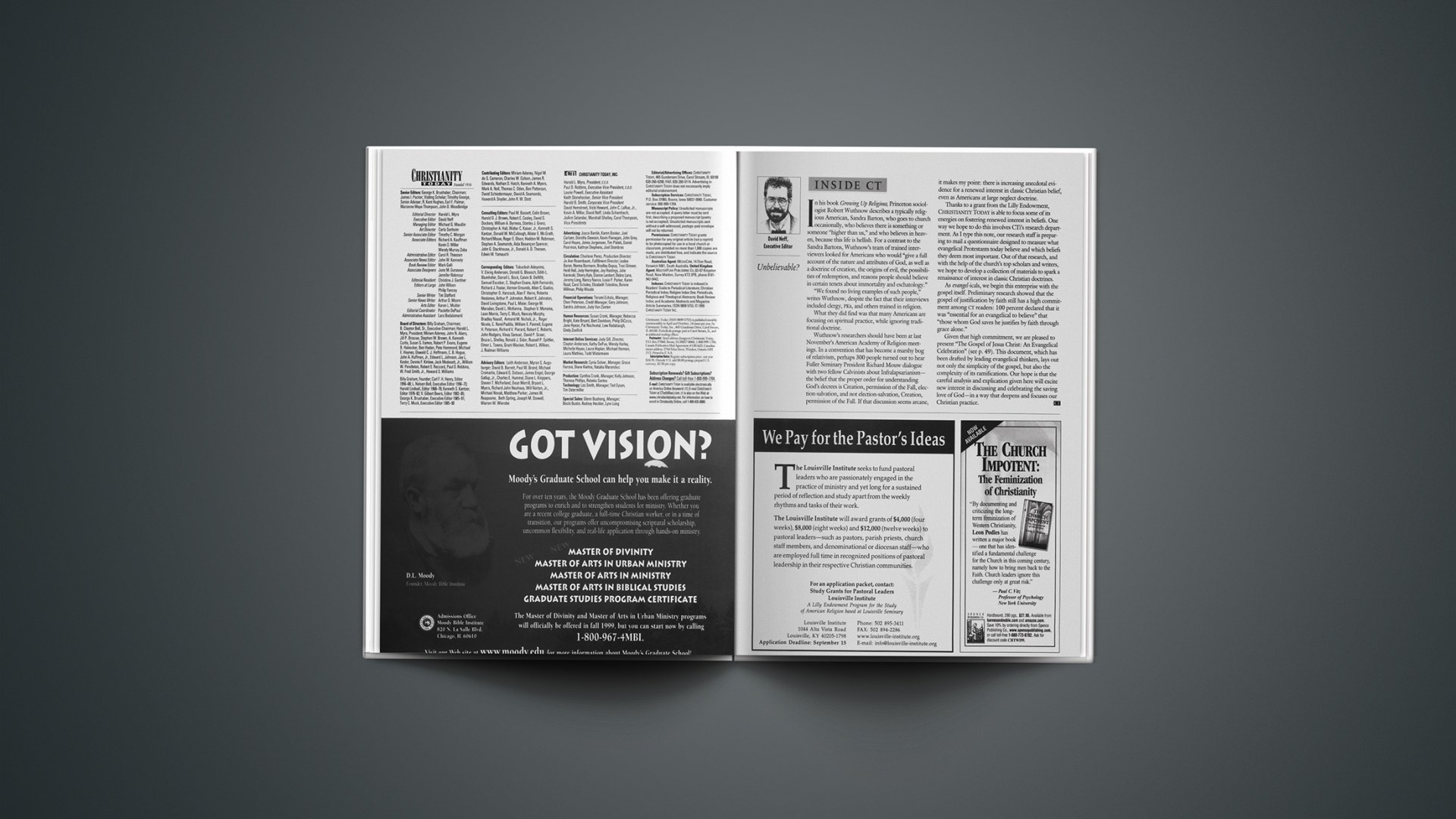
Unbelievable?

In his book Growing Up Religious, Princeton sociologist Robert Wuthnow describes a typically religious American, Sandra Barton, who goes to church occasionally, who believes there is something or someone “higher than us,” and who believes in heaven, because this life is hellish. For a contrast to the Sandra Bartons, Wuthnow’s team of trained interviewers looked for Americans who would “give a full account of the nature and attributes of God, as well as a doctrine of creation, the origins of evil, the possibilities of redemption, and reasons people should believe in certain tenets about immortality and eschatology.”

“We found no living examples of such people,” writes Wuthnow, despite the fact that their interviews included clergy, PKs, and others trained in religion.

What they did find was that many Americans are focusing on spiritual practice, while ignoring traditional doctrine.

Wuthnow’s researchers should have been at last November’s American Academy of Religion meetings. In a convention that has become a marshy bog of relativism, perhaps 300 people turned out to hear Fuller Seminary President Richard Mouw dialogue with two fellow Calvinists about Infralapsarianism—the belief that the proper order for understanding God’s decrees is Creation, permission of the Fall, election-salvation, and not election-salvation, Creation, permission of the Fall. If that discussion seems arcane, it makes my point: there is increasing anecdotal evidence for a renewed interest in classic Christian belief, even as Americans at large neglect doctrine.

Thanks to a grant from the Lilly Endowment, Christianity Today is able to focus some of its energies on fostering renewed interest in beliefs. One way we hope to do this involves CT‘s research department. As I type this note, our research staff is preparing to mail a questionnaire designed to measure what evangelical Protestants today believe and which beliefs they deem most important. Out of that research, and with the help of the church’s top scholars and writers, we hope to develop a collection of materials to spark a renaissance of interest in classic Christian doctrines.

As evangel-icals, we begin this enterprise with the gospel itself. Preliminary research showed that the gospel of justification by faith still has a high commitment among CT readers: 100 percent declared that it was “essential for an evangelical to believe” that “those whom God saves he justifies by faith through grace alone.”

Given that high commitment, we are pleased to present “The Gospel of Jesus Christ: An Evangelical Celebration” (see p. 49). This document, which has been drafted by leading evangelical thinkers, lays out not only the simplicity of the gospel, but also the complexity of its ramifications. Our hope is that the careful analysis and explication given here will excite new interest in discussing and celebrating the saving love of God—in a way that deepens and focuses our Christian practice.

Copyright © 1999 Christianity Today. Click for reprint information.
Also in this issue

The Coming of the Pragmatic Prophets: These activists are more than critics. They work the corridors of power to channel money and influence for good.

The Gospel of Jesus Christ

The Gospel of Jesus Christ

What Makes Music Christian?

Chris Lutes

Classic & Contemporary Excerpts from June 14, 1999

A Troubled Young Evangelist

Orthodoxy with an Attitude

Can Good Come Out of This Evil?

73,000 Teens Pledge Responsibility

Josh Kennedy in Pontiac.

Ministry Leaders Lose Tax Breaks

Debra Fieguth.

Gambling Panel Urges Moratorium

Evangelicals Target 'Marriage Tax'

Mark A. Kellner.

Mall Gains Second Life As Church

Mike Wilson.

Church Name-Dropping Pays Off

Ken Walker.

Religious Freedom Panel in Place

Tony Carnes.

In Brief: June 14, 1999

Churches Reach Out to Refugees

Christine J. Gardner.

Evangelicals Reject Religious Statues

Deann Alford in Managua.

Baptist Seminary Back in Business

Tobin Perry.

Evangelicals Come Up for Air

Bishop Faces Genocide Accusation

Odhiambo Okite.

The Criminologist Who Discovered Churches

Tim Stafford

Letters

Shooting Aftermath: Parents Take Aim at Hollywood

Mark A. Kellner.

Harvest Season?

By Anil Stephen in Manila.

Missionaries in Harm’s Way

Preparing for Pilgrims

Gordon Govier.

Church of the Web

Jody Veenker.

Salvation Army: Newest General Wants to Save Souls

Mark A. Kellner.

Editorial

The Long Road After Littleton

News

Sharon Baptist Discovered Welfare Ministry

Amy L. Sherman

Mr. Wallis Goes to Washington

John Wilson

God's Contractor

Michael G. Maudlin

A Call to Evangelical Unity

The Gospel of Jesus Christ: An Evangelical Celebration

Guardians of the Lost Ark

Wendy Murray Zoba

Severe Mercy in Oregon

Christine J. Gardner in Portland and Coos Bay

A Mother’s Strange Love

Miroslav Volf

Dispatch from Sri Lanka: Bombs Away

Ajith Fernando

Committing the Unforgivable Sin

Marianne Meye Thompson, professor of New Testament interpretation at Fuller Theological Seminary.

View issue

Our Latest

SCOTUS Ruling on ‘Conversion Therapy’ Is a Win for Christians

This week’s Chiles v. Salazar ruling allows counselors freedom to serve their clients in the ways they see fit.

From Our Community

A Renewed Subscription and a Broadened Perspective

Hannah Glad

How one Texan lawyer found himself reading CT again and supporting the One Kingdom Campaign.

Public Theology Project

Easter Is Not a Zombie Story

Jesus joined us in death—and defeated it.

What $18 Would Get You

In 1979, CT investigated deceptive Christians, made the case for psychology, and watched Islam with concern.

News

Palestinian Christians Prepare for Easter amid War and Settler Violence

Heather M. Surls

Many in the community have moved abroad. Those who stay are barred from visiting holy sites.

The Eternal Meaning of the Cup

John Anthony Dunne

Across the church, our Communion practices reveal a broken world and anticipate the one to come.

The Russell Moore Show

Everything Depends on an Empty Tomb

 A reflection on how the resurrection reshapes science, suffering, joy, and the future of the world.

A Case for In-Person Voting

As a volunteer at a polling station, I saw what we lose when we choose convenience over communal participation.

addApple PodcastsDown ArrowDown ArrowDown Arrowarrow_left_altLeft ArrowLeft ArrowRight ArrowRight ArrowRight Arrowarrow_up_altUp ArrowUp ArrowAvailable at Amazoncaret-downCloseCloseellipseEmailEmailExpandExpandExternalExternalFacebookfacebook-squarefolderGiftGiftGooglegoogleGoogle KeephamburgerInstagraminstagram-squareLinkLinklinkedin-squareListenListenListenChristianity TodayCT Creative Studio Logologo_orgMegaphoneMenuMenupausePinterestPlayPlayPocketPodcastprintremoveRSSRSSSaveSavesaveSearchSearchsearchSpotifyStitcherTelegramTable of ContentsTable of Contentstwitter-squareWhatsAppXYouTubeYouTube