 |
WHEN HIGH SCHOOL students leave English teacher David Dark’s classroom at Christ Presbyterian Academy in Nashville, Tennessee, they pass under a picture of two pills—one red, the other blue. The picture represents a choice the students must make. It alludes to the decision by Neo (Keanu Reeves) in The Matrix to swallow the red pill so that perhaps he might seek truth and truly live.
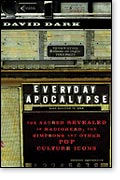
Dark presents the same choice to readers of his first book. He begins by telling us we’ve got apocalypse all wrong. That is, too often we choose the blue pill of settling for the Disneyfied, Ameri-evangelical spiritual fantasy. “God” becomes shorthand for every culturally shaped view we prefer, what one of Dark’s colleagues calls “selective fundamentalism.”
Dark calls this blue pill a “heretical worldview” that disdains the earthly and human as secular. With Madeleine L’Engle, Dark claims the secular does not exist. Rather, he believes the “secular” is exactly the place to find the sacred.
Seeing the sacred in the mundane requires revelation, the literal meaning of apocalypsis. The punch line to Nathan’s story to David is an apocalyptic moment, as is seeing the face of an infant through a hospital glass. Hearing the voice of the earth awaiting redemption is apocalypsis.
This revelation is the red pill. We take it, however, not by opening our mouths but our ears and eyes. We ask with the readers of John’s Revelation, “How is it that Jesus is Lord when the violence and exploitation that rule the world suggest otherwise?”
Rather than burying those questions or sermonizing, apocalypse awakens us to the reality that Jesus’ testimony is true, and his way will overcome.
We begin noticing and honoring people we hadn’t before. The face of a child in the desert crying out in war is more likely, in Dark’s view, to communicate apocalypsis than numerology or fortune-telling using proof texts from John’s Revelation.
He enters discussion about revelation through the back door—looking for apocalypse in all the “wrong places.” Tell many evangelicals that you see something redemptive in The Simpsons and Radiohead and you’re likely to get your tongue washed. Yet Homer Simpson praying, “Thank you, Lord, for another crack at togetherness” might be more redemptive than the contrived, market-whipped religious frenzy that dulls our imaginations.
What militates against the apocalyptic, says Dark, is the portrayal of the material and political world as a mere waiting room—”irredeemable and at best discarded.” The blue pill saps us of life with “self-proclaimed representatives of ‘the gospel’ [who] have reduced the good news to ‘how to get to heaven when you die.’ “
Dark had me “redemptively unsettled” throughout the book. I was also appropriately disturbed by his favorites—every film by the Coen brothers, such as Raising Arizona; music from Beck, Radiohead, and Bono; and literature such as Flannery O’Connor’s stories that scrape the bottom of the gene pool for characters.
The summons
Too often, though, Dark simply declares the weightiness of his favorites as self-evident. He tells us that if we were listening and full of grace, we’d find godly meaning in The Simpsons, Radiohead, and so on.
Finding godly meaning in a Disney movie, however, seems off-limits, because of the dichotomy he sets up between Disney and the Crucified. “The incarnational ethics of Jesus embraces everything that the Disney impulse is tempted to paint over.” Talk about setting up your straw Bambi.
Yet that is precisely the point. Dark relays a priceless exchange between Malcolm Muggeridge and William F. Buckley to explain that anything since the resurrection of Christ is laughable. It is also painfully anemic, “compared to what we somehow know we’re made for.”
Like Karl Barth’s dictum that sermons should be written with Bible in one hand and newspaper in the other, Dark thrives in the theater seat of a Coen film with Bible scholar N. T. Wright on one side and rock star Bono on the other. Everyday Apocalypse calls us out of the classroom to a fresh way of seeing and hearing. Dark shows the ironic summons of apocalypse for us to be “more awake and alive.”
Greg Taylor is managing editor of New Wineskins magazine (www.wineskins.org) and coauthor of the newly released Down in the River to Pray (Leafwood).
Copyright © 2003 Christianity Today. Click for reprint information.
Related Elsewhere
Everyday Apocalypse is available from Christianbook.com and other book retailers.
Christianity Today sister publication Books & Culture also reviewedEveryday Apocalypse.
The book web site has other reviews, discussion, and chapter summaries along with other David Dark information.
An excerpt is available from the publisher.