
Family Life Church loves their new building in Elgin, Illinois, except for one thing: The walls still bear symbols of its past as a Masonic temple. The suburban Chicago Daily Herald reported that Elgin officials barred the markings’ removal because they “contribute to the overall character of the building, its history.” The church argued the symbols conflict with Christian belief, but the government said the church can only cover them up, not remove them.
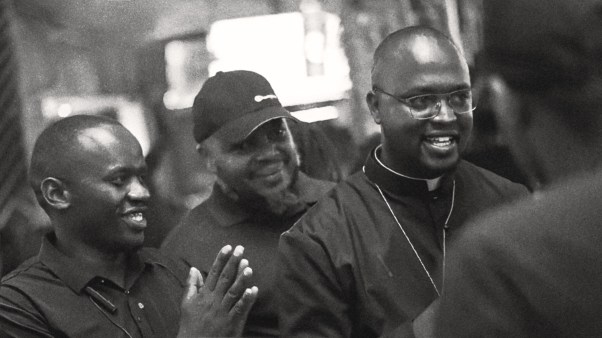
Family Life Church’s effort echoes a long fight in Kenya’s Presbyterian Church of East Africa over eradicating Masonic symbols in colonial-era churches and government buildings. “These symbols and artifacts must be removed and destroyed,” PCEA head David Githii explained to The Nation as at least 30 stained-glass windows and other items were removed from Nairobi’s St. Andrews Church. “They are anti-Christ.” Githii sent demolition squads to other PCEA churches around the country. Tensions with preservationists and Presbyterian Freemasons got so heated that police had to be called to keep the peace.
Yes, there are stillFreemasons, including a reported 1.8 million members in the United States. And if the unconfirmed anecdotes ct editors hear regularly are to believed, Masonic cliques still wield power in several places.
But membership is half what it was 50 years ago. It’s hard to believe that Freemasons and similar secret societies were one of the top three social ills targeted by evangelicals of the mid-1800s, along with slavery and alcohol. In 1868, several prominent evangelicals, including revivalist Charles Grandison Finney and Wheaton College founder Jonathan Blanchard, created the National Christian Association (NCA) to warn believers that “all secret societies [are] deistical, antagonistic to Christianity, [and] tend to loosen moral ties.”
Now Freemasonry is nearlyforgotten, and the Christian campaign against “secretism” had little to do with the decline. That makes me wonder how much our social-reform campaigns of the early 21st century resemble those of the mid-18th. There are some issues, like the abolition of slavery, where Christian efforts were required for change. There are others, like Prohibition, where Christian efforts floundered after initial success. Then there are those like secret societies, where we’ll look back and wonder what all the fuss was about. The tough question is when to listen to William Wilberforce and when to listen to Gamaliel (Acts 5:38): “Leave these men alone! Let them go! For if their purpose or activity is of human origin, it will fail.”
Copyright © 2007 Christianity Today. Click for reprint information.
Related elsewhere:
Recent Tidings columns include:
The Quest for the Historical Jerry | You can tell a lot about someone by what he says about Falwell. (June 13, 2007)
Partial Reversal | The Supreme Court’s abortion decision shows that the arguments have changed. (May 14, 2007)
Jingo Jangle | Christian tribalism is a renunciation of God’s kingdom. (April 18, 2007)
Church Divorce Done Right | Denominational splits just aren’t what they used to be. (Mar. 7, 2007)
Why Isn’t ‘Yes’ Enough? | The fuss over swearing-in ceremonies reveals a deeper problem. (Feb. 23, 2007)
Bottom-Up Discipline | What do you do when your pastor—or your entire denomination—strays? (January 16, 2007)