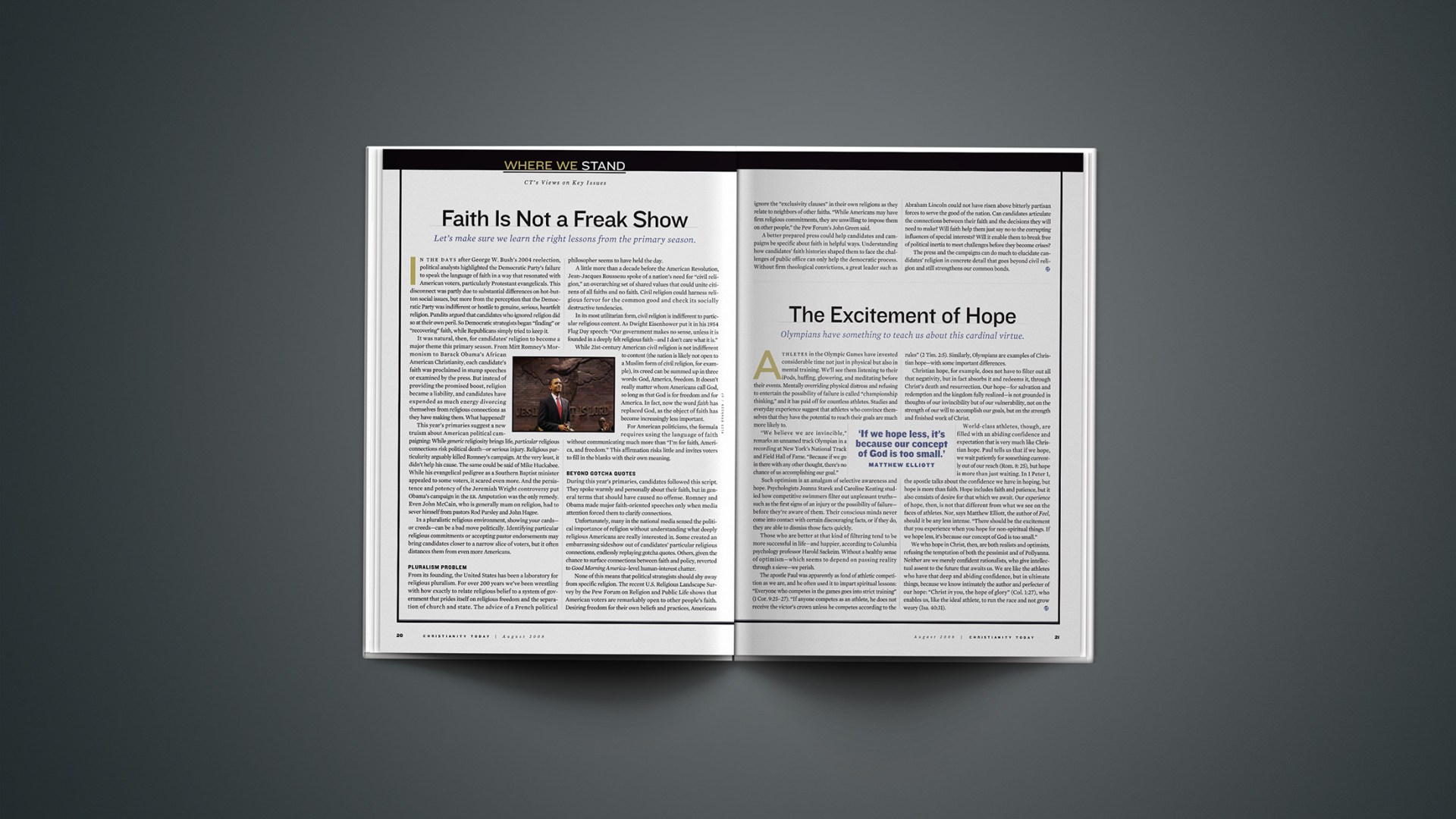

In the days after George W. Bush’s 2004 reelection, political analysts highlighted the Democratic Party’s failure to speak the language of faith in a way that resonated with American voters, particularly Protestant evangelicals. This disconnect was partly due to substantial differences on hot-button social issues, but more from the perception that the Democratic Party was indifferent or hostile to genuine, serious, heartfelt religion. Pundits argued that candidates who ignored religion did so at their own peril. So Democratic strategists began “finding” or “recovering” faith, while Republicans simply tried to keep it.
It was natural, then, for candidates’ religion to become a major theme this primary season. From Mitt Romney’s Mormonism to Barack Obama’s African American Christianity, each candidate’s faith was proclaimed in stump speeches or examined by the press. But instead of providing the promised boost, religion became a liability, and candidates have expended as much energy divorcing themselves from religious connections as they have making them. What happened?
This year’s primaries suggest a new truism about American political campaigning: While generic religiosity brings life, particular religious connections risk political death—or serious injury. Religious particularity arguably killed Romney’s campaign. At the very least, it didn’t help his cause. The same could be said of Mike Huckabee. While his evangelical pedigree as a Southern Baptist minister appealed to some voters, it scared even more. And the persistence and potency of the Jeremiah Wright controversy put Obama’s campaign in the ER. Amputation was the only remedy. Even John McCain, who is generally mum on religion, had to sever himself from pastors Rod Parsley and John Hagee.
In a pluralistic religious environment, showing your cards—or creeds—can be a bad move politically. Identifying particular religious commitments or accepting pastor endorsements may bring candidates closer to a narrow slice of voters, but it often distances them from even more Americans.
Pluralism Problem
From its founding, the United States has been a laboratory for religious pluralism. For over 200 years we’ve been wrestling with how exactly to relate religious belief to a system of government that prides itself on religious freedom and the separation of church and state. The advice of a French political philosopher seems to have held the day.
A little more than a decade before the American Revolution, Jean-Jacques Rousseau spoke of a nation’s need for “civil religion,” an overarching set of shared values that could unite citizens of all faiths and no faith. Civil religion could harness religious fervor for the common good and check its socially destructive tendencies.
In its most utilitarian form, civil religion is indifferent to particular religious content. As Dwight Eisenhower put it in his 1954 Flag Day speech: “Our government makes no sense, unless it is founded in a deeply felt religious faith—and I don’t care what it is.”
While 21st-century American civil religion is not indifferent to content (the nation is likely not open to a Muslim form of civil religion, for example), its creed can be summed up in three words: God, America, freedom. It doesn’t really matter whom Americans call God, so long as that God is for freedom and for America. In fact, now the word faith has replaced God, as the object of faith has become increasingly less important.
For American politicians, the formula requires using the language of faith without communicating much more than “I’m for faith, America, and freedom.” This affirmation risks little and invites voters to fill in the blanks with their own meaning.
Beyond Gotcha Quotes
During this year’s primaries, candidates followed this script. They spoke warmly and personally about their faith, but in general terms that should have caused no offense. Romney and Obama made major faith-oriented speeches only when media attention forced them to clarify connections.
Unfortunately, many in the national media sensed the political importance of religion without understanding what deeply religious Americans are really interested in. Some created an embarrassing sideshow out of candidates’ particular religious connections, endlessly replaying gotcha quotes. Others, given the chance to surface connections between faith and policy, reverted to Good Morning America-level human-interest chatter.
None of this means that political strategists should shy away from specific religion. The recent U.S. Religious Landscape Survey by the Pew Forum on Religion and Public Life shows that American voters are remarkably open to other people’s faith. Desiring freedom for their own beliefs and practices, Americans ignore the “exclusivity clauses” in their own religions as they relate to neighbors of other faiths. “While Americans may have firm religious commitments, they are unwilling to impose them on other people,” the Pew Forum’s John Green said.
A better prepared press could help candidates and campaigns be specific about faith in helpful ways. Understanding how candidates’ faith histories shaped them to face the challenges of public office can only help the democratic process. Without firm theological convictions, a great leader such as Abraham Lincoln could not have risen above bitterly partisan forces to serve the good of the nation. Can candidates articulate the connections between their faith and the decisions they will need to make? Will faith help them just say no to the corrupting influences of special interests? Will it enable them to break free of political inertia to meet challenges before they become crises?
The press and the campaigns can do much to elucidate candidates’ religion in concrete detail that goes beyond civil religion and still strengthens our common bonds.
Copyright © 2008 Christianity Today. Click for reprint information.
Related Elsewhere:
Other editorials and our full coverage of the 2008 election are available on our site.