
When I found a brand new lap-top for half price on eBay, I told my friend and musical colleague Spencer about my bargain of a find. He was worried: “Usually when something’s too good to be true …”
“I know,” I replied impatiently, “but the seller has a 100 percent approval rating.”
“Be careful,” warned Spencer.
“Of course,” I assured him, annoyed. I wasn’t born yesterday.
I sent the seller $1,300 and discovered in very short, sickening order that I had fallen prey to a classic scam. A fraudster had hacked someone’s eBay identity in order to relieve easy marks like me of our money.
I felt an absolute fool—and didn’t want to tell Spencer. The next time I saw his number on my caller ID, I didn’t answer. I could just imagine his “I told you so.”
Soon, I was avoiding Spencer completely. And I started to resent him. Why did he have to be so judgmental? Why couldn’t he be on my side? Why was I ever friends with that jerk?
Eventually, we had to fly together to perform at a concert. “Whatever happened with that computer thing?” he asked an hour into the flight. Cornered, I finally confessed my foolishness, dreading the inevitable response. But as soon as I told Spencer about my mistake, a strange thing happened. The enemy I had turned him into evaporated. Spencer turned into Spencer again, my teasing but deeply empathetic buddy.
As embarrassed as I was by my eBay error, I felt even dumber about the way I had allowed my shame to distort my perception of a best friend. If my hand had not been forced, I would have remained estranged from him indefinitely.
I’ve always considered myself perceptive, but the longer I live, the more I discover my susceptibility to misinterpretation. This is true of the way I view my friends, truer of the way I see my enemies, and perhaps truest of the way I perceive God.
I was raised to understand that sin’s gravest consequence is the way it forces God to perceive me: God is holy, I’m not, and there’s no way he can even look at me until I have the covering of Christ’s blood. In my teens, I clipped a poem out of a youth magazine in which the poet asks—and answers—a pressing question: “How can a righteous God look at me, a sinner, and see a precious child? Simple: The Son gets in his eyes.”
But what about how I look at God? I’ve often been oblivious to one of the most insidious byproducts of the Fall: Sin affects my perception of God. Or, to turn a phrase from that poem, the sin gets in my eyes.
Before Adam and Eve had fallen for the first lie, they basked in God’s company. But after a few bites of forbidden fruit, they no longer looked forward to seeing their Maker. When he came calling, they hid.
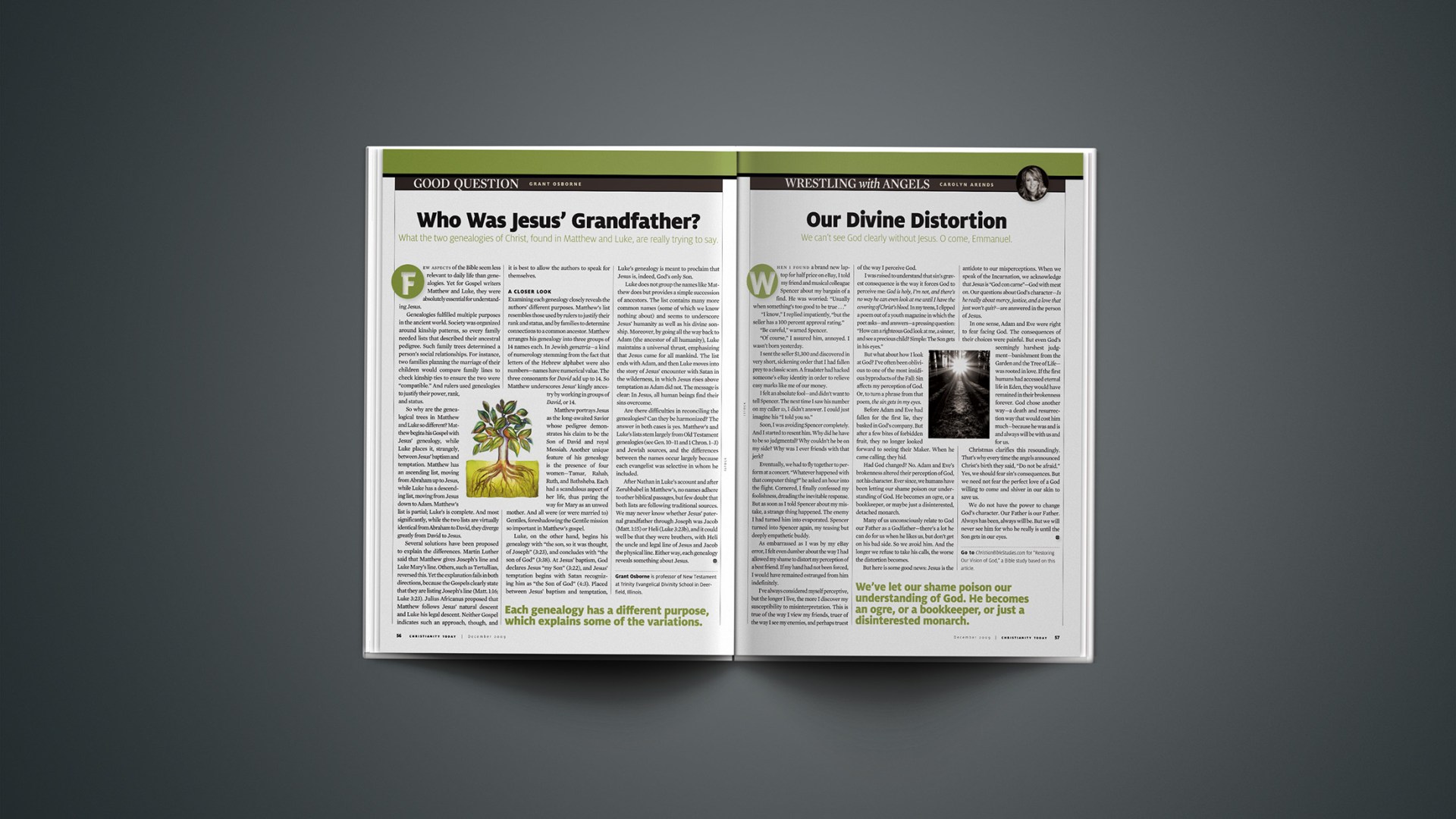
Had God changed? No. Adam and Eve’s brokenness altered their perception of God, not his character. Ever since, we humans have been letting our shame poison our understanding of God. He becomes an ogre, or a bookkeeper, or maybe just a disinterested, detached monarch.
Many of us unconsciously relate to God our Father as a Godfather—there’s a lot he can do for us when he likes us, but don’t get on his bad side. So we avoid him. And the longer we refuse to take his calls, the worse the distortion becomes.
But here is some good news: Jesus is the antidote to our misperceptions. When we speak of the Incarnation, we acknowledge that Jesus is “God con carne”—God with meat on. Our questions about God’s character—Is he really about mercy, justice, and a love that just won’t quit?—are answered in the person of Jesus.
In one sense, Adam and Eve were right to fear facing God. The consequences of their choices were painful. But even God’s seemingly harshest judgment—banishment from the Garden and the Tree of Life—was rooted in love. If the first humans had accessed eternal life in Eden, they would have remained in their brokenness forever. God chose another way—a death and resurrection way that would cost him much—because he was and is and always will be with us and for us.
Christmas clarifies this resoundingly. That’s why every time the angels announced Christ’s birth they said, “Do not be afraid.” Yes, we should fear sin’s consequences. But we need not fear the perfect love of a God willing to come and shiver in our skin to save us.
We do not have the power to change God’s character. Our Father is our Father. Always has been, always will be. But we will never see him for who he really is until the Son gets in our eyes.
Go to ChristianBibleStudies.com for “Restoring Our Vision of God,” a Bible study based on this article.
Copyright © 2009 Christianity Today. Click for reprint information.
Related Elsewhere:
More Christianity Today articles by Carolyn Arends are available on our site, including:
Come, Lord Jesus | Oh, wait. He’s already here. (October 12, 2009)
Matter Matters | Lessons learned between the couch and a 10k race. (July 27, 2009)
Saying More Than We Can Say | Why the arts matter even during a recession. (June 22, 2009)