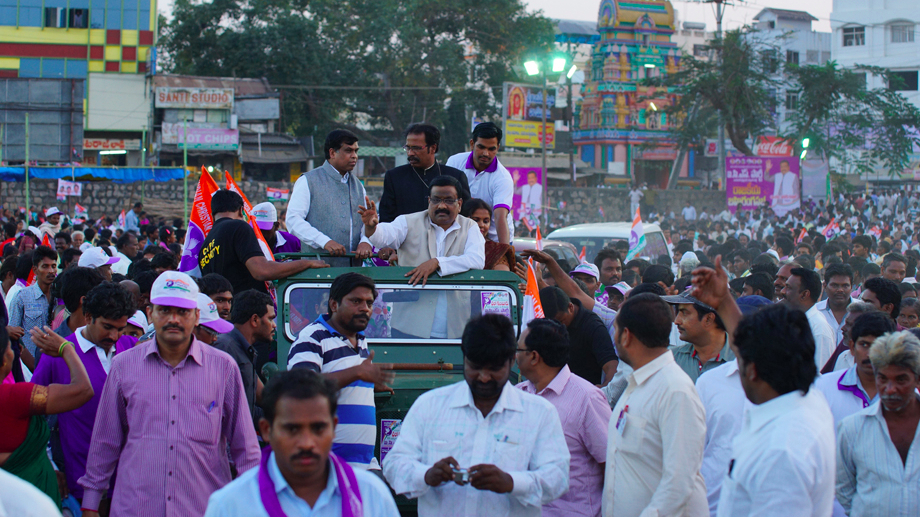
(WWM) India's low-caste citizens have taken a sizable step into politics with a newly formed Christian political party and a campaign dedicated to earning seats in a new state assembly.
As India's month-long national election closed Monday [May 12], residents of Seemandhra, a new state carved out of India's southern state of Andhra Pradesh, elected 25 members to the Indian Parliament and 175 members to the new state's assembly.
The new Indian Christian Secular Party (ICSP), launched in February, put up more than 60 candidates—the majority of them Dalit Christians, according to one of the party's founders, Sleeva Galilee. (The election results have not yet been tallied.)
"With this election, there will be certainly a change in the attitude of other political parties towards Dalit Christians," said Galilee. "Dalit Christians have been long taken for a ride and treated as a vote bank. We want to tell the main political parties that they cannot take our votes for granted any longer."
Dalit means "trampled upon" and refers to people who are treated as "untouchables" in caste-entrenched India. Dalits are a mixed population, living all over the country, speaking a variety of languages and practicing numerous religions.
The Constitution of India bans discrimination based on caste, but prejudice and discrimination toward Dalits remains rampant. The majority of Dalits have menial jobs such as scavenging, and they live segregated from people in upper castes.
Such maltreatment became more prevalent after federal legislation enacted in 1950 enabled discrimination against Christian Dalits. The law made Hindu Dalits eligible for free education and set quotas for government jobs and seats in legislatures to improve their status. While the privileges were extended to Sikh Dalits in 1956 and to Buddhist Dalits in 1990, they are still denied to Muslim and Christian Dalits.
Christians also face pressure from Hindu nationalists, who continue to implement laws to dissuade conversion from one faith to another.
[Editor's note: The 2012 International Religious Freedom Report called the rise of anti-conversion laws a "worrying trend." In one Indian state, a proposed bill will send Christians to jail if they don't ask for permission to convert at least a month in advance. In another, both local and foreign Christians have faced mob attacks over alleged conversions. Some Hindu extremists have sworn to destroy Dalit Christians, burning villages, attacking homes and killing pastors.]
Establishing a political party may be a powerful idea to help fight this inequality, but whether the new ICSP can effectively carry that out is a separate question, said Raj Bharat Patta, general secretary of Student Christian Movement in India.
The party "may not have much impact, since it has come up all of a sudden and without much ground work," he said.
Franklin Caesar, a Dalit Christian activist, is skeptical of the Indian government's ability to provide justice. His petition seeking a judicial remedy for discrimination against Christian Dalits has been sitting before the federal Supreme Court for 10 years.
"Each time the [Congress party-led coalition] government was asked to make its stand clear on the issue by the [Supreme] Court, the government adopted evasive tactics," said Caesar.
It's difficult to get an accurate count of Dalit Christians. Many do not make their faith public as it would shut them out of government jobs, free education, and state scholarship for studies.
"The number of Dalit Christians is much higher than what is projected in the census," said Patta, a pastor of the Andhra Evangelical Lutheran Church. In fact, India now hosts more believers than at any time in history.
Galilee agreed, and said that since the actual number of Christians is much higher than documented, a Christian political party can make an impact in the elections with their nominal presence.
"We have a strong presence in many areas," Galilee said. "Thousands of Christians are forced to hide their Christian identity and remain Hindu in government registers."
India is ranked No. 28 on the 2014 World Watch List of the 50 countries where it is most difficult to be a Christian.