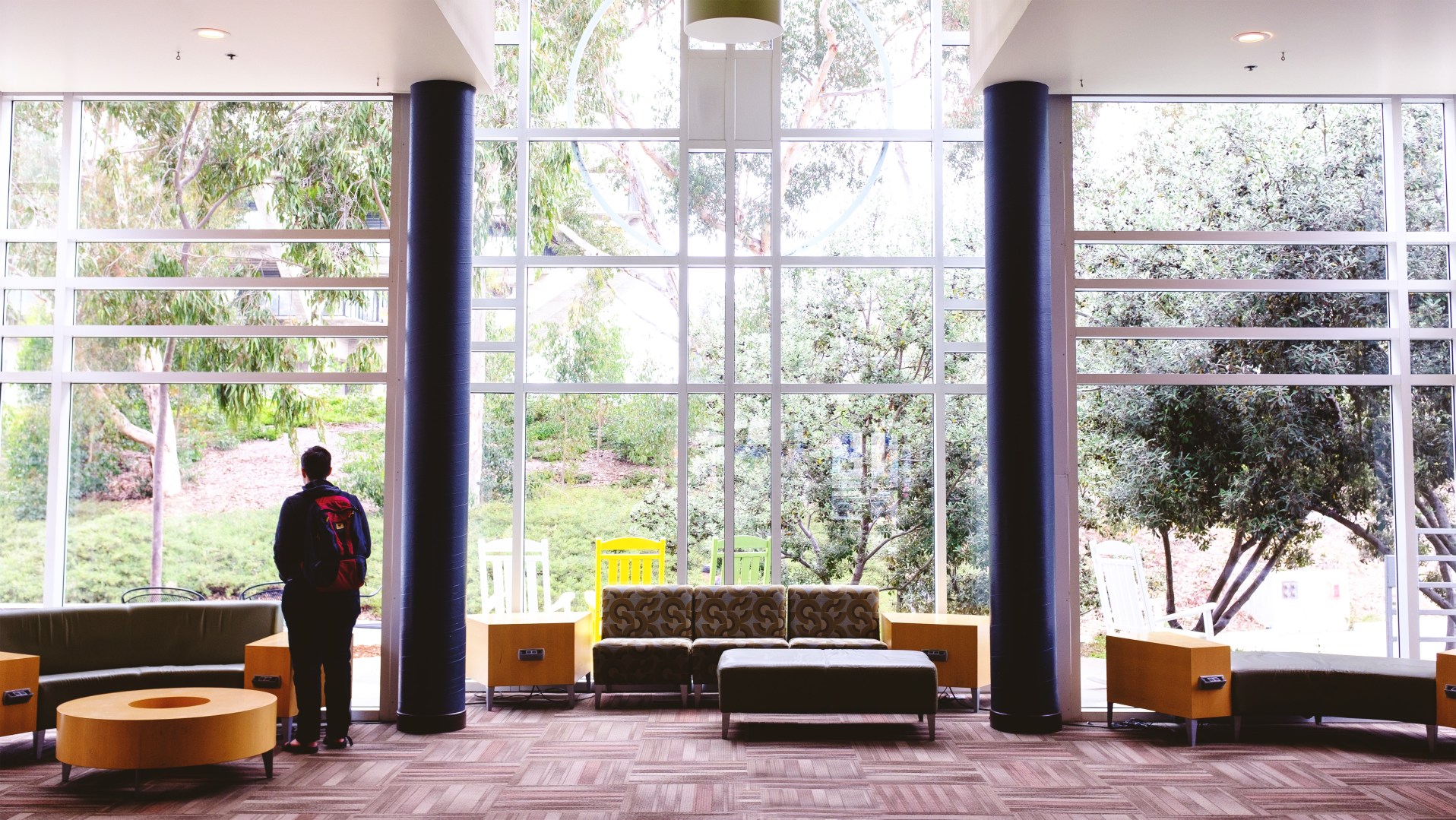
T hey're taking us out of the dorms on Friday. I have to try to pass my midterms while figuring out where my stuff is going to go.
When Tommy Britt received a panicked text from a college senior on March 15, it hit close to home. His friend studies at Duquesne University in Pittsburgh, where students have been asked to vacate and transition to online learning. Britt could relate. As a Carnegie Mellon PhD student, he is now teaching classes online.
The mass migration of students from American college campuses has caught parents off guard, overwhelmed students, and confused professors who had to configure online education. Tuesday night, 12,000 students were told to move when NYU decided to close their Manhattan residence halls. At Wheaton College, students on spring break were told they could return only to collect their possessions and move out.
Though colleges are closing too fast to count, roughly 2.5 million students were living in college residences at the 2010 census, roughly 12 percent of America's college students. UNESCO estimates that over 120 million tertiary students have faced school closures globally.
Closing dorms will likely save lives since residence halls have shared kitchens, bathrooms, and dorm rooms that make quarantine difficult. But many students who rely on colleges for meals, housing, and healthcare have nowhere to go. While many colleges are offering exceptions, the process of applying to stay adds to student uncertainty. According to Aaron King, a House Assistant Dean at Cornell University, many students feel overwhelmed with information and decisions.
Transitions to online teaching are impacting every student, not just those who are unsure of where to live and how to connect. Many classes with labs and other hands-on experiences will be difficult or impossible to teach online. Faculty are now re-designing lectures, workshops, exams, and group projects for distance learning and conflicting time zones.
Even as university staff support students, Christians are organizing to love their neighbors during the pandemic. King described an online spreadsheet with local community offers of housing, storage, transportation, and even dog walks. To reduce complexity for students, Christian groups started using the spreadsheets for their own offers of support.
The wider church can make a difference for disrupted students, according to Walter Kim, President of the National Association of Evangelicals.
“We have an incredible missional opportunity to demonstrate to the next generation of students, ‘What does it mean to be a Christ-follower?’” said Kim. “They are going to remember this moment in many ways as the generation that experienced 9/11 remembers that moment. They will remember what the church did, and they will remember what we did not do. Serving in this time is a very powerful witness to the next generation about what it means to be a Christ-follower.”
Even as communities mobilize short-term pandemic prevention, epidemiologists have argued that the crisis will not end soon. The pandemic response follows a cycle of prevention, response, and recovery that could take months, or as some experts argue, more than a year. Many college seniors are grieving canceled graduation ceremonies. As internships are axed, even more students will need advice on summer opportunities and income.

How can Christians support students through this difficult time? We talked to leading US and global student ministries to find out what churches and individuals can do:
Pray imaginatively
Kim emphasized the value of praying “specifically and imaginatively” for students experiencing emotional distress, academic distress, economic distress, and spiritual distress.
Council for Christian Colleges & Universities President Shirley Hoogstra agrees: “Emotionally, students are shaken, grieving and in disbelief, many coming to terms with the likelihood that they may not be able to finish out the semester on their campus,” she said. Hoogstra encourages church leaders to share prayers with their congregations that recognize those challenges.
Provide spiritual support and community
Churches have a wealth of options to organize digital hangouts on Facebook Live or Zoom, or keep a Zoom chat open with a host for students to drop in virtually. If the church has a list of students, leadership can consider short check-in texts or calls to those on the list.
Vivek Mathew, Executive Director of residential Christian study center Chesterton House in Ithaca, NY, emphasizes a tailored approach since each student’s needs will be different. For those wondering what to say, Hoogstra offers: “try asking specific and open-ended questions—tell me what you are missing most about campus life, tell me a cool thing your professor is doing in an online class, tell me how I can pray for you, tell me how it’s going at home.”
Campus ministers also encourage churches to reach out to international students to offer support and community. As most other students leave campus, InterVarsity Campus Minister Stephan Teng at Cornell knows students from Mongolia and Italy who can’t go home right now.
Teng says many international students are worried about their families during the pandemic and are also finding their usual campus communities disrupted. In Albany, NY, campus minister Niki Campbell is organizing local churches to provide housing and rides for international students and others being displaced as dorms close.
King urges Christians to remember that many students are overwhelmed with information and decisions right now. Contacting student leaders to triage needs or pool information across ministries into a minimum number of messages can help avoid adding further to student anxiety.
Offer direct financial support
As The Atlantic reports, the unpredictable costs of this moment disproportionately hurt lower-income students. Some churches may be able to hold special offerings or draw on the mercy fund to help. King suggests that Christians can donate to access funds created by colleges to help students with financial needs during the pandemic.
Help and encourage grad students, adjuncts, faculty
Long-term student outcomes depend on faculty, adjuncts, and graduate students. These leaders are organizing to support university decision-making, moving classes online, and in many cases caring for children at home. Contingent faculty such as adjuncts—who make up 70 percent of US university teaching staff—often have precarious employment arrangements and may have substantial financial needs.
Serving these leaders is a powerful way to help students. Brief encouraging notes or texts sharing prayer and understanding will mean a great deal. Check in with the faculty you know to learn if meals, shopping, or other time-saving support would help them serve students well. Tactful offers of financial help or technical support may be meaningful too.
Support digital ministries and teams
As almost all campus ministry migrates online, already-established digital ministries and teams are in a great place to provide support and expertise. In addition to reaching out to local student ministries and donating to local campuses, here are a few you can help:
- InterVarsity Digital Response to COVID-19
- Cru Response to COVID-19
- International Fellowship of Evangelical Students (supports Christian student movements in more than 170 countries)
- The Navigators Response to COVID-19
The next few weeks are a critical time for the well-being of a whole generation of students. Let’s care for them as Christ does, and like Teng says, be “brave in our love.”
Bob Trube is the Director and Hannah Eagleson is the Associate Director of Emerging Scholars Network, which supports Christian graduate students and early career faculty as part of InterVarsity Graduate and Faculty Ministries. J. Nathan Matias, an assistant professor of Communication at Cornell University, contributed to this report.