Theology

Comfort My People

An Advent reading for December 6.

Advent Week 2: Sin and Redemption


John the Baptist played a crucial role in preparing people for the Messiah. This week, we consider what Scripture says about John’s purpose. We reflect on how his teachings about sin and repentance can speak to our own lives of Christian discipleship.

Read Isaiah 40:1–5.

As we seek to gain insight on this beautiful passage, a window into its meaning for the Jewish community can help us better understand its context and significance. The Jewish people worldwide move through a weekly biblical reading cycle, similar to the Christian lectionary. The darkest weeks of the cycle fall in midsummer, leading up to Tisha B’Av, the saddest day in the Jewish calendar. It commemorates the destruction of both the first and second temple in Jerusalem. Tisha B’Av also marks numerous other tragedies throughout Jewish history. It is a day of fasting and mourning. The Book of Lamentations is read publicly and Israel’s sin before God is laid bare.

But that is not the end of the story. Immediately following Tisha B’Av, the reading cycle enters seven weeks of consolation, leading up to Rosh Hashanah, the Jewish New Year. Isaiah 40:1–26 is the designated reading for the week after Tisha B’Av, offering a reminder that judgment is not the final word. Each year, the Jewish people walk through the darkness of divine rebuke and are then reminded that God’s grace and forgiveness ultimately carry the day. They emerge from a time of ashes and despair into a new promise of God’s unyielding love.

Isaiah wrote during the expansion of the Assyrian empire and the demise of the kingdom of Israel (and eventually Judah). It was a tumultuous and tragic time, which Isaiah paints with haunting imagery. Yet Isaiah knew that this would not be Israel’s ultimate destiny. His description of restoration is equally visionary, instilling hope and perseverance in a battle-sieged people who doubted God’s presence in their midst.

Isaiah’s words also point forward to the pinnacle of divine revelation in the New Testament and the role played by John the Baptist, who’s identified as “one calling in the wilderness” (Matt. 3:3). The reference to Jerusalem’s hard service being completed and her sin being paid for (Isa. 40:2) would one day become true for all nations, as Jesus proclaimed that all people on earth are now invited into a covenantal relationship with God.

The contours of this new covenant inaugurated by Jesus’ life, death, and resurrection mirror the covenant Israel had long known. While there are repercussions for sin, God’s forgiveness and commitment to his people are renewed again and again, like waves crashing on a shore. May we press into the comfort of God’s presence and promises as we await the full revelation of his glory, even as Isaiah prophesied.

Jen Rosner is affliate assistant professor of systematic theology at Fuller Theological Seminary and the author of Finding Messiah: A Journey Into the Jewishness of the Gospel.

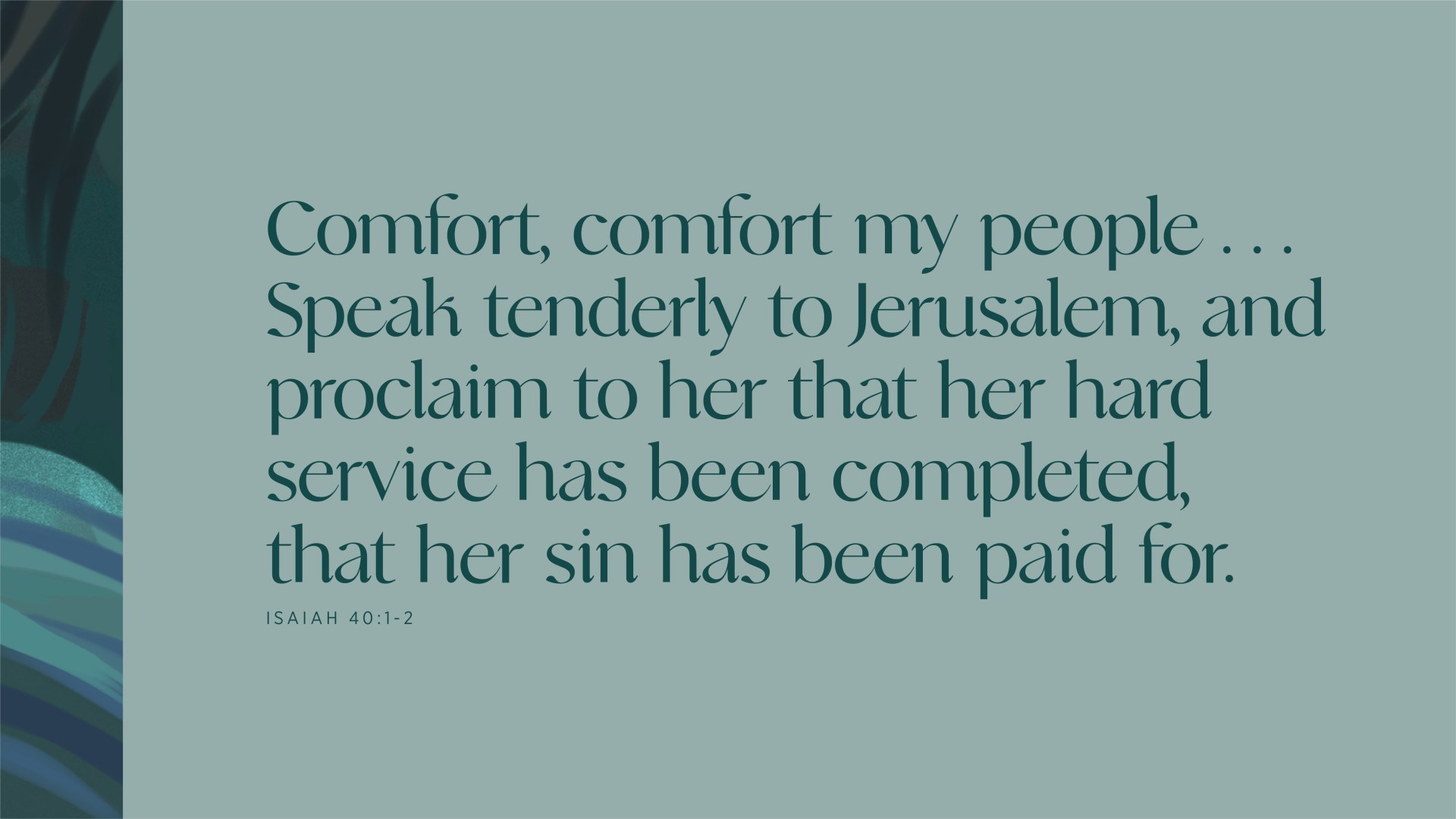
Contemplate Isaiah 40:1–5. (Option: Also read vv. 6–26.)

How does the context of tragedy and sorrow—in the Jewish scriptural reading cycle and in Isaiah’s day—enrich your reading of this passage and the comfort it offers? How might it deepen your understanding of John the Baptist’s purpose?

Also in this issue

Many core tenets of the gospel reverberate powerfully throughout Advent’s traditional readings and themes. In these daily devotional readings from CT, we reflect on the mystery of the Incarnation, on Christ’s purpose as the long-awaited Messiah, on our sin and need for repentance, on God’s promises of salvation and justice, and on our firm hope in Christ’s return and everlasting kingdom. We prepare to celebrate the “newborn King” who was “born that man no more may die,” as Charles Wesley’s beloved carol declares. And we’re reminded again and again throughout Advent that the gospel is not just for us, but it is a message of “great joy for all the people” (Luke 2:10)—it’s good news that’s meant to be shared.

The God Who Suffers

A Light to the Nations

Glenn Packiam

Great Joy for All People

Rachel Gilson

Quietly Hidden

Tracey Gee

Gospel Anticipation

Matthew D. Kim

A Pregnant Promise

Let it Be

Glenn Packiam

Silent Time, Holy Time

Jonathan T. Pennington

What it Means to Be God

Wesley Hill

The Baby King

Matthew D. Kim

The Light Is Coming

Rich Villodas

The Messiah’s Mission

Glenn Packiam

True Hope

Kristie Anyabwile

Bringing Us Home

Marlena Graves

What Hope Looks Like

Marlena Graves

The Gospel of Advent: Good News for the Season

Behold the Lamb

Anthony J. Carter

Amazing, Cleansing Grace

Jen Pollock Michel

Good, Severe News

Jen Pollock Michel

Repentance Made Possible

Jen Pollock Michel

The Rising Son

Wesley Hill

He Won't Leave Us Alone

Jennifer M. Rosner

The Gospel Life in Person

Matthew D. Kim

Come, Lord Jesus!

Richard Bauckham

City of Light

Richard Bauckham

All Things New

Richard Bauckham

Right or Left?

Rachel Gilson

Watch and Pray

Rachel Gilson

We Begin at the End

Kelli B. Trujillo

View issue

Our Latest

The Bulletin

Joe Kent Resigns, Iranian Threats, and a Victory for Parents’ Rights

Mike Cosper, Clarissa Moll, Russell Moore

Public opinions on the Iran war, homeland security risks, and disagreements about gender transition in the classroom.

Review

What Kids Think About God Matters

Three theology books to read this month.

Analysis

Q&A: Why Pakistan and Afghanistan Are Fighting and How Christians There Survive

The Bulletin with Knox Thames

A conversation with human rights lawyer and former diplomat Knox Thames.

Turning ‘a Miracle’ into Long-Haul Help for the Homeless

Taylor Berglund

A North Carolina nonprofit is thinking in decades, not days, about sustainable, affordable housing.

Urgency Is Not Faithfulness

Thomas Anderson

A church that quickly reacts to every controversy is echoing the culture, not God’s Word.

What to Expect at This Year’s Church Conventions

SBC, LCMS, ACNA, CREC, and Global Methodist gatherings in 2026 will weigh issues including abuse investigations and sexual ethics.

Gospel Matriarch Lucie Campbell Looked To God

Daylan Woodall

Her songs spoke to life’s uncertainties and God’s presence—and taught me how to hope.

The Just Life with Benjamin Watson

Johnny Joey Jones: What Do We Owe the Men and Women We Send to War?

Trauma, Responsibility, and the Honor of Being Needed

Apple PodcastsDown ArrowDown ArrowDown Arrowarrow_left_altLeft ArrowLeft ArrowRight ArrowRight ArrowRight Arrowarrow_up_altUp ArrowUp ArrowAvailable at Amazoncaret-downCloseCloseEmailEmailExpandExpandExternalExternalFacebookfacebook-squareGiftGiftGooglegoogleGoogle KeephamburgerInstagraminstagram-squareLinkLinklinkedin-squareListenListenListenChristianity TodayCT Creative Studio Logologo_orgMegaphoneMenuMenupausePinterestPlayPlayPocketPodcastprintRSSRSSSaveSaveSaveSearchSearchsearchSpotifyStitcherTelegramTable of ContentsTable of Contentstwitter-squareWhatsAppXYouTubeYouTube