Americans with evangelical beliefs have a great deal in common. They trust in Jesus alone, evangelize their neighbors, and believe the Bible is the final authority in their lives.
But when it comes to voting, race and political affiliation still divide evangelicals, according to a survey from LifeWay Research taken before the second presidential debate.
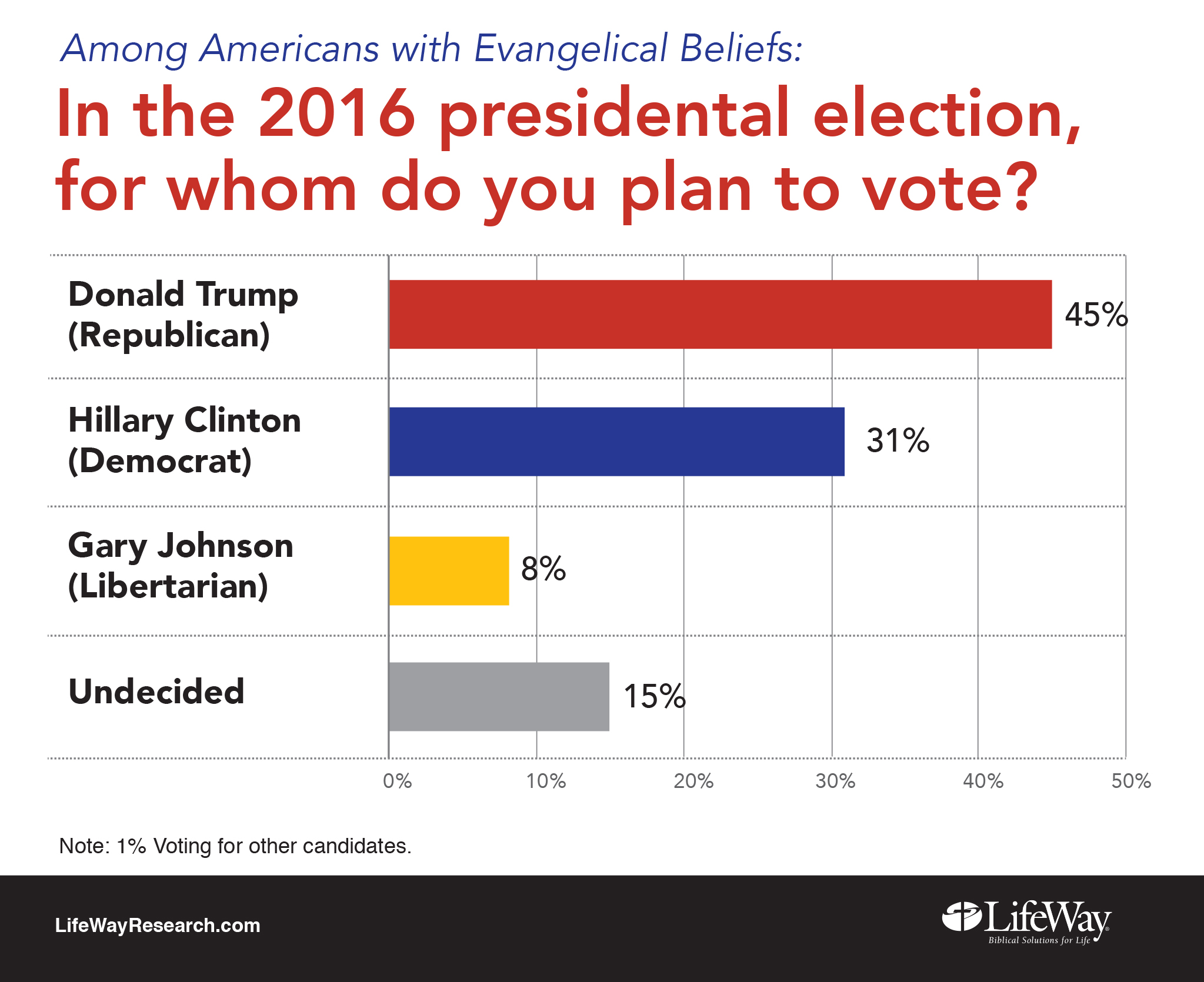
Overall, the split between those with evangelical beliefs who support Donald Trump (45%) and those who support Hillary Clinton (31%) isn’t that far apart.

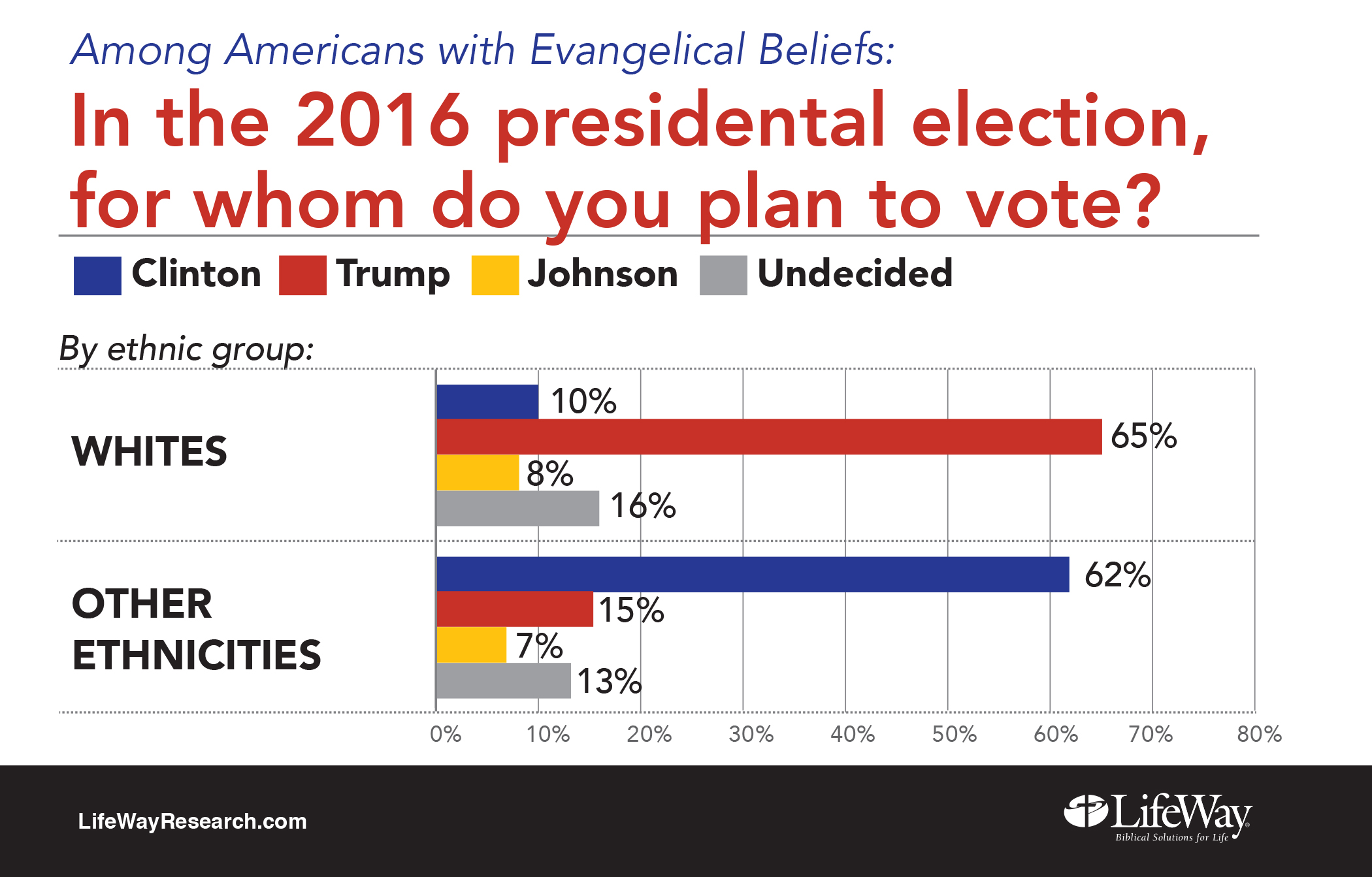
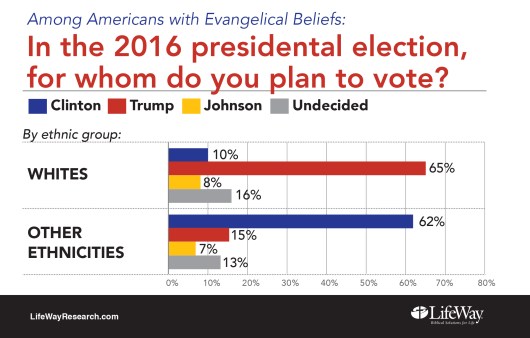
The divide becomes clearer when respondents are split by race.
White Americans with evangelical beliefs favor Trump (65%) over Clinton (10%). Those with evangelical beliefs who are African American, Hispanic American, or Asian American vote virtually the opposite, favoring Clinton (62%) over Trump (15%).
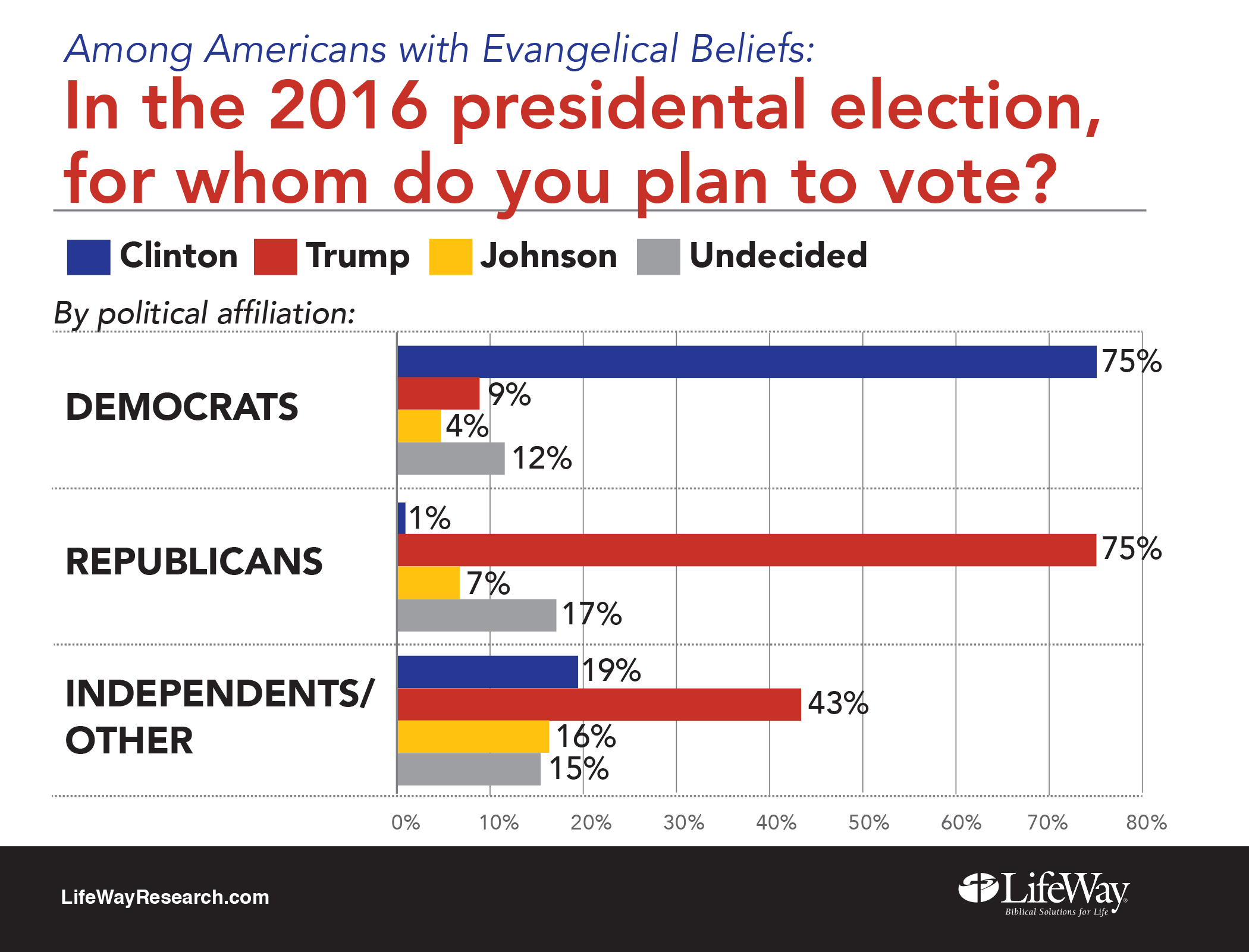
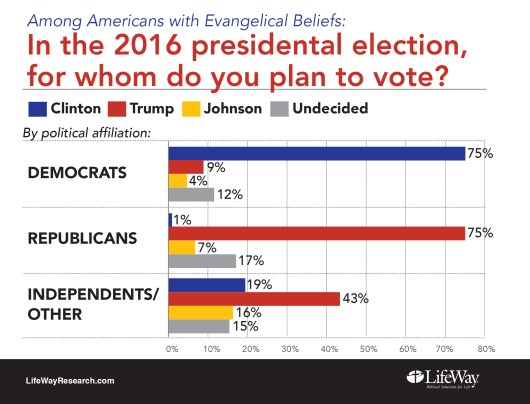
Party affiliation is also a stronger predictor of voting preferences than faith. Three-quarters of Republicans with evangelical beliefs plan to vote for Trump. Though a smaller sample, 75 percent of Democrats with evangelical beliefs plan to vote for Clinton.
LifeWay executive director Scott McConnell said the divides among evangelicals will remain regardless of twists and turns in the election season.
“This group of Christians shares the same core beliefs, but they don’t vote the same way,” said McConnell. “There are significant cultural and political divides among evangelicals that will remain long after the election is over.”
Identifying evangelicals
The representative online survey asked 1,000 Americans four questions about core evangelical beliefs on the Bible, the crucifixion of Jesus, salvation, and evangelism. Those who strongly agreed with all four (17%) qualified as having evangelical beliefs.
The idea is to define evangelicals by belief rather than self-identified religious affiliation, said McConnell.
“The evangelical label has picked up political and social overtones that mask any patterns that are actually tied to evangelical religious beliefs,” he said.
For example, many political surveys look only at self-identified white evangelicals, who have tended to support Republican presidential candidates, including Trump. The pool of Americans with evangelical beliefs, however, is more diverse. LifeWay’s survey found that 2 in 5 Americans with evangelical beliefs are African-American, Hispanic American, Asian-American, or another ethnic minority.
Along with racial diversity, those with evangelical beliefs also have diverse political views.
Issues at Play
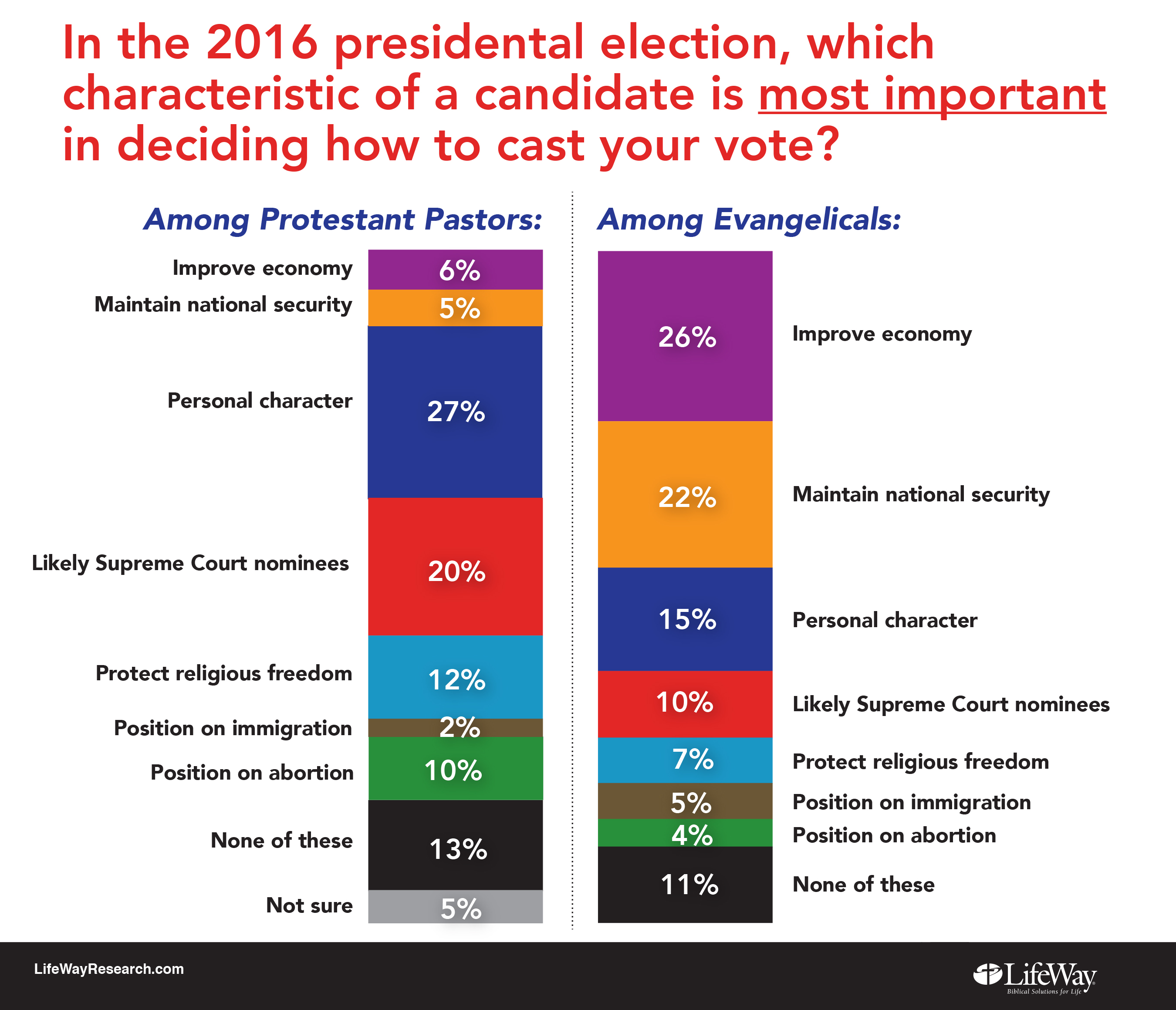
As part of the survey, researchers looked at how people with evangelical beliefs and churchgoers see the issues at play in the 2016 election. Topics such as personal character, abortion, and religious liberty—often identified as key evangelical issues—matter less in this election. Other pragmatic concerns—such as the economy and national security—are more influential.
For Americans with evangelical beliefs, a candidate’s ability to improve the economy matters most, followed by national security and personal character. For self-identified Christians who go to church at least once a month, the economy, national security, and personal character top their concerns. In both groups, few prioritize Supreme Court nominees, religious freedom, immigration, or abortion.
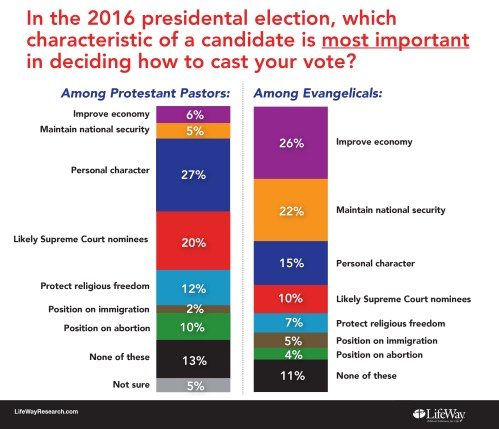
Overall, the economy is the top concern for Americans regardless of religious affiliation (30%). National security (17%) and personal character (17%) also are significant issues. Supreme Court nominees (10%), immigration (5%), religious freedom (2%), and abortion (1%) are less important.
“For churchgoers and those with evangelical beliefs, their pocketbook and personal safety are paramount,” said McConnell. “Moral issues aren’t a priority for many of them.”
Though not as important to voting predictions as race or political affiliation, religion does seem to have an effect.
A plurality of self-identified Christians who go to church at least once a month favor Trump (41%), while 34 percent plan to vote for Clinton, 18 percent are undecided, and 6 percent support a third-party candidate.
Pluralities of Americans who skip church (46%) and those without evangelical beliefs (45%) favor Clinton, while about a third of each group plan to vote for Trump. Roughly 15 percent are undecided, and 8 percent favor a third-party candidate.
A previous LifeWay poll of Protestant pastors found that most clergy don’t expect Christians to vote the same way. Two-thirds (65%) disagree with the statement, “Christians who truly vote their conscience will vote for the same candidate.” Less than a third (29%) agree.
Neither major party in the United States has a monopoly on biblical values, McConnell said. So it’s no surprise, he said, that evangelicals who value the Bible will vote differently.
“Until one party or one candidate embodies everything that evangelicals believe, there is no reason to expect them to vote the same way,” he said.
Methodology:
LifeWay Research conducted the study Sept. 27 to Oct. 1, 2016. The survey was conducted using the web-enabled KnowledgePanel®, a probability-based panel designed to be representative of the US population. Initially, participants are chosen scientifically by a random selection of telephone numbers and residential addresses. Persons in selected households are then invited by telephone or by mail to participate in the web-enabled KnowledgePanel®. For those who agree to participate, but do not already have Internet access, GfK provides at no cost a laptop and ISP connection.
Sample stratification and weights were used for gender by age, race/ethnicity, region, metro/non-metro, education, and income to reflect the most recent US Census data. The completed sample is 1,000 surveys. The sample provides 95 percent confidence that the sampling error does not exceed plus or minus 3.1 percent. Margins of error are higher in sub-groups.
Evangelical beliefs are defined using the NAE LifeWay Research Evangelical Beliefs Research Definition based on respondent beliefs.
Respondents are asked their level of agreement with four separate statements using a four-point, forced-choice scale (strongly agree, somewhat agree, somewhat disagree, strongly disagree). Respondents are categorized as having evangelical beliefs if they strongly agree with all four statements:
- The Bible is the highest authority for what I believe.
- It is very important for me personally to encourage non-Christians to trust Jesus Christ as their Savior.
- Jesus Christ’s death on the cross is the only sacrifice that could remove the penalty of my sin.