America’s got problems and needs to talk.
But few Americans agree on who can best lead a conversation about the nation’s woes, according to a new report from Nashville-based LifeWay Research.
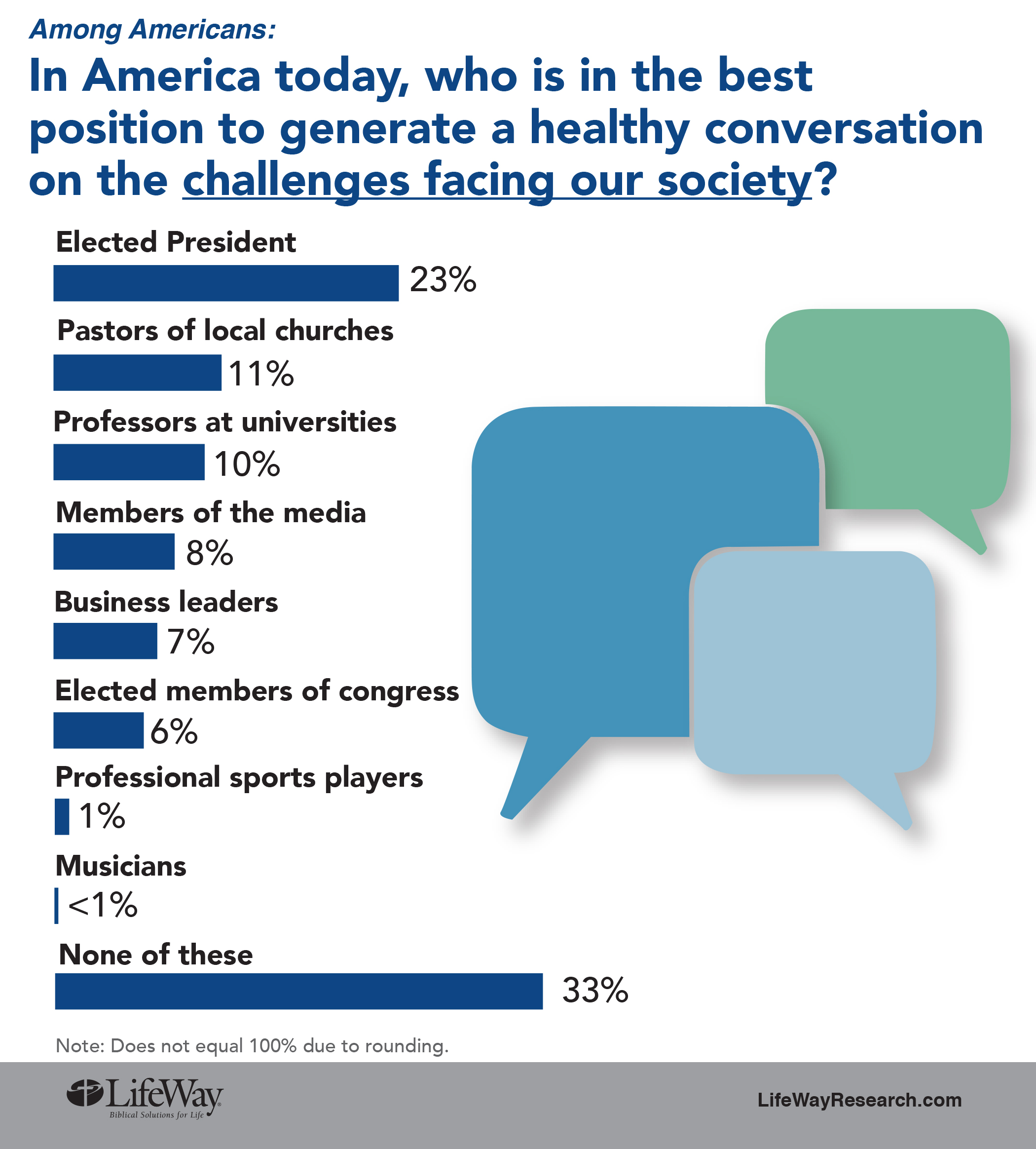
Less than a quarter (23%) would turn to the office of the US president. About 1 in 10 would turn to the nation’s preachers (11%) or to college professors (10%).
“Almost no one would ask a musician or pro athlete,” said Scott McConnell, executive director of LifeWay Research, “even though they often try to start public conversations.
“Musicians or athletes get a great deal of attention for their public statements about the issues,” he said. “But few Americans seem to look to them as thought leaders.”
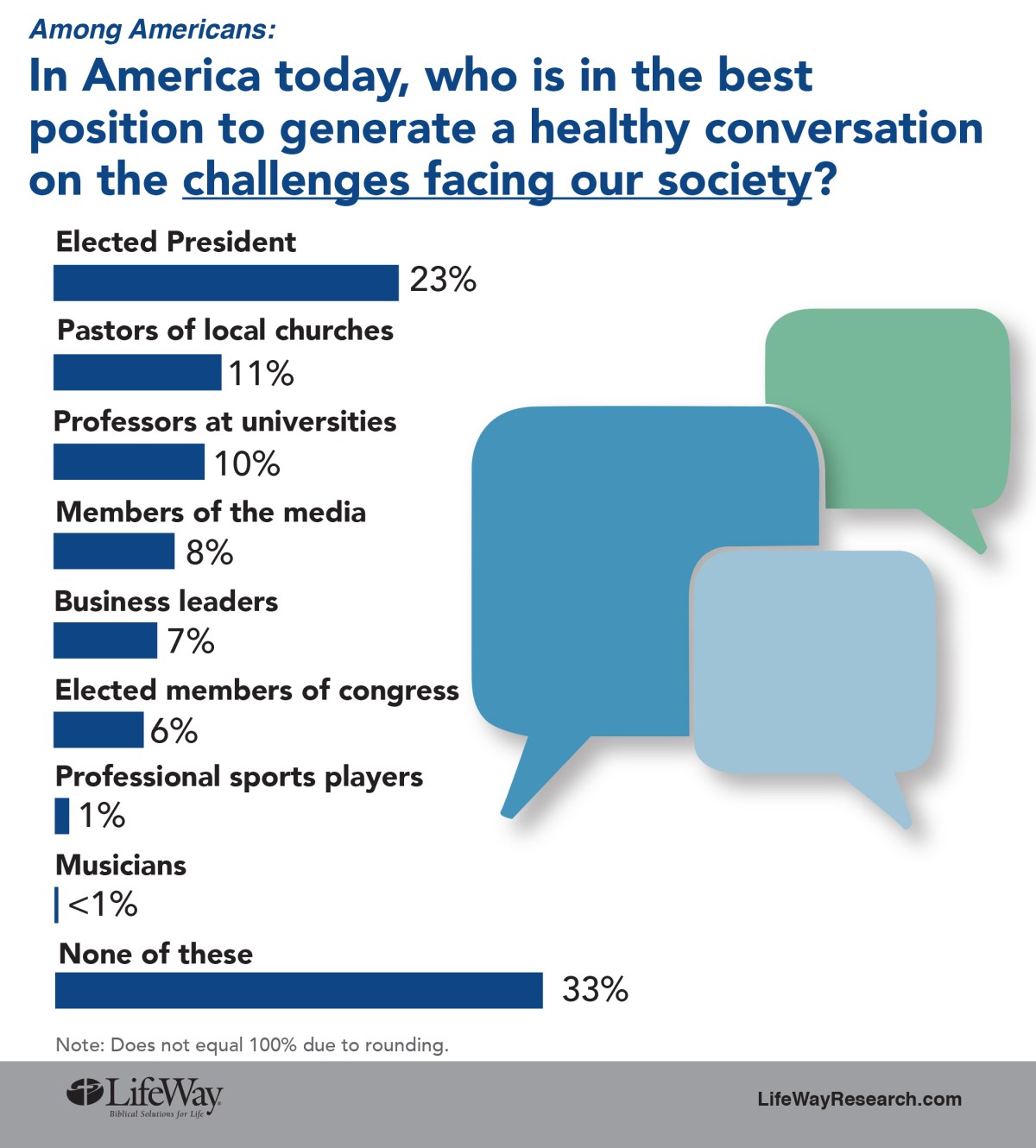
Before the recent presidential election, LifeWay Research asked a representative sample of 1,000 Americans this question: “In America today, who is in the best position to generate a healthy conversation on challenges facing our society?” Possible responses included “our elected president,” preachers, and pro athletes.
 LifeWay Research
About 1 in 4 of those surveyed say the office of the president has the best chance of fostering healthy public conversations (23%), while about 1 in 10 say pastors of local churches (11%) or university professors (10%). Members of the media (8%) faired slightly better than business leaders (7%) or members of Congress (6%). Few Americans look to professional athletes (1%) or musicians (less than 1%) to lead healthy conversations about the nation’s challenges.
The most common response: “None of these” (33%).
Among other findings:
- Southerners are more likely to look to the president (25%) than those in the Midwest (18%).
- Those in the Northeast choose the media (11%) more than those in the South (5%).
- Younger Americans—those 18 to 34—look to the media (12%) more than those 65 and older (3%).
- African-Americans are the most likely ethnic group to choose local pastors (21%) and the president (37%).
- Hispanic Americans are the least likely ethnic group to choose the media (3%).
- Christians are more likely to look to pastors (16%) than those from other faiths (1%) or those with no religious preference (2%).
- Christians (7%) are less likely to look to professors than those from other faiths (18%) or those with no religious preference (15%).
- Americans with evangelical beliefs have faith in pastors (36%) but little faith in the media (3%) or professors (3%) to guide such conversations.
Overall, the survey reflects the reality that Americans are fractured and divided, says McConnell. Few leaders can draw a wide, diverse audience.
“There’s a vacuum of public leadership in America,” he said. “We know we have problems and that we should talk about them. But there’s no one who can bring us all together.”
Bob Smietana is senior writer for Facts & Trends magazine.